*Major
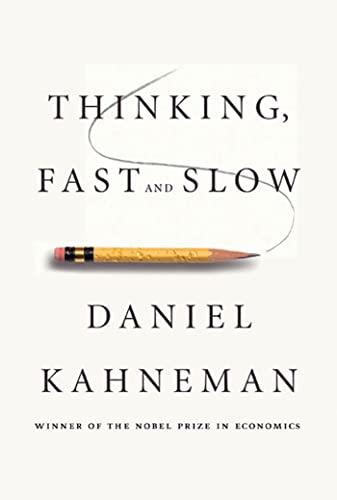
System 1 is fast, intuitive, and emotional; System 2 is slower, more deliberative, and more logical. The impact of overconfidence on corporate strategies, the difficulties of predicting what will make us happy in the future, the profound effect of cognitive biases on everything from playing...
They noted that Kahneman's book was a superpopular airport read that explained the twosystem model of thinking.
"
Yeah, Daniel Kahneman came out with Thinking Fast and Slow, which was one of those super popular airport books, you know? Yeah, Thinking, Fast and Slow.
— Episode: How Cognitive Biases Work
Episode: How Cognitive Biases Work
They noted that Kahneman's book was a superpopular airport read that explained the twosystem model of thinking.
"
Yeah, Daniel Kahneman came out with Thinking Fast and Slow, which was one of those super popular airport books, you know? Yeah, Thinking, Fast and Slow.
The title was repeatedly cited as a key source for understanding how loss aversion, framing effects, and the distinction between fast and slow thinking shape motivation and decision‑making. Hosts David Yeager, Asi Wind, and Peter Attia each referenced its insights when discussing prospect theory, question phrasing, and backcasting strategies. The overall tone was appreciative, treating the work as essential background for the podcast’s topics.
Highly Recommended
Episode: Dr. David Yeager: How to Master Growth Mindset to...
The book is referenced in connection with the concept of prospect theory, which suggests that the fear of a loss can be more motivating than the prospect of a gain. It's also noted that while this idea can be motivating, it shouldn't be interpreted as meaning that the prospect of a gain is unimportant.
"
I guess put simply take it down out of the ivory tower a little bit which is what we're doing here anyway. You can do things out of love, you can do things out of fear. You do it for both reasons too. You can do things to please yourself, you can do things to please others, you can do things to avoid others being disappointed in you, you being disappointed in yourself. Presumably it's both. But is there any, I'm dying for you to tell me that when we do things out of love, we learn faster but maybe that's not the case.
Well, I don't know. I mean, so two thoughts. One is just honoring Danny Kahneman who just passed away. His work with Amos Tversky took on a version of this question in prospect theory and it's the idea of does the fear of a loss motivate us more than the prospect of a gain?
And their argument is that both can be motivating as well as the possibility of a loss but that loss is loom larger, that people are more willing to take a risky gamble to prevent a loss than they are to get a numerically equal, like a mathematically equal gain.
Episode: Asi Wind: What Magic & Mind Reading Reveal About t...
The book talks about how people make decisions in a fast and slow way. Asi Wind mentioned it as a book that highlights how phrasing a question in different ways can make people prefer one choice over another, even if it's the same thing.
"
Daniel Conman in Amos Tversky they talk about it in their work you know they're thinking fast and slow for example which which to us is a magic book how people make decisions and he they often say if you phrase a question one way versus another way and even though the same thing is at stake it's the same equation if you phrase it this way they'll prefer that if you phrase it that way they prefer the other one it and it makes no sense because that's it about online it's like which one do you want well I think the brain runs algorithms and some of its historical and how we are raised
Episode: Dr. Peter Attia: Exercise, Nutrition, Hormones for...
Dr. Attia mentioned this book in the context of backcasting, a decision-making process that involves planning backward from a desired outcome. He implied that Daniel Kahneman's book offers insights into cognitive biases and decision-making that are relevant to backcasting.
"
I should give a nod to Annie Duke. I used to always refer to this as reverse engineering, but in Annie Duke's book she wrote about this exact thing and called it backcasting, and I was like, I like the term backcasting better. I think it's more intuitive than reverse engineering.
Ezra Klein mentioned Kahneman's Thinking, Fast and Slow several times, first noting it as a wellknown work and later recommending it as a mustread for listeners.
"
I've mentioned Danny Kahneman a few times ... I'm just curious ... I think you have read or at least heard about his book Thinking Fast and Slow.
— Episode: Predicting the Future Is Possible. ‘Supe...
Episode: Predicting the Future Is Possible. ‘Superforecaste...
Ezra Klein mentioned Kahneman's Thinking, Fast and Slow several times, first noting it as a wellknown work and later recommending it as a mustread for listeners.
"
I've mentioned Danny Kahneman a few times ... I'm just curious ... I think you have read or at least heard about his book Thinking Fast and Slow.
I'm going to recommend Daniel Kahneman's Thinking Fast and Slow for all the reasons we've been discussing over the last many minutes.
The hosts repeatedly highlighted the book as a seminal work that introduced the concepts of System 1 and System 2 thinking and explained cognitive biases such as the planning fallacy and blind spots. Stephen Dubner, Nate Silver, and several guests cited it as a modern guide to decision‑making and praised its impact on behavioral economics. Overall, the episode discussions portrayed the title as a highly influential and recommended read.
Highly Recommended
Episode: 595. Why Don't We Have Better Candidates for Presi...
Daniel Kahneman, the author of "Thinking Fast and Slow", was a renowned psychologist and economist who revolutionized both fields. His influence was immense, and this book was a significant part of that.
"
Daniel Kahneman is perhaps best known as the author of Thinking Fast and Slow, but he also helped revolutionize the fields of both psychology and economics.
Episode: Extra: The Men Who Started a Thinking Revolution (...
It was his 2011 book that made him famous, but it was his earlier research that revolutionized psychology and helped create the field of behavioral economics.
"
He became famous for his 2011 book Thinking Fast and Slow but it was his decades of earlier research, much of it done with his collaborator Amos Tversky,
Episode: 490. What Do Broken-Hearted Knitters, Urinating Go...
The book was mentioned as a source for the concept of 'System 1' and 'System 2' thinking, which was used to explain how people can be both logical and superstitious.
"
You may be familiar with system one and system two from the book Thinking Fast and Slow by Daniel Kahneman.
Episode: 445. Why Do We Seek Comfort in the Familiar?
It was mentioned that the book Thinking, Fast and Slow, contained a quote that illustrated the idea that people are unaware of what they do not know, which was discussed in the context of Dunning-Kruger effect.
"
He wrote, not only are we blind to the obvious, but we are blind to our blindness.
Episode: Here’s Why All Your Projects Are Always Late — and...
The planning fallacy was discussed and was mentioned as being a concept previously explored by Kahneman and Tversky, which is likely a reference to their book 'Thinking, Fast and Slow'.
"
The phenomenon even had a name, courtesy of the psychologists Danny Kahneman and Amos Tversky. They had called it the planning fallacy.
From an economic standpoint, this sounds backwards. You would think that larger size theoretically creates more specialization of labor and ultimately higher productivity.
If you realistically present to people what can be achieved in solving a problem, they will find that completely uninteresting. You can't get anywhere without some degree of overpromising.
Episode: 330. Extra: Ray Dalio Full Interview
The book was mentioned as having a parallel with Ray Dalio's emphasis on principled decision-making, suggesting that deliberate, reflective thinking ('thinking slow') leads to superior outcomes compared to rapid, intuitive choices.
"
I read your book. I don't know if you've thought about this or if others have said this to you, but I read this as a little bit of an analog to Danny Kahneman's book, Thinking Fast and Slow. Are you familiar with Danny and or his book?
Episode: 323. Here’s Why All Your Projects Are Always Late...
It was mentioned that Kahneman and Tversky discussed the planning fallacy, and that Kahneman himself endorsed a degree of overpromising to get projects started.
"
If you realistically present to people what can be achieved in solving a problem, they will find that completely uninteresting. You can't get anywhere without some degree of overpromising.
Episode: 224. How To Win A Nobel Prize
It was discussed how Daniel Kahneman's book 'Thinking, Fast and Slow' brought increased attention to behavioral economics and its concepts.
"
Kahneman's book thinking fast and slow really opened a lot of eyes around the world
Episode: 219. Preventing Crime for Pennies on the Dollar
The book's concept of 'system one' and 'system two' thinking was referenced, illustrating how different environments can lead to varied automatic responses in individuals.
"
The research paper that Heller and the others would write is called 'Thinking Fast and Slow', which is the same name as Kahneman's 2011 book.
Episode: 204. Nate Silver Says: “Everyone Is Kind of Weird”
It was mentioned as a great guide to modern thinking, and was highlighted as one of Nate's favourite books.
"
You know, I kind of often talk about Daniel Kahneman and thinking fast and slow was kind of just, I think, a really great overall kind of modern guide to thinking, if that isn't a little too pretentious or too precious rather.
Episode: 198. The Maddest Men of All
It was mentioned that the book discusses two different systems of thinking (System 1 & 2) and that it was used to illustrate how advertisers attempt to influence consumer decisions.
"
Sutherland here subscribes to the theories of Daniel Kahneman, the author of Thinking Fast and Slow, who suggests the brain engages in two distinct kinds of thinking, system one and system two, Kahneman calls it.
Episode: 62. How Biased Is Your Media?
It was mentioned as a source that described being 'blind to our blindness', the tendency for people to think others are biased but not themselves.
"
The best description I've ever heard of this comes from Danny Kahneman, the Nobel-winning psychologist and author of Thinking Fast and Slow. He calls it being blind to our blindness.
Episode: What Happens When You Turn 20
Dubner referenced the wellknown work on dualprocess thinking as a "wonderful book" while discussing decisionmaking.
"
You may have heard. That's the title of a wonderful book by Daniel Kahneman.
The hosts highlighted the book as a key explanation of the brain's dual processing systems, noting how its careful, System 2 thinking can counteract the errors of the fast, intuitive System 1. They described it as a concise summary of Kahneman's lifelong research and praised its relevance to everyday decision‑making, even though Kahneman himself joked that reading it didn’t magically improve his mind. Overall, the discussion presented the title as essential listening for anyone interested in cognition.
Highly Recommended
Episode: Why Trying Too Hard Can Backfire On You
Kahneman argued that the cool-headed system two, with its careful cognition can save us from the errors and biases of the hot-headed system one.
"
Thinking Fast and Slow
Episode: What Would Socrates Do?
It was suggested that this book, by Danny Kahneman, also suggests that we have different modes of thinking inside our heads, echoing the ancient ideas about divided selves.
"
Danny Kahneman, whose famous book, Thinking Fast and Slow, also suggests that we are a house divided.
If you think about the dual processing tradition, of which Danny Kahneman and Amos Fersky are the most famous proponents, what you're getting there is an exact echo of this Buddhist or Platonic picture.
Episode: Think Fast with Daniel Kahneman
The book, published in 2011, was discussed throughout the podcast as Daniel Kahneman's summary of his life's work into a single book, detailing many of the theories and insights he developed with Amos Tversky.
"
He's the author of the book Thinking Fast and Slow.
Some people read thinking fast and slow in the hope that reading it will improve their minds.
Episode: Disney's Victory Lap, Online Privacy, and Guest Ru...
The book explores the relationship between money and happiness.
"
I'm a big fan of his books, "Thinking, Fast and Slow." Kind of like it was one of those books.
Episode: Bezos vs. the world, retail in India and Scott’s e...
The podcast host mentioned misquoting Kahneman's book in a previous episode. They discussed the concepts of "fast" and "slow" thinking in relation to the encryption debate and the importance of using slow thinking for nuanced decision-making.
"
I want to apologize to the Daniel Kahneman fans or disciples. The Nobel Prize winner talked about wrote this great book around fast and slow thinking. And I misquoted him last week saying that people were subject to slow thinking. Slow thinking is actually the good part when you rely on the better notions of your instincts or your brain to slow down and really think through stuff and offer some nuance.
I think that it's really interesting. I think from an optic standpoint, we have Trump tweeting last week that, you know, Apple should kind of get on board and help the government. And then it's kind of like the right hand, maybe not knowing what the left hand is doing. The other side of the government working closely with Apple.
It's just again, going back to Daniel Kahneman, we need to we need to think this through.
It was mentioned in the context of Danny Kahneman, a Nobel laureate in economics, and his enjoyment of discovering that his hypotheses were incorrect, as a learning opportunity.
"
I'm sure a lot of folks here have read Thinking Fast and Slow, and Danny is, I think, one of the great social scientists in history.
— Episode: Live From The HIBT Summit: Adam Grant
Episode: Live From The HIBT Summit: Adam Grant
It was mentioned in the context of Danny Kahneman, a Nobel laureate in economics, and his enjoyment of discovering that his hypotheses were incorrect, as a learning opportunity.
"
I'm sure a lot of folks here have read Thinking Fast and Slow, and Danny is, I think, one of the great social scientists in history.
Scott Galloway repeatedly highlighted the title as a seminal work that explains cognitive biases and the two-system model of fast intuition versus slow logic, noting it had saved him from many poor decisions. He linked its insights to his thinking on markets, chance, loss aversion, and the importance of humility in success. The overall tone was enthusiastic and endorsing.
Highly Recommended
Episode: No Mercy / No Malice: Forewarned
It was mentioned that Daniel Kahneman's work illuminated many of the cognitive biases that sometimes misdirect our healthy sense of anxiety toward the wrong risks.
"
I wrote about Daniel Kahneman a few weeks ago.
Episode: No Mercy / No Malice: Think Slow
It's a seminal book that discusses the concept of two thinking systems: a fast one for intuition and emotions, and a slow one for logic and calculations. This has helped the speaker avoid making poor decisions many times.
"
Prospect theory won condominium his Nobel, but he's best known for his seminal book, Thinking Fast and Slow.
The titular concept that we have two thinking systems, a fast one for intuitive emotional insights and a slow one for logical calculated decisions is something that has saved me from me dozens of times.
Episode: Prof G Markets: Trump’s Memestock Goes Public, the...
This best-selling book explores how we often act on instincts and take mental shortcuts, rather than thinking deliberately, which can negatively impact our decisions in the long run. It was mentioned as being impactful to Scott Galloway's thoughts on money and life, and he found the insights particularly relevant.
"
We are prone to overestimate how much we understand about the world and to underestimate the role of chance.
Markets and random chance trump individual performance.
When something really good happens you make a great investment when you get promoted Keep in mind a lot of that is you're in the right place of the right time and be really humble.
The pain of loss is greater than the emotional benefit of gains.
The real way to make money is to zig when everyone's zagging and your emotions are not isolated to you.
Episode: How to Get Unstuck — with Adam Alter
Adam Alter's work was compared to Daniel Kahneman's work in 'Thinking, Fast and Slow', particularly the idea of slowing down thinking on important decisions to avoid rash actions.
"
a lot of it out echoes of Daniel Kahneman's thinking slow and fast.
The hosts highlighted that the title had taught them valuable lessons about human decision‑making and left a memorable, positive impression. They noted that it challenged the assumption of rational behavior and helped popularize behavioral economics concepts and heuristics across many fields. Overall, the book was praised as a transformative and widely influential work.
Highly Recommended
Episode: Robinhood’s New Gold Credit Card & NCAA Wants Ban...
The book, which challenged the assumption that people act rationally, became a mega best-seller. Coniman, the author, was a titan in the field of behavioral economics, and his book led to a rethinking of issues as far-ranging as massive infrastructure projects to the evaluation of baseball talent.
"
Thinking fast and slow brought these ideas to the mainstream and became a mega best seller Neil I believe I saw it on your bookcase the last time I was over
Coniman and his longtime collaborator almost versky created a bunch of these heuristics which show which are basically rules of thumb that show how humans do not behave rationally
Episode: Markets Brace After First Harris/Trump Debate & Th...
The podcast hosts mentioned learning a lot from this book. The book's impact was positive and memorable for them.
The title was briefly referenced in the holiday special and later compared by Ben Gilbert to Graham's classic, describing it as a distilled, public‑consumption version with case studies. The discussion highlighted its accessible style rather than deep endorsement.
Episode: Berkshire Hathaway Part I
This was compared to Graham's Intelligent Investor, in that it was a more public consumption style book.
"
The intelligent investor is like the Danny Kahneman thinking fast and slow You know a version of like, uh, you know, it's case studies. It's like distilled down for public consumption
The Mayor referenced Kahneman's book to explain his view on the importance of creating an environment where people can thrive and be successful.
"
I read his books and saw I didn't would not have guessed personally, you know that vivek would have and again no shade on vivek. He's a super successful guy.
— Episode: The Next Crisis Ahead for US Cities | Ma...
Episode: The Next Crisis Ahead for US Cities | Mayor Franci...
The Mayor referenced Kahneman's book to explain his view on the importance of creating an environment where people can thrive and be successful.
"
I read his books and saw I didn't would not have guessed personally, you know that vivek would have and again no shade on vivek. He's a super successful guy.
The hosts repeatedly referenced the title as a bestselling work that introduced the influential concepts of System 1 and System 2 thinking, priming, the narrative fallacy, and the Dunning‑Kruger effect. Angela Duckworth, Stephen Dubner, and other contributors cited it to explain how our brains form quick judgments and compelling stories, while also noting the later controversy over some priming research. Overall, the book was presented as a foundational and highly recommended resource for understanding cognitive biases.
Highly Recommended
Episode: 189. When Should You Trust Your Gut?
The book, Thinking Fast and Slow, was described as a bestseller and explored the concept of 'system one' and 'system two' thinking, which are respectively, fast, effortless, and automatic, and slow, controlled, conscious, and effortful.
"
That's why Danny called his bestselling book, thinking fast and slow because thinking fast is using system one and thinking slow is using system two.
Episode: 173. How Important Is Your Choice of Words?
It was discussed as a source of information on priming, although there was later controversy around the validity of some of the research Kahneman cited in this book.
"
Josiah says, Greetings from England. I recently came upon the No Stupid Questions podcast and would love to hear your thoughts on the importance of semantics, especially in relation to the idea of priming as written about in the great Danny Kahneman's Thinking Fast and Slow.
He's so great, Danny Kahneman. He is.
And so is Josiah from England exactly.
And Danny Kahneman did write a great book too, you know, Thinking Fast and Slow.
One of the things that some readers took from Thinking Fast and Slow was the idea that priming was really important. But what then happened after Danny Kahneman published Thinking Fast and Slow was that there was a huge controversy about whether it was true.
Episode: 169. Can We Disagree Better?
It was mentioned in passing as being more well-known than adversarial collaboration, a concept also attributed to Kahneman.
"
It's one of Danny Kahneman's Inventions but has gotten less attention than like thinking fast and slow and cognitive biases and so forth
Episode: 136. Is Sloth a Sin or a Virtue?
It was briefly mentioned that Daniel Kahneman, a Nobel laureate in economics, has made distinctions between two systems of thinking, which were discussed in relation to sloth and thoughtful deliberation.
"
So think about system one and system two, a distinction in judgment and reasoning that our good friend, wait for it. Danny Kahneman has made.
Episode: Why Do We Seek Comfort in the Familiar? (NSQ Ep. 3...
It was mentioned that the book contains a line which suggests that humans are not only blind to the obvious but also to their own blindness, related to the Dunning-Kruger effect.
"
Not only are we blind to the obvious, but we are blind to our blindness.
Episode: How Can You Stop Comparing Yourself With Other Peo...
It was mentioned as a book where the author discusses the narrative fallacy, explaining how people often create compelling but potentially inaccurate causal stories.
"
I know that Danny Kahneman wrote about what Nassim Talab calls the narrative fallacy and Danny wrote about that in Thinking, Fast and Slow
Episode: How Can You Stop Comparing Yourself With Other Peo...
It was mentioned in relation to the narrative fallacy, specifically the concept of how humans create compelling stories that are often oversimplified and focus on a few striking events, neglecting chance and uncertainty.
"
I know that Danny Kahneman wrote about what Nassim Talab calls the narrative fallacy and Danny wrote about that in "Thinking, Fast and Slow"
Episode: 30. Why Do We Seek Comfort in the Familiar?
It was mentioned in relation to the Dunning-Kruger effect and the concept that people are blind to their own biases and lack of knowledge. A quote from the book was referenced.
"
Not only are we blind to the obvious, but we are blind to our blindness.
Episode: 13. How Can You Stop Comparing Yourself With Other...
It was mentioned in relation to the narrative fallacy, and how people create compelling explanatory stories that are often simple and concrete, while underemphasizing luck and chance.
"
I know that Danny Kahneman wrote about what Nassim Taleb calls the narrative fallacy and Danny wrote about that in Thinking, Fast and Slow.
Episode: 13. How Can You Stop Comparing Yourself With Other...
It was mentioned as a book where Kahneman wrote about the narrative fallacy, the tendency for humans to create simple and compelling stories to explain events.
"
and Danny wrote about that in Thinking, Fast and Slow
Episode: 211. Why Do We Listen to Sad Songs?
It was mentioned in relation to a conversation with Barbara Tversky, the widow of Amos Tversky, who was a close collaborator with Daniel Kahneman, discussing how the brain connects related ideas and concepts.
"
And she was like, well, of course you do that because one of the features of the human brain, and it's actually something that Danny Condomin wrote about, and I think it's like widely misunderstood.
The title was repeatedly highlighted by Jordan Harbinger and guests such as Julia Galef, Daniel Kahneman, Maria Konnikova, and Chris Voss as a foundational guide to understanding cognitive biases, the dual‑process model of fast and slow thinking, and effective decision‑making. They praised it as an excellent, widely‑referenced work that helped illustrate concepts from mental models to negotiation tactics, while Stuart Ritchie noted that some of the priming studies it cites have been questioned by replication attempts. Overall, the podcast presented the book as a highly recommended resource for listeners interested in improving their thinking.
Highly Recommended
Episode: 536: Julia Galef | Why Some People See Things Clea...
It was mentioned in the context of discussing biases and how one bias can lead to others, a concept explored in a previous podcast episode.
"
also Julia mentions in the book that there are ripple effects of bias or misjudgment this is something I hadn't thought about before but it is true let's say that we don't think that we have one bias we did talk about this a little bit with Daniel Coniman in episode 518 but when we think that we are not biased and others are we view ourselves as perfect we may be less patient with others also if we have one bias it can lead to other biases later on down the line cascading bias is what this was called and this is a fascinating concept where being wrong in one way can lead us to be wrong in many other ways that just make us more and more wrong no surprise there so the key is to mitigate bad decisions and bad thinking early on in the decision chain of the results chain
Episode: 518: Daniel Kahneman | When Noise Destroys Our Bes...
It was discussed at length, with reference to system one and system two thinking, as a prior work by the author.
"
I read Thinking, Fast and Slow and we talked about system one and system two thinking today.
Episode: 436: Stuart Ritchie | The Science Fictions Undermi...
In Thinking, Fast and Slow, Kahneman discusses various studies on priming, unconscious influences, and their effects on human behavior, which have been called into question.
"
There's loads of stuff in thinking fast and slow is like ultra popular and really good overall really good book. I'm not you know criticizing the book. I think it's a great book but you know he says in that book there are these studies on priming unconscious influences can have you know big effects on our behavior and you know these are published in scientific journals.
This is a direct quote he says you have no choice but to believe that these are true about you about your behavior.
Episode: 214: Gabriel Weinberg | How Mental Models Boost Su...
It was brought up as a book that provided a way to help people understand mental models and biases. It was referenced in the context of ego playing a large part in rejecting new ideas.
"
Yeah it's ego is at the center of a lot of it I mean there is a another good book called thinking about spianny dude true yeah
Episode: 436: Stuart Ritchie | The Science Fictions Undermi...
The book was discussed during the podcast when the host and guest were talking about the issue of priming in psychology research. The guest mentioned that this book is considered a great book, but it includes some studies on priming that have not held up to scrutiny in replication studies.
"
There's loads of stuff in Thinking, Fast and Slow is like ultra popular and really good overall really good book.
There are these studies on priming unconscious influences can have you know big effects on our behavior and you know these are published in scientific journals. This is a direct quote he says you have no choice but to believe that these are true about you about your behavior.
And you know these are published in scientific journals. This is a direct quote he says you have no choice but to believe that these are true about you about your behavior.
Episode: 165: Chris Voss | Negotiate as If Your Life Depend...
It was mentioned in relation to how using how- or what-questions triggers in-depth thinking and can be used to exhaust the other party, giving the asker the advantage.
"
Danny Connellman wrote a book called Thinking Fast and Slow
I'll link to that in the show notes as well
Episode: 57: Phil Hellmuth | The Winning Strategies of a Ce...
It was mentioned as a book that focuses on reducing cognitive biases and improving decision-making, which is relevant to poker, as Phil explained.
"
you and I talked earlier via email about Annie Duke who I just spoke with think like three or four days ago and she would her book 'Thinking, Fast and Slow', just getting rid of bias and making better decisions.
Episode: 518: Daniel Kahneman | When Noise Destroys Our Bes...
It was discussed and mentioned multiple times, primarily as a foundation to understand the concept of system one and system two thinking, later contrasting with the new book "Noise".
"
I read Thinking Fast and Slow and we talked about system one and system two thinking today.
Episode: 232: Daniel Goleman | A Logical Look at Emotional...
It was mentioned as a great book to better understand the relationship between the amygdala and the neocortex, and the differences between the 'fast' and 'slow' thinking processes.
"
So you have to realize, there's a wonderful book thinking fast and slow by an economy.
Episode: 165: Chris Voss | Negotiate as If Your Life Depend...
It was mentioned in the context of negotiation and how asking 'how' or 'what' questions can trigger slow thinking and in-depth thinking, which can be exhausting.
"
Danny Connellman wrote a book called Thinking Fast and Slow Slow Thinking is in-depth thinking you're using a how or what question to trigger in-depth thinking which also is exhausting
I'll link to that in the show notes as well
Episode: 57: Phil Hellmuth | The Winning Strategies of a Ce...
It was discussed in relation to the concept of cognitive biases, which poker players need to combat and minimise as much as possible when playing.
"
and she would, her book 'Thinking, Fast and Slow', just getting rid of bias and making better decisions.
This book introduced Kahneman's groundbreaking ideas, which he pioneered with Amos Tversky, into mainstream culture; it explores the two systems of thinking: System 1 (fast, intuitive) and System 2 (slow, deliberative).
"
Daniel Kahneman's book, Thinking Fast and Slow, brought his groundbreaking ideas, which he pioneered with his late friend and fellow psychologist Amos Tversky, into mainstream culture.
— Episode: Daniel Kahneman – Why We Contradict Ours...
Episode: Daniel Kahneman – Why We Contradict Ourselves and...
This book introduced Kahneman's groundbreaking ideas, which he pioneered with Amos Tversky, into mainstream culture; it explores the two systems of thinking: System 1 (fast, intuitive) and System 2 (slow, deliberative).
"
Daniel Kahneman's book, Thinking Fast and Slow, brought his groundbreaking ideas, which he pioneered with his late friend and fellow psychologist Amos Tversky, into mainstream culture.
In his 2011 book, Thinking Fast and Slow, Daniel Kahneman brought a core idea from academic psychology into mainstream cultural dialogue. The notion that human behavior at any given moment is an interplay between two forms or systems of thinking.
Before he wrote Thinking Fast and Slow, Daniel Kahneman won the Nobel Prize in Economics for helping create the field of behavioral economics.
Many have loved his book, Thinking Fast and Slow, and he's just releasing a new book he's co-authored titled Noise, A Flaw in Human Judgment.
Episode: [Unedited] Daniel Kahneman with Krista Tippett
It was described as a book that explains the two systems of thinking in the human mind; the fast, intuitive system one, and the slower, more deliberative system two. The author did not coin the terms system one and system two, but adopted them to help resolve controversies in his field.
"
I did not make the distinction and I didn't even coin the term system one and system two. They pre-existed my work. I picked them up because I saw that they would help us resolve many controversies in my field.
The idea, which is, I think, I find it compelling and many other people find it compelling, is that there is a very big difference in what happens in your mind when I say two plus two and what happens in your mind when I say 24 times 17.
What makes this story, I think, interesting to some people is that it's the idea that in many situations it's not system two that's in charge.
But in fact, system one runs the show a lot of the time except you never know it.
The book propelled Daniel Kahneman into the public eye after it was published in 2011, and is an example of Daniel Kahneman's prolific writing and research in the field of psychology.
"
His groundbreaking 2011 book thinking fast and slow propelled him into the public eye and he went on to win countless awards and honorary degrees.
— Episode: How Biden Can Beat Trump, Again (with Ev...
Episode: How Biden Can Beat Trump, Again (with Evan Osnos)
The book propelled Daniel Kahneman into the public eye after it was published in 2011, and is an example of Daniel Kahneman's prolific writing and research in the field of psychology.
"
His groundbreaking 2011 book thinking fast and slow propelled him into the public eye and he went on to win countless awards and honorary degrees.
Note: The book recommendations on this page are discovered automatically from podcast transcripts, and may be incorrect or incomplete.