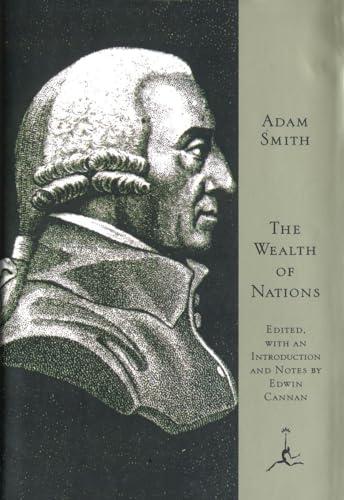
The Wealth of Nations (Modern Library) Cover
Podcast Mentions

The Wealth of Nations (Modern Library)

Adam Smith

First published in 1776,

Podcasts 19
Quotes 64
The Joe Rogan Experience

The book was referenced while discussing natural laws of the market and classic economic theory.

"

and one of the wealth of nations

— Episode: #1373 - Kyle Kulinski

Episode: #1373 - Kyle Kulinski

The book was referenced while discussing natural laws of the market and classic economic theory.

"

and one of the wealth of nations

Stuff You Should Know

It was described as a book written by Adam Smith in 1776 that advocated for minimal government interference in economic and financial matters, emphasizing the concept of an invisible hand guiding market principles.

"

Scottish man in 1976 wrote his Wealth of Nations, which basically said the government should not interfere with matters of finance and economics.

— Episode: SYSK Selects: How The Enlightenment Work...

Episode: SYSK Selects: How The Enlightenment Works

It was described as a book written by Adam Smith in 1776 that advocated for minimal government interference in economic and financial matters, emphasizing the concept of an invisible hand guiding market principles.

"

Scottish man in 1976 wrote his Wealth of Nations, which basically said the government should not interfere with matters of finance and economics.

Episode: SYSK Selects: How The Enlightenment Works

It was mentioned in the context of the enlightenment's influence on economic thought, arguing that the government should not interfere with finance and economics.

"

Scottish man in 1976 wrote his Wealth of Nations, which basically said the government should not interfere with matters of finance and economics.

Episode: SYSK Selects: How The Enlightenment Works

It was written by Adam Smith in 1776 and discussed the idea that the government shouldn't interfere with financial and economic matters, advocating for the invisible hand to guide economic principles.

"

Scottish man in 1976 wrote his Wealth of Nations, which basically said the government should not interfere with matters of finance and economics.

There should be the invisible hand guiding all these principles.

Episode: SYSK Selects: How The Enlightenment Works

Adam Smith's book, published in 1776, was mentioned in the context of economic changes during the Enlightenment, arguing for minimal government intervention in finance and economics and the idea of the 'invisible hand'.

"

Scottish man in 1976 wrote his Wealth of Nations, which basically said the government should not interfere with matters of finance and economics.

There should be the invisible hand guiding all these principles.

The Ezra Klein Show

DeLong cited a passage from Smith's classic work to illustrate early arguments against mercantilism and the moral foundations of market economies.

"

Adam Smith in The Wealth of Nations has a passage where he's arguing against mercantilists who say a low wage economy is going to be a strong economy because you can spend your gold and you get lots o...

— Episode: Inflation Does More Than Raise Prices. I...

Episode: Inflation Does More Than Raise Prices. It Destroys...

DeLong cited a passage from Smith's classic work to illustrate early arguments against mercantilism and the moral foundations of market economies.

"

Adam Smith in The Wealth of Nations has a passage where he's arguing against mercantilists who say a low wage economy is going to be a strong economy because you can spend your gold and you get lots of work on it and produce lots of stuff and project military power.

Today, Explained

Adam Smith spent 10 years writing this book while tutoring in France, describing the economic organization he observed around him, which included private property, firms seeking profit, and an invisible guiding hand.

"

While he was there, he started writing The Wealth of Nations. It took him 10 years to finish.

— Episode: Blame Capitalism: Souring on the system

Episode: Blame Capitalism: Souring on the system

Adam Smith spent 10 years writing this book while tutoring in France, describing the economic organization he observed around him, which included private property, firms seeking profit, and an invisible guiding hand.

"

While he was there, he started writing The Wealth of Nations. It took him 10 years to finish.

Smith was describing what he saw around him. It sounds simple and shockingly, it really sort of is. There was private property, there were firms and those firms wanted to make profits.

Freakonomics Radio

The book was repeatedly highlighted as the founding text of economics, with the hosts using its ideas to frame modern debates about AI, market power, and trade policy. They noted its historical critique of monopolistic firms like the East India Company and emphasized its arguments about division of labor and the invisible hand as essential for understanding economic systems. The discussion conveyed a strong endorsement of the title as a crucial reference for anyone interested in economic theory.

Highly Recommended

Episode: 555. New Technologies Always Scare Us. Is A.I. Any...

It was the founding text of economics, and the questions about AI today are essentially variations of the same question: when things change, why do some people win and others lose?

"

It's right there in the title of the founding text of the field, Adam Smith's book, An Inquiry into the Nature and Causes of the Wealth of Nations.

Episode: 527. Can Adam Smith Fix Our Economy?

It was frequently referenced throughout the episode, particularly regarding the East India Company and how its actions contradict the principles of a free market economy.

"

They know about the Wealth of Nations and they know that Margaret Thatcher, the enemy, always had a copy of Wealth of Nations, the legend goes, in her handbag.

She didn't read the first book, The Theory of Moral Sentiments, clearly.

But she read the second one and she did use that as an authority to promote her economic theories and activities and policies.

When Adam Smith was writing The Wealth of Nations in the mid-18th century, it wasn't supermarkets he was worried about. It was trading firms like the English East India Company, which grew so massive that it began acting like a sovereign, as Smith put it.

Writing in The Wealth of Nations, Smith blamed the severity of the famine on the East India Company's improper regulations and injudicious restraints.

Episode: 526. Was Adam Smith Really a Right-Winger?

Smith's second and final book, published in 1776, was a polemic against restrictive trade practices. It was written for political leaders of the day and became a blueprint for the science of political economy in the US.

"

By preferring the support of domestic to that of foreign industry, he intends only his own security. And by directing that industry in such a manner as its produce may be of the greatest value, he intends only his own gain. And he is in this, as in many other cases, led by an invisible hand to promote an end which was no part of his intention.

Great Britain have for more than a century past amused the people with the imagination that they possessed a great empire on the west side of the Atlantic. This empire, however, has hitherto existed in imagination only.

It has hitherto been not an empire, but the project of an empire, not a gold mine, but the project of a gold mine.

A project which has cost, which continues to cost, and which if pursued in the same way as it has been hitherto, is likely to cost immense expense without being likely to bring any profit.

For a very small expense, the public can facilitate, can encourage, and can even impose upon almost the whole body of the people the necessity of acquiring those most essential parts of education.
Episode: 525. In Search of the Real Adam Smith

It was described as a book that explored national wealth and the global economy, focusing on production and output. It was also said to be an attack on the entire commercial system of Great Britain.

"

If you go at it with the mindset that this is a book of economics, the way that we understand the field of economics today, you're going to narrow your field of vision.

What was Smith's primary purpose of publishing that book or what did he hope would come of it? I think that Smith is hoping that educated readers will understand that national wealth is not measured in terms of gold and silver coin, and that actually you need to pay attention to output. You need to pay attention to how people are producing and where they're producing and what they're producing.

It is not from the benevolence of the butcher, the brewer, or the baker that we expect our dinner but from their regard to their own interest. We address ourselves not to their humanity but to their self-love.

The Wealth of Nations is an attack on the entire commercial system of Great Britain?

By telling a small story about the pin factory, Adam Smith was making a larger argument about some of the ingredients required for a thriving economy. Division in labor and the division of labor.

Episode: 673. What Is Money?

The podcast highlighted Adam Smith's 1776 treatise as the source material for David Lang's new oratorio, noting how the book's ideas about labor, trade and money inspired the composition.

"

You may recognize that title. It is a book published in 1776 by the Scotsman Adam Smith, who is widely seen as the father of modern economics, and some people consider the Wealth of Nations a sacred text of capitalism.

By the time I first spoke with David Lang, he had finished writing Wealth of Nations, the score had been distributed, and rehearsals would start soon.

I wasn't going to read the book unless I had a gig to read the book. It's a long book. It's a long book. And it's, you know, 18th century language. The language is very hard, and there's a lot of stuff that I wouldn't have read if I wasn't reading it for purpose.

And the piece we're talking about is Lang's new oratorio, The Wealth of Nations, which repurposes text from the Adam Smith book of the same name.

Lang's music ... a passage from one of the most famous lines in Wealth of Nations. It is not from the benevolence of the butcher, the brewer, or the baker that we expect our dinner, Adam Smith writes, but from their regard to their own interest.

Episode: 674. How Does a Composer Feel After the World Prem...

The transcript repeatedly referenced Adam Smith's 1776 classic, noting that Lang's new oratorio was based on its text and that its ideas were still seen as relevant to modern economics.

"

At the end of March, the composer David Lang debuted a modern piece of music set to a 250-year-old book, Adam Smith's The Wealth of Nations.

The math and aftermath of Wealth of Nations, starting now.

I caught up with David Lang about a week after the last of the four performances of The Wealth of Nations, and I asked what it felt like to work on a big new piece like this for years, and then hear it come to life, and then go away.

To what degree is your new Oratorio Wealth of Nations a, quote, religious piece?

Movement 18, the final section, you go back to the text of Adam Smith.

Hidden Brain

It was mentioned as a book that focuses on economic growth through competition, but the podcast highlighted that it overlooks the significance of culture in maintaining a well-functioning economic system.

"

His two great books were The Wealth of Nations, as is well known, but also The Theory of Moral Sentiments.

— Episode: Our Better Angels

Episode: Our Better Angels

It was mentioned as a book that focuses on economic growth through competition, but the podcast highlighted that it overlooks the significance of culture in maintaining a well-functioning economic system.

"

His two great books were The Wealth of Nations, as is well known, but also The Theory of Moral Sentiments.

The Megyn Kelly Show

It was mentioned as part of a Scottish intellectual legacy that Niall Ferguson believes in and feels responsible for preserving.

"

Think of Adam Smith's contribution, The Wealth of Nations, The Theory of Moral Sentiments.

— Episode: Biden's Foreign Policy Failures, Rise of...

Episode: Biden's Foreign Policy Failures, Rise of Woke Poli...

It was mentioned as part of a Scottish intellectual legacy that Niall Ferguson believes in and feels responsible for preserving.

"

Think of Adam Smith's contribution, The Wealth of Nations, The Theory of Moral Sentiments.

Modern Wisdom

Simon referenced Adam Smith's "The Wealth of Nations" when discussing the original intent of capitalism as being customerfocused rather than investordriven.

"

Adam Smith imagined it in The Wealth of Nations wasn't what we have now. He wrote about a customerfocused, employeefocused capitalism.

— Episode: #964 - Simon Sinek - How To Find Meaning...

Episode: #964 - Simon Sinek - How To Find Meaning When Life...

Simon referenced Adam Smith's "The Wealth of Nations" when discussing the original intent of capitalism as being customerfocused rather than investordriven.

"

Adam Smith imagined it in The Wealth of Nations wasn't what we have now. He wrote about a customerfocused, employeefocused capitalism.

The Jordan B. Peterson Podcast

It was mentioned as a book that is grounded in a biblical context, and that divorcing it from that context produces outcomes that Smith likely wouldn't approve of.

"

I read this great book once called The Wealth of the Wealth and Poverty of Nations by man named Richard Landis and he analyzed Japan in particular because he thought Japan was a very interesting case...

— Episode: 361. Husbands, Fathers, Warriors & Kings...

Episode: 361. Husbands, Fathers, Warriors & Kings | Senator...

It was mentioned as a book that is grounded in a biblical context, and that divorcing it from that context produces outcomes that Smith likely wouldn't approve of.

"

I read this great book once called The Wealth of the Wealth and Poverty of Nations by man named Richard Landis and he analyzed Japan in particular because he thought Japan was a very interesting case history the Japanese have a very disciplined culture and after World War 2 was a westernized culture and Japan is very very wealthy but Japan has no natural resources so then you might say well what's the basis of Japanese wealth and the answer is something like well it's an ethos the Japanese are very disciplined and the fundamental transaction between two Japanese is honest I think you could say that there isn't any other natural resource except air maybe there we breathe the only natural resource is trust and trust is predicated on like you can't trust productively unless people are honest and if people are honest and trustworthy then they can cooperate in a manner that makes abundance not only possible but inevitable and that means that the technology has to be embedded in an ethos and that ethos has to facilitate trust and so the way that you make a society rich isn't as a consequence of them being blessed with natural resources say or even with technological prowess it's that all of that's embedded in an ethos and and that ethos is the one that enables people to cooperate and compete productively and generously and that's the ethos that seems to be laid out in the biblical corpus and though that's the case you're making in your book I agree and you could just ask yourself to it I mean you think about our technological advances you think about AI now but why is it I mean if you look at science alone my contention would be science alone is at a loss to explain why those who are not the most intelligent however you define it why those who are not the strongest however you define that why they should not be privileged in some way in other words if you look at what what's the natural world where that is true right and this is Darwin natural selection and you had the social Darwinists of the last century who we rightly despise and condemn now but they would have said that's just science we're just applying to the human realm what we've observed in the natural scientific realm and why should it be that those who have the AI technology that can displace thousands of workers why should they not be the ones who have most power in society I don't think science can rely on that to us well there's irrationality there like I think the rational stance is that if I can take what you have then why shouldn't I yes a why isn't that a rational stance in fact right the Romans would have thought that was a rational stance absolutely and the Greeks would have thought that was a rational stance and I would say it's partly because it does have its own self evidence if you're weak and despicable and I can just take what you have and there's nothing you can do to stop me why isn't it the case that your own contemptible weakness isn't evidence that I should be allowed to do whatever I want with you that is not irrational now that doesn't mean it's not wrong and so now I would dispute you know I would dispute to some degree if you don't mind momentarily the the the the social Darwin or Darwinist argument you know because I talked a lot to friends to wall the primatologist and you know do wall has shown quite clearly that among chimpanzees who do have quite a patriarchal social structure and who are extraordinarily powerful physically and brutal beyond belief like they hunt colibus monkeys those things weigh 38 pounds and they eat them when they're alive right there's no pity in chimps and so the chimps will tear each other apart and they do that in their chimp war but do wall has shown very clearly in his analysis of the chimps that he's studied over the last 20 years that the biggest roughest toughest social Darwin triumph male is very very likely to meet an unbelievably violent end and to rule very briefly over a very unstable and malfunctioning community he showed that the the stable alpha males sometimes they're the smallest male in the troop they're the most reciprocal individuals in the entire troop male or female they do the best at tracking social relationships and engaging in essentially reciprocal altruism and so that's the state that's the basis for a stable polity even among chimpanzees so it's another bit of evidence but this time from the scientific side that power it doesn't look like in a biological community or in many biological communities that its power and dominance per se that are associated with let's say biological success reproductive success so you know there are situations baboons are more baboons are more violent but even then it's it's not by no means as simple as the most powerful male is the one who propagates this genes forward and it's certainly not the case in complex social organizations not true with rats for example

If you look at his his theory of capitalism the wealth of nations if you look at his theory of moral sentiments which I think he actually wrote beforehand you can see that it's embedded in a particular social context which is frankly very biblically informed and when you divorce it from that context you get something that I suspect he would not have approved of he would have said oh wait wait wait wait no no no no that's what I'm talking about so I think that that's where we are with with much of that I am not a Losefare conservative I never have been and in my party that's heretical to say that you know you don't believe in Losefare but I just you know I am not because I think that it does not capture these deeper intuitions that you've been talking about and it does not preserve the most important things in life and in the nation you know a nation is not a corporation a nation is not premised on pursuit of profit you know I have nothing against pursuit of profit in the business realm that's great but that's not what a nation is you know a nation is held together by mutual bonds of belonging a shared sense of purpose and moral vision that's what a nation is and we've got to we have to preserve that tend that and cultivate it if we don't we end up where we are now which is at daggers drawn

Behind the Bastards

Adam Smith discusses people who work on an assembly line, suggesting that repetitive tasks limit the range of knowledges and expertises an individual can acquire.

"

You know, you have all these people on this assembly line making pins.

— Episode: It Could Happen Here Weekly 30

Episode: It Could Happen Here Weekly 30

Adam Smith discusses people who work on an assembly line, suggesting that repetitive tasks limit the range of knowledges and expertises an individual can acquire.

"

You know, you have all these people on this assembly line making pins.

But Alexis de Tocqueville asks, what can be expected of a man who has spent 20 years of his life putting heads on pins?

Episode: It Could Happen Here Weekly 30

The book was discussed as an example of how people can become restricted in the range of their knowledges and expertises when they engage in repetitive tasks for long periods.

"

You know, as I believe Adam Smith points out in Wealth of Nations, you know, you have all these people on this assembly line making pins.

Pivot

Podcast

Pivot

No quotes extracted yet.

The Prof G Pod with Scott Galloway

It was discussed how Adam Smith's second book, 'The Wealth of Nations', established him as an economist, despite there being no formal school of economics at the time.

"

His second book, 'The Wealth of Nations', that's the short name of it, which many people know established that reputation.

— Episode: Capitalism, Private Equity, and the Seve...

Episode: Capitalism, Private Equity, and the Seven Deadly S...

It was discussed how Adam Smith's second book, 'The Wealth of Nations', established him as an economist, despite there being no formal school of economics at the time.

"

His second book, 'The Wealth of Nations', that's the short name of it, which many people know established that reputation.

StarTalk Radio

It was suggested that the formation of stars could be explained using a similar concept to the book's economic theories, specifically how the rich tend to get richer.

"

I might rewrite Adam Smith's The Wealth of Nations in terms of the formation of stars. The formation of life, death, and stars.

— Episode: Cosmic Queries – Kitchen Sink Edition

Episode: Cosmic Queries – Kitchen Sink Edition

It was suggested that the formation of stars could be explained using a similar concept to the book's economic theories, specifically how the rich tend to get richer.

"

I might rewrite Adam Smith's The Wealth of Nations in terms of the formation of stars. The formation of life, death, and stars.

Episode: Cosmic Queries – Science and Morality

It was mentioned as a scientific treatise by Adam Smith, published in 1776. The book investigated the nature and causes of the wealth of nations and explored cause-and-effect relationships in economics.

"

One of the founders of economic science Before Adam Smith Was the...

Adam Smith's great work The Wealth of Nations 1776

That's right

The real title of it is An inquiry into the nature

And causes of the wealth of nations

Episode: Cosmic Queries – Science and Morality

It was mentioned as a scientific treatise on economics, exploring cause-and-effect relationships within economic systems, published in the same year as the American Declaration of Independence.

"

Adam Smith's great work The Wealth of Nations 1776

The real title of it is An inquiry into the nature And causes of the wealth of nations

Timcast IRL

The podcast host suggested reading it to understand the concept of monopolies and why they are harmful to the economy.

"

you should read Wealth of Nations by Adam Smith because he talks about monopolies and why monopolies are bad explicitly.

— Episode: Sunday Uncensored: Cliff Maloney Members...

Episode: Sunday Uncensored: Cliff Maloney Members Only Podc...

The podcast host suggested reading it to understand the concept of monopolies and why they are harmful to the economy.

"

you should read Wealth of Nations by Adam Smith because he talks about monopolies and why monopolies are bad explicitly.

Episode: Timcast IRL #821 MTG Shares EXPLICIT Images From H...

The speaker cited the book when discussing the need for a moral society for capitalism to work its magic.

"

Adam Smith's first book was actually about ethics. The second book was actually about the wealth of nations and His view is There has to be a moral society for capitalism to be able to work its magic on yes, right.

The Learning Leader Show With Ryan Hawk

Ryan used Adam Smith's classic to illustrate the traditional view that effort should reduce value, contrasting it with the IKEA effect.

"

If you think about traditional economic theory ... Adam Smith called it in The Wealth of Nations, should reduce the value of something.

— Episode: 622: Alex Hutchinson - Why We Seek Big C...

Episode: 622: Alex Hutchinson - Why We Seek Big Challenges,...

Ryan used Adam Smith's classic to illustrate the traditional view that effort should reduce value, contrasting it with the IKEA effect.

"

If you think about traditional economic theory ... Adam Smith called it in The Wealth of Nations, should reduce the value of something.

Philosophize This!

The title was brought up in three episodes as a historical reference point for early capitalism, with the hosts noting that its description of specialization and division of labor differed from later Marxist critiques. Stephen West and other speakers contrasted the idealized system presented in the book with the modern capitalist reality and the critiques of Marx, emphasizing that the 1776 version was not the same as the system being analyzed in the 1800s.

Episode: Episode #199 ... A conservative communist's take o...

The Wealth of Nations was referenced as an example of capitalism from 1776. It was not the same system that was being critiqued in the 1800s.

"

It's not the same thing as what Marx was critiquing in the 1800s.

Episode: Episode #111 ... The Frankfurt School pt. 4 - Eros

The speaker contrasts the current capitalist system with the idealized version of capitalism described by Adam Smith in his book The Wealth of Nations.

"

You don't live in a capitalist system as described by Adam Smith and the wealth of Nations.

Episode: Episode #081 ... Capitalism vs. Communism

The podcast discussed Adam Smith's book, focusing on its ideas of specialization and division of labor within a capitalist system and how it was viewed at the time of its publication. The speaker contrasted Smith's ideas with the later critiques of Karl Marx.

"

So when Adam Smith writes The Wealth of Nations and he walks into some guy's office, it's pulling the strings, and he just slams his book on his desk, he says, wow, capitalism, read it.

The Clay Travis and Buck Sexton Show

The father of free trade underscored in this book that a country should not depend on its neighbors for things critical to national defense.

"

Adam Smith, the father of free trade, even underscored in his book, Wealth of Nations, that a country should not depend on its neighbors for things that are critical to national defense.

— Episode: The Truth with Lisa Boothe: Trump Tariff...

Episode: The Truth with Lisa Boothe: Trump Tariffs After th...

The father of free trade underscored in this book that a country should not depend on its neighbors for things critical to national defense.

"

Adam Smith, the father of free trade, even underscored in his book, Wealth of Nations, that a country should not depend on its neighbors for things that are critical to national defense.

Stuff They Don't Want You To Know

The book's concept of the 'invisible hand' was discussed, but it was mentioned that it is not referenced as often as people might think. It was suggested that anyone who uses the term 'invisible hand' should ensure they have actually read Smith's book.

"

Also, the invisible hand is not mentioned near as often in that book as people might think.

— Episode: Why do CEOs make so much money?

Episode: Why do CEOs make so much money?

The book's concept of the 'invisible hand' was discussed, but it was mentioned that it is not referenced as often as people might think. It was suggested that anyone who uses the term 'invisible hand' should ensure they have actually read Smith's book.

"

Also, the invisible hand is not mentioned near as often in that book as people might think.

Episode: Why do CEOs make so much money?

The book, 'The Wealth of Nations', was briefly discussed, and the hosts noted that the 'invisible hand' is not mentioned as often as many people might think.

"

Also, the invisible hand is not mentioned near as often in that book as people might think.

Episode: Why do CEOs make so much money?

The 'invisible hand' of the free market was discussed, but it was noted that the concept isn't as prevalent in the book as many people believe.

"

Also, the invisible hand is not mentioned near as often in that book as people might think. So so when you hear somebody talking about the invisible hand, make sure they actually read Adam Smith, just a pro tip there.

On Being with Krista Tippett

Smith's 1776 treatise launched the doctrine of capitalist political economy and free enterprise, but Mishra discovered that years before, Smith himself detailed the human cost of capitalist progress.

"

The poor man's son whom heaven in its anger has visited with ambition admires the condition of the rich...he sacrifices a real tranquility that is at all times in his power...Power and riches appear t...

— Episode: Pankaj Mishra — The Buddha in the World

Episode: Pankaj Mishra — The Buddha in the World

Smith's 1776 treatise launched the doctrine of capitalist political economy and free enterprise, but Mishra discovered that years before, Smith himself detailed the human cost of capitalist progress.

"

The poor man's son whom heaven in its anger has visited with ambition admires the condition of the rich...he sacrifices a real tranquility that is at all times in his power...Power and riches appear then to be what they are enormous machines contrive to produce a few trifling conveniences to the body...

Note: The book recommendations on this page are discovered automatically from podcast transcripts, and may be incorrect or incomplete.