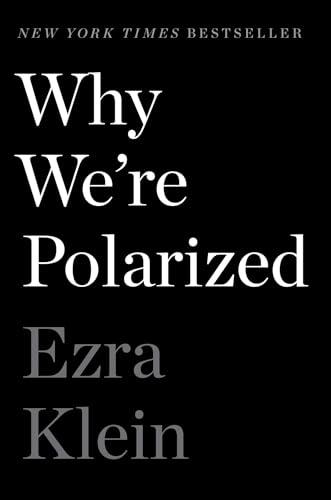
ONE OF BARACK OBAMA’S FAVORITE BOOKS OF 2022
“The American political system—which includes everyone from voters to journalists to the president—is full of rational actors making rational decisions given the incentives they face,” writes political analyst Ezra Klein. “We are a collection of function...
It was discussed as a book that talks about how we search for where we fit in a crazy world, and how politics is part of that search for identity and belonging.
"
In Ezra Klein's book, Why We're Polarized, he talks about how - remember those BuzzFeed quizzes that are like 37 ways you're from Ohio or 37 ways you went to high school in the mid-90s?
— Episode: "Two Truths & the Big Lie." (with Jen Ps...
Episode: "Two Truths & the Big Lie." (with Jen Psaki!)
It was discussed as a book that talks about how we search for where we fit in a crazy world, and how politics is part of that search for identity and belonging.
"
In Ezra Klein's book, Why We're Polarized, he talks about how - remember those BuzzFeed quizzes that are like 37 ways you're from Ohio or 37 ways you went to high school in the mid-90s?
Episode: “Go Big or Lose Small.”
It was recommended at the end of the podcast, described as an outstanding book. It was mentioned in the context of the author's broader argument about the Democrats' failure to govern effectively and its effects on democracy and the potential return of Trump.
"
Pick up his book, Why We're Polarized, outstanding book.
Episode: “Bolton’s bombshell.”
Ezra Klein's book was discussed at length, focusing on how polarization has evolved in American politics, its impact on policy, and the incentives it creates for political actors. It was described as causing deep thought, confirming some biases, and prompting questions about politics.
"
I read your book over the weekend. It really caused me to Think deeply about a lot of things Confirm some of my biases made me question a lot about things. I've thought about politics
Why is the topic of polarization the one you wanted to explore?
So I should say that Bill Clinton was in his time the most polarizing president in in polling history
It is an incredibly smart book that will help you understand What has happened in politics and I think really help you understand what is at stake? In this upcoming election in 2020.
So go check out the book everyone I really appreciate it.
Episode: "Two Truths & the Big Lie." (with Jen Psaki!)
Ezra Klein's book on political polarization was referenced as a source for understanding how identity-based appeals influence voters and shape the political conversation.
"
In Ezra Klein's book, Why We're Polarized, he talks about how - remember those BuzzFeed quizzes that are like 37 ways you're from Ohio or 37 ways you went to high school in the mid-90s?
The book was brought up when the host recalled being on its tour while discussing historical political divisions, and another guest mistakenly claimed to have authored it, citing its concluding argument about realism and past divisions. Both references were brief and did not include a strong endorsement.
Episode: Ta-Nehisi Coates on Bridging Gaps vs. Drawing Line...
Klein recalled that he had been on the book tour for this title while discussing historical political divisions.
"
I remember when I was on the Why We're Polarized book tour.
Episode: Spencer Cox Wants to Pull Our Politics Back From t...
Spencer Cox said he had published his first book in 2020 titled Why We're Polarized and noted its concluding argument about realism and historical divisions.
"
You know, in 2020, I published my first book, which is called Why We're Polarized. And the final paragraphs of that book are this argument that I make about realism, that as polarized, as divided as things feel, I mean, you can look back in our history and see it much worse.
Episode: What I Learned in 2025
Klein said the book had resurfaced in his mind over the last few months and that it examined how the parties shifted from broad coalitions to narrow, ideologically coherent groups.
"
I feel my personal experience of that book is that it has roared back into focus for me in the past four or five months. So Why We're Polarized is about the way that the highly regionalized, ideologically diverse political parties of the 20th century ... collapsed into much more ideologically narrow and coherent groups.
When I was writing that book, I was treating that sorting of the parties into these much more coherent units as an inevitability of media, of technology, of politics.
I will say the thing that why we're polarized did not talk about enough in the new versions is an afterward talking about it. It did not talk enough about educational polarization, which as a decisive form of polarization the Democratic Party was sorting into the higher educated coalition, the Republican Party moving into a less educated structure.
Episode: What I Learned in 2025
Klein recalled that the book was central to a column piece and explained that it analyzes how U.S. parties shifted from broad coalitions to ideologically narrow groups, arguing the thesis remains relevant but noting its weaker treatment of educational polarization.
"
And a big part of that piece was kind of a callback to your first book, Why We're Polarized, which tees up a question from Mark S., who's a college professor who assigns Why We're Polarized to his students.
Why We're Polarized is about the way that the highly regionalized, ideologically diverse political parties of the 20th century, where you had very liberal and very conservative Democrats, very liberal and very conservative Republicans, how those parties collapsed or transformed into much more ideologically narrow and coherent groups by the end of the 20th century and coming into the 21st century.
I will say the thing that why we're polarized did not talk about enough in the new versions is an afterward talking about it. But it did not talk enough about educational polarization. That that as a decisive form of polarization, the Democratic Party was sorting into the higher educated coalition, the Republican Party moving into a less educated structure.
Episode: The Republican Party’s NPC Problem — and Ours
The host mentioned that he had authored a book titled Why We're Polarized.
"
If you'd like to read about it, I wrote a whole book called Why We're Polarized.
Episode: Are We on the Cusp of a New Political Order?
The host said he had published a book analyzing the causes and dynamics of political polarization in the United States.
"
I published a whole book about political polarization. It was called Why We're Polarized.
Episode: I Watched the Republican Convention. The Democrats...
Ezra Klein said he had written the book, which was published in 2020, and noted that it argues the country is polarized but the key is over what it is polarized about.
"
I wrote a book on it that came out in 2020, Why We're Polarized. And one of the points of that book is that to say a country is polarized doesn't actually give you that much information. The question is what is it polarized over?
Episode: Biden, Psychedelics, Twitter, My New Book — and So...
Klein said his first book, Why We're Polarized, had been an incredibly lonely experience to write.
"
He's been on Bookly first due to his schedule and then I'm going on. One of the reasons I wanted to cowrite this book is I found writing my first book, Why We're Polarized, to be an incredibly lonely experience.
Episode: What I'm Thinking About at the End of 2022
Ezra Klein referred to his own book while discussing political polarization and its impact on society.
"
I wrote my book, Why We're Polarized, about polarization and the way it has locked people in place.
Episode: Is Climate Change a Reason to Avoid Having Childre...
At the close of the episode, Ezra's own book was mentioned as the author's title alongside his column.
"
Your book is Why We're Polarized and your column is at the New York Times.
Episode: Putin May Not Like How He’s Changed Europe
Krastev mentioned his own book, stating that its main theme was being discussed in the conversation.
"
This is a big theme of my book, Why We're Polarized.
Episode: Putin May Not Like How He’s Changed Europe
It was mentioned as the author's own book that deals with the drivers of political polarization.
"
This is a big theme of my book, Why We're Polarized.
Episode: Ask Ezra Anything: Degrowth, Third Parties, Readin...
He noted that the paperback includes a new afterword where he admitted his biggest mistake was not believing the book's thesis enough and reflected on how the pandemic and political events fit his analysis.
"
So one fun thing about the paperback, a reason to run out and buy it is there is an afterword in the paperback, a new afterword about what I think the book got right and what I wish I had done differently in it.
the single biggest mistake I made was not believing the book's thesis enough.
Episode: Ask Ezra Anything: Degrowth, Third Parties, Readin...
Ezra explained that the paperback includes a new afterword where he reflected on the book's thesis and admitted his biggest mistake was not believing it enough.
"
Aura asks, has anything changed in how you view Why We're Polarized since its publication?
So one fun thing about the paperback, a reason to run out and buy it is there is an afterword in the paperback, a new afterword about what I think the book got right and what I wish I had done differently in it.
Episode: Ask Ezra Anything: Degrowth, Third Parties, Readin...
Klein said the paperback's new afterword admitted his biggest mistake was not fully believing the book's thesis and reflected on how the pandemic and 2020 election largely confirmed his original arguments.
"
So one fun thing about the paperback, a reason to run out and buy it is there is an afterword in the paperback, a new afterword about what I think the book got right and what I wish I had done differently in it.
I say this in the afterword, the single biggest mistake I made was not believing the book's thesis enough.
One of the things I said in the book is that we are creating a political system through polarization that is almost immune to new evidence, where there is very little accountability because very little can change minds.
Episode: Best of: George Saunders on Kindness in a Cruel Wo...
George said he wrote the book about the political divide and its rational underpinnings.
"
I wrote this book, Why We're Polarized, which is very much all about why it is on some basic level rational for even a Republican who didn't like Donald Trump on a personal level to have voted for him.
Episode: How Identity Politics Took Over the Republican Par...
Klein noted that his book on polarization was currently available in paperback, and he said it was heavily influenced by Mason's Uncivil Agreement.
"
I wrote a book on polarization, Why We're Polarized, out in paperback now. My book is very influenced by Mason's book.
Episode: Republicans Are Setting Off a ‘Doom Loop’ for Demo...
Klein highlighted that his book was a key theme of the discussion and announced the release of a new paperback edition with an afterword.
"
This was a key theme of my book, Why We're Polarized. Although I should say right now, quick plug, that the paperback with the brand new afterword just came out last week.
Episode: An Appalled Republican Considers the Future of the...
Ezra reminded the audience that his own book had addressed the very topic they were discussing.
The host identified Ezra Klein as the author of Why We're Polarized, noting his role as a columnist and podcast host. The book was referenced twice as part of Klein's credentials.
"
And he's the author of Why We're Polarized.
— Episode: How Algorithms, Money, & Bureaucracy Dis...
Episode: How Algorithms, Money, & Bureaucracy Distance us f...
The host identified Ezra Klein as the author of Why We're Polarized, noting his role as a columnist and podcast host. The book was referenced twice as part of Klein's credentials.
"
And he's the author of Why We're Polarized.
Ezra Klein, columnist at New York Times, host of the Ezra Klein Show podcast, the author of Why We're Polarized.
This new book was discussed extensively, detailing the roots of the "Coronavirus culture war" and the role of mindfulness in depolarizing individuals. The author aimed to provide a dispassionate analysis of political polarization mechanisms in the US system.
"
he's the author of a new book or a new wish book called Why Were Polarized?
— Episode: How to Be a Good and Sane Citizen in Ugl...
Episode: How to Be a Good and Sane Citizen in Ugly Times |...
This new book was discussed extensively, detailing the roots of the "Coronavirus culture war" and the role of mindfulness in depolarizing individuals. The author aimed to provide a dispassionate analysis of political polarization mechanisms in the US system.
"
he's the author of a new book or a new wish book called Why Were Polarized?
Hopefully what I'm offering in the book will to people of all political persuasions. And thankfully, it's largely been how people reacted to it. Be seen as an accurate description of what is happening in the system and why people's incentives look the way they do.
I try to preempt a little bit of the mockery here in the book but I don't even mean mindfulness in the sense that a lot of people mean it as meditation.
The sophistication with which we are manipulated in politics far exceeds the sophistication with which we understand our own cognitive and emotional reactions to political stimuli.
I don't think this is a systemic solution for our problems. I think it is a healthy thing to do as individuals and that is not worthless.
The speaker mentioned writing the book, and it was the topic of a few conversations in the podcast. He later referenced information siloing, which he said was the topic of the book.
"
host of the Ezra Klein Show. Ezra Klein, what's happening, man? Good to be here.
— Episode: Ezra Klein: A Path to Defeat
Episode: Ezra Klein: A Path to Defeat
The speaker mentioned writing the book, and it was the topic of a few conversations in the podcast. He later referenced information siloing, which he said was the topic of the book.
"
host of the Ezra Klein Show. Ezra Klein, what's happening, man? Good to be here.
And so I'm wondering what worries you most as you think about a Trump second term, Project 2025, etc.?
It's kind of related to the topic of your book, Why We're Polarized.
It was discussed as a book that offered a theory on how America is broken, who broke it and how it can be fixed, specifically regarding polarization.
"
I really recommend to everybody listening that they read the book. There's your book, there's Adam Jendelson's book, Killswitch, about the Senate. There's Heather McGhee's book, The Sum of Us.
— Episode: Cuomosexual Misconduct
Episode: Cuomosexual Misconduct
It was discussed as a book that offered a theory on how America is broken, who broke it and how it can be fixed, specifically regarding polarization.
"
I really recommend to everybody listening that they read the book. There's your book, there's Adam Jendelson's book, Killswitch, about the Senate. There's Heather McGhee's book, The Sum of Us.
It explores the deep historical and personal aspects of the current political climate, examining how the divisions we see today go far beyond the present moment. Klein also reflects on his personal experiences as a journalist and the inadequacy of purely rational approaches to understanding political issues.
"
I am a voter, a news junkie, and a liberal.
— Episode: Ezra Klein — How We Walked Into This and...
Episode: Ezra Klein — How We Walked Into This and How We Ca...
It explores the deep historical and personal aspects of the current political climate, examining how the divisions we see today go far beyond the present moment. Klein also reflects on his personal experiences as a journalist and the inadequacy of purely rational approaches to understanding political issues.
"
I am a voter, a news junkie, and a liberal.
Change of this magnitude acts on us psychologically and not just electorally.
the love of a democracy that has to compensate for the pain of democracy
we need to build a politics where one of our aims is the participation and respect we give to each other.
are we activating good identities in people or bad identities in people?
Episode: [Unedited] Ezra Klein with Krista Tippett
The book was described as a great conversation that the speaker had been wanting to take part in, tracing how people walked into polarization and how to walk out of it. The author's journalistic background and personal experiences were also discussed.
"
I am a voter, a news junkie and a liberal.
The book is great. I made too many notes.
I think that publishing a book is the closest thing to the experience of kind of pregnancy and childbirth.
it's really this kind of extended conversation you've been having kind of from inside the American political experience for a number of years.
the master story here is the logic of polarization, which creates this massive feedback loop that just keeps making the polarization deeper.
It was the focus of the conversation, and it was mentioned as a book that validated some theories about political trends, particularly in relation to political polarization in the U.S.
"
But as somebody who's been a media executive now, has been at a bunch of different newspapers and has run an organization and started one, one thing that's important to understand is that everybody ru...
It was the focus of the conversation, and it was mentioned as a book that validated some theories about political trends, particularly in relation to political polarization in the U.S.
"
But as somebody who's been a media executive now, has been at a bunch of different newspapers and has run an organization and started one, one thing that's important to understand is that everybody running a media organization actually has access to the same analytics to some degree.
It is something that is explaining many, many political systems at once right now and is being validated by cross-national data.
One thing particularly that they are is polarized.
And so you have differentiation.
Episode: Iowa & The State of Disunion (with John Dickerson)
Ezra Klein's book was mentioned in the context of media's role in political polarization, with a focus on how it can influence individual actions and fundraising.
"
Ezra Klein: "Why the media is so polarized -- and how it polarizes us," Vox, 1/28/20
Note: The book recommendations on this page are discovered automatically from podcast transcripts, and may be incorrect or incomplete.