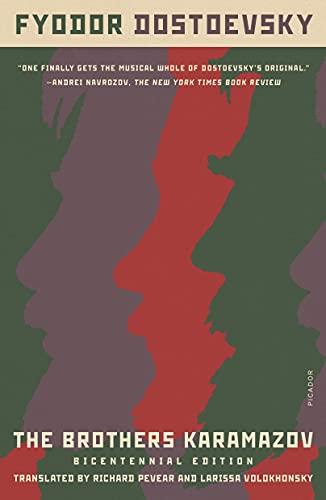
The novel was mentioned while discussing the Grand Inquisitor chapter as a literary parallel.
"
the Grand Inquisitor by Ivan Karamazov, it's a paradox. Because in a way, the Grand Inquisitor is suggesting ... it's a paradox. Because in a way, the Grand Inquisitor is suggesting ...
— Episode: John Leake: The Demonic Rituals to Repli...
Episode: John Leake: The Demonic Rituals to Replicate God a...
The novel was mentioned while discussing the Grand Inquisitor chapter as a literary parallel.
"
the Grand Inquisitor by Ivan Karamazov, it's a paradox. Because in a way, the Grand Inquisitor is suggesting ... it's a paradox. Because in a way, the Grand Inquisitor is suggesting ...
In two episodes, Conan and guest Asiya both said they had finished the title a few weeks earlier and loved it, noting that some passages were sloggy as is typical for Dostoevsky but the overall experience was enjoyable, and they also praised Crime and Punishment. Their comments conveyed a strong endorsement of the book.
Highly Recommended
Episode: Don’t Look A Gift Horse Meat In The Mouth Yet Agai...
Conan said he had finished reading The Brothers Karamazov a couple of weeks earlier and loved it, despite some sloggy sections.
"
I went on a Dostoevsky jag, and I just--I read--I finished Brothers Karamazov a couple of weeks ago, and I loved it. There are parts that are a bit of a slog, because it's Dostoevsky, and he had a lot of time on his hands and a lot of ink, but I really liked it, and I liked Crime and Punishment a lot.
Episode: Don’t Look A Gift Horse Meat In The Mouth Yet Agai...
The guest said they finished the novel a couple of weeks earlier, loved it despite some sloggy sections, and also praised Crime and Punishment.
"
I just read Brothers Karamazov.
I went on a Dostoevsky jag, and I just--I read--I finished Brothers Karamazov a couple of weeks ago, and I loved it. There are parts that are a bit of a slog, because it's Dostoevsky, and I really liked it, and I liked Crime and Punishment a lot.
It was used as an example of a difficult moral dilemma, where the potential for universal peace was weighed against the torture of a child.
"
It's the same idea incidentally that is in Dostoevsky's famous example in The Brothers Karamazov where he poses the question, suppose you could create utopia forever basically, peace on earth forever,...
— Episode: Justifying The Means
Episode: Justifying The Means
It was used as an example of a difficult moral dilemma, where the potential for universal peace was weighed against the torture of a child.
"
It's the same idea incidentally that is in Dostoevsky's famous example in The Brothers Karamazov where he poses the question, suppose you could create utopia forever basically, peace on earth forever, but to do so you first have to torture this little child in front of you.
Torture the child to death I think he says, I don't remember exactly.
A doctor's line from this novel was cited to illustrate the difficulty of loving particular people.
"
He has a wonderful kind of offhand, brilliant insight from a doctor in The Brothers Karamazov where the doctor says, oh, you know, it's very easy to love mankind in general. And it's very hard to love...
— Episode: #974 - Joe Folley - Existential Philosop...
Episode: #974 - Joe Folley - Existential Philosophy, Nietzs...
A doctor's line from this novel was cited to illustrate the difficulty of loving particular people.
"
He has a wonderful kind of offhand, brilliant insight from a doctor in The Brothers Karamazov where the doctor says, oh, you know, it's very easy to love mankind in general. And it's very hard to love people in particular.
The book was repeatedly cited as a deep source for exploring religious and moral philosophy, especially the contrast between its characters and Ivan's argument that existence might be better without consciousness. Jordan Peterson and several guests referenced its "Grand Inquisitor" passage and the vivid dramatization of ideas, while Stephen Fry called it a work of genius and urged listeners to read it. Across episodes, it was highlighted for its profound insight into suffering, freedom, and the structure of belief, earning a strong endorsement from the hosts.
Highly Recommended
Episode: 341. Jordan Peterson Interviews Presidential Candi...
Jordan Peterson and Vivek Ramaswamy discussed 'The Brothers Karamazov' in the context of a philosophical debate about the nature of religious institutions, including the climate movement's parallels to a religious structure.
"
I was reminded of actually one of my favorite stories about Christ actually which came from not the Bible but from Fyodor Dostoevsky's book the brothers Karamazov...
Episode: 321. A Conversation So Intense It Might Transcend...
Dr. Peterson referenced this book as an example of a narrative that embodies virtue, even if the arguments for moral pronouncements are underdeveloped.
"
You see something similar happening in the brothers Karamazov yeah because you have Ivan is a very is very able to put forward extremely compelling propositionly atheistic arguments right in kind of a Nietzschean spirit in real sense right and alliosa who's the monastic novitiate is no match for Ivan on the propositional front but he's a way better person
Episode: 291. How to Combat Hedonism | Dr. Peter Kreeft
It was mentioned as an example of a book where a character, Ivan Karamazov, argues that life is so full of catastrophe and suffering that it would be better if consciousness itself was brought to an end. Peter Kreeft mentioned that he didn't know that Karl Marx referenced this book, but it's absolutely stunning because it is the core ethos of Mefistopheles, the core satanic ethos that non being is better than being.
"
He says life is so right with catastrophe and suffering betrayal malevolence it's so intrinsically unworthy that it would be better if consciousness itself was just brought to an end.
Episode: 224. Questioning Sam Harris
It was mentioned as a deeply interesting and meaningful book written by Dostoevsky, and the example of a text that can offer depth in meaning.
"
Okay, so let's take that, let's take that argument apart because you you put your finger on the postmodern quandary right because the postmodernists in some sense the reason that they ran into trouble with assuming they criticized the notion that there was a canonical interpretation of the text because there's so many subjective interpretations of any text in fact there's a near infinite number of potential subjective interpretations of any text just like there's almost an infinite number of places you could be looking right now and so it's a huge deep problem so and when you say that you can project something onto the text that in some sense isn't there that's also an extremely deep problem and these problems are deep enough you know the fact of multiple interpretations of a single reality is so pervasive that it stopped AI researchers it's the thing that stopped AI researchers from being able to build functional robots like it's a killer problem yeah yeah okay so if that's the frame problem okay so let's let's agree that that exists but we should also agree and partly I think by the merits of your own argument that we do have a reliable subjective intuition that texts differ in depth yeah and that that means something so I'm going to propose what it means and you tell me what you think about this okay sure so one of the ways that we specify where to look at is by looking at what we deem to be important and so here's a way of conceptualizing that and it sort of maps on to the idea of the phoVA extending outward to less high-resolution consciousness so I write a sentence because I want to write a paragraph I write a paragraph because I want to sequence paragraphs into a book a chapter I write chapters to sequence them into a book I write a book because I want to be a practicing scientist I want to be a practicing scientist because I'm a good citizen I want to be a good citizen hypothetically because I want to be a good person you know and maybe I want to be a good person to avoid the hell that you described okay so those are nested value structures and we see the world through that structure simultaneously the whole thing is there and if one part of it collapses we make reference to the part that contains it that's how we don't crash like a computer now that now the navigation that you described these nested structures their navigation maps as far as I can tell now okay so here's the depth issue some maps have more other maps dependent on them than other maps do okay so if I go into your map structure some of that's even propositionalized and I mess about with the deeper axiomatic propositions upon which many other propositions rest then that's going to disturb you fundamentally and that's part of that experience of depth and you know look look you get much more if you're married and you love your wife you're much more upset if she divorces you than if you have an argument about who should do the dishes well why well because the stability of your marriage is a precondition for all sorts of other ways that you perceive the world and if that's violated well that's traumatic yeah so when we so and the reason I'm trying to get this clear with you is because you think clearly about these things but also because it allows to it allows for clarification of language in some sense so we could say that as you go deeper into that nested structure what you approach becomes more and more sacred by definition I'm trying to define it experientially because the so let's say you're transformed at a fundamental level that means something shifts way down deep and that's how you feel it even in an embodied sense and and what we've defined as as human beings as religious as far as I can tell or as sacred is our attempt to define the landscape that is characterized by those deepest structures of maps now what you're talking about I think is outside the map system altogether in some sense you know it's the container for all of it yeah yeah it is in some sense because or it's or thoghnall to it I mean it penetrates it at every point but it's not reducible to it and I mean that's why it's so consequential so for instance I think you can so taking accepting your your picture of nested maps and and depth and all that I agree with all of that and maps can be more or less useful in more or less in register with with the reality they're purporting to describe right so you can have faulty maps and in science we really try to get an accurate map and and we have a high resolution yeah and we have a language game which is when it's working is optimized to you know as Richard Feynman famously said not fooling ourselves right I mean that's like the master value of not fooling yourself whereas I would argue in in religious discourse not fooling yourself is not a master value and in fact you know so much of what goes by the name of religious faith okay but let me put that in terminology then because you talk about the sacred right and and and you accept that and and you also and you also see it as revivifying and and and and crucial to the prevention of suffering yeah but you juxtapose that against religion and so what what's the difference as far as your concern between what sacred and what's religious uh yeah good question well so maybe the best way to get at it is by reference to a principle which is I think what I think anything that's true right and this is this is true scientifically descriptively but it's true spiritually and it's true with respect to anything we would call sacred anything that's true anything that's real is discoverable now right it's like a little like like if we if we lost everything if we lost all the books if we lost all the tools if we lost everything and we just found ourselves having to reboot not only civilization but human cognition you know everything that is real is discoverable from that starting point even if you're even if you're starting zero again now we would we would talk about it differently we would have you know we would we would have memories of what what you know some of us would have memories of all that we've lost and that would anchor us to certain expectations but the point is what is true what is real what is what is what is the real opportunity for a direct self-transcendent engagement with reality right what what is the real opportunity for let me take exception let me take exception to that in one manner I see what you mean I understand what you mean I believe but here's here's a potential problem with that so I'm not saying let me just close it or do it possible misunderstanding I'm not saying that we shouldn't stand on the shoulders of giants and I'm not saying tradition is useless in fact either you know I would I would probably agree with you that that we should be fairly conservative in how we in how we overthrow our traditions I mean so I'm not I'm not arguing that we should just be radical iconic lasts the tears that we should tear everything down to the studs and start again that's not that's not what I'm I have okay well what's the difference but what's the difference in your vision then between the tradition that you would be conservative about and religion I'm not trying to corner you I'm just trying to see how you're making the distinction exceptionally it comes down to very specific claims that that I think are clearly false and which many of our religions advertise as not only important but indispensable for their projects so to take Islam as a specific example is I mean Islam mainstream Islam not just al-Qaeda style Islam just any Islam that really is worthy of the name in the year 2021 is founded on the claim that the Quran is the literal word of God and it is yeah but in the minds of most Muslims most of the time it means that these stanzas were dictated to Muhammad in his cave by the archangel Gabriel and he was he was commanded to recite and he recited them and what we have here is in truth the claim the the Orthodox claim is is even more stringent than what the seemingly analogous you know fundamentalist religion Christian claim about the Bible it's not just that the text itself is verbatim what God said uh it's that the document itself is in fact like every instantiation of the physical document is itself the word of God it's like it's it's there's sort of a double layer of sacredness to it well is it cannot be edited okay is it this is a problem that claim or is it the problem that the people who purport to understand it claim to be 100% right no no but the problem is that given that claim and given the actual contents of the book yeah which you have is an endless source of divisiveness and conflict like if you dignify that claim okay this is the most important series of utterances ever expressed on earth this is it let's find out what the creator of the universe wants us to know what he wants us to know above all else is that one we should hate and fear and despise and resist and never befriend unbelievers right that's that's that message comes through on virtually every page and a hell has been prepared for these unbelievers where their skins will be endlessly burned off of them and and replenished so that they can be tortured and new right do you think there's any relationship between that claim and your observation that failure to take refuge in the sacred as you laid it out dooms you to possession by the default network and puts you into a hell okay so it is possible to give a very enlightened reading of this text or really any text that that allows you to step out of its divisive and toxic implications so I would support that kind of reading you know if we were joined in this conversation by by Muslim scholars who said no no don't you understand Jordan's spiritual interpretation of this admonishment is precisely what God intended he intended it to be to be an engine not of hate and division and sectarian tribalism he intended it to be a device that would allow you to recognize the emotional and cognitive implications of of being caught by dualism say right like really you know etc etc he goes far as you want in that direction that'd be great the problem is the book itself gives no indication that your interpretation is the right one in fact it gives every indication that it's not and then it's heterodontous.
Episode: 169. An Atheist in the Realm of Myth | Stephen Fry
It was highly recommended for its genius and exploration of the problem of evil and God's existence, with Ivan's argument being highlighted.
"
because the God who created this universe if it was created by God is quite clearly a maniac
other maniac Ivan in the brothers Karamazov
it's very interesting I would urge everyone to read the brothers Karamazov because I do think it's a work of genius
Episode: 166. Writer of Braveheart | Randall Wallace
The book was mentioned as pitting the characters Ivan and Alyosha against each other, with Ivan being the atheistic warrior type, and Alyosha the monastic one. The book was described as being profound because the characters act out ideas that can't be made explicit.
"
and and it's so interesting how it works in in the brothers Karamazov Dostoevsky pits Ivan against Iliocia and Ivan is handsome and debonair and he's he's the warrior type that you just described he's very atheistic and he can put up a pretty good argument you know he he tortures his brother who's a monastic novigiant with stories of children locked in outhouses overnight and freezing to death they were punished by their parents which Dostoevsky took from a newspaper and said I don't I cannot possibly imagine how there could be a god who is omniscient and and had all the other classic attributes of God who could create a universe where that was allowed to happen even once and Ivan it can out debate Iliocia consistently but Iliocia's character is such that he wins the argument he loses all the battles in some sense but wins the war and that's something you can really portray when you clothe your ideas in characters or or when the characters are even more I think to the point is when the characters are so profound that they're acting out ideas that you couldn't yet make explicit no and that is one of the things that that narrative does is that it enables us to play out ideas that were not yet intelligent enough to understand and sometimes the gap between the narrative representation and the explicit understanding can be thousands and thousands of years because we're still unwrapping while we're certainly still unwrapping the Bible we're unwrapping we're still unwrapping Shakespeare there's more depth there than we can then we can understand explicitly and so anything that uses character has that tremendous advantage and then also there's also this strange ability that some people have in spades to create fictional worlds that are of unbelievable profundity and power and I mean the greatest example of that in the last 30 years in terms of sheer imaginative powers gotta be JK rolling and the Harry Potter series which you know grip the imagination of the entire planet for for a decade and produced untold wealth and spread literacy everywhere as well she had an unremarkably creative imagination and something quite mysterious
Episode: 162. Christianity and the Modern World | Bishop Ba...
Dostoevsky's character Ivan makes the case that conscious existence is so rife with suffering that it would be better if it didn't exist at all. This was mentioned in a discussion with David Benatar who argued a similar point.
"
And Dostoevsky's Ivan makes that case in the brothers Karamazov brilliantly brilliantly he tortures his brother Aliyosha who's the novitiate and it's a very interesting book because Aliyosha is nowhere near the retoration that Ivan is but he is the most admirable character in the book because of the totality of his personality not because of the brilliance of his rational mind it's amazing book in that regard but the problem I had with Benatar's hypothesis wasn't it's it's axiom because I think you can make a strong case that there's so much suffering in the world that the question of its validity is a valid question the problem for me there is that if you do that and you start to act that out things take a things appear to take a vicious turn very rapidly you start working against everything that's alive and striving yes and no quite right
Episode: 482. The Meaning Crisis: Resolution | Dr. John Ve...
Dr. Peterson proposed that a future discussion on the Daily Wire could incorporate 'The Brothers Karamazov,' specifically 'The Grand Inquisitor' section, to further explore the concept of the new advent of the sacred in relation to institutionalized religion.
"
maybe we could do that by referring to the Grand Inquisitor in 'The Brothers Karamazov'.
Episode: Jordan Peterson Live on Tour: The Hidden Key to a...
He grouped The Brothers Karamazov with other classic novels as works that convey deeper truths despite being fictional.
"
We know that Crime and Punishment is true. We know that the brothers Karamazov or war and peace is true. Well, it's fictional. It never happened. So how can it be true? And the answer is, well, it's a distillation of what's true.
Episode: 509. Retelling the Greatest Story Ever Told | Dall...
They referenced The Brothers Karamazov, noting its hero Eliosha and its broader philosophical reach compared with Nietzsche's work.
"
So in the Brothers Karamazov, the hero is a novitiate named Eliosha. He does the same thing in his book, The Idiot, which is about a prince who's an analog of Christ.
Dax Shepard mentioned listening to the book on Audible and said it tended to put him to sleep because of the many Russian names, making it hard to follow. He compared it unfavorably to another Dostoevsky novel, noting it was more exhausting to track. The overall impression was critical, suggesting it was not a recommended listen.
Critiqued
Episode: Armchair Anonymous: Wild Card V
Dax said he was listening to the novel on Audible and that it tended to put him to sleep because of the many Russian names. He also noted it was harder to follow than another Dostoevsky work.
"
And I'm listening to Brothers Karamazov right now. And it puts me to sleep. There are so many Russian names. I'm just struggling to keep up with who they're talking about. And it's so exhausting. I wouldn't ever be able to do audiobook on something like that.
Episode: Armchair Anonymous: Wild Card V
They mentioned listening to The Brothers Karamazov on Audible, noting it was exhausting to follow.
"
And I'm listening to Brothers Carmao's off right now.
yeah, well, certainly I read crime and punishment and it was easier to follow than Brothers Carmao's off on audible.
He argued that avoiding the novel because of the author's personal views was misguided and that not reading it was a selfinflicted penalty.
"
A lot of great authors too were troubled people. Dostoevsky, he would not have been a pleasant guy to be around. A lot of interesting facts about his life. But if you're going to let that stop you fro...
— Episode: Ep. 1056 - Democrats Double Down On Baby...
Episode: Ep. 1056 - Democrats Double Down On Baby Killing P...
He argued that avoiding the novel because of the author's personal views was misguided and that not reading it was a selfinflicted penalty.
"
A lot of great authors too were troubled people. Dostoevsky, he would not have been a pleasant guy to be around. A lot of interesting facts about his life. But if you're going to let that stop you from reading Crime and Punishment or from reading Brothers K or one of his great books, then you're punishing yourself.
Episode: Ep. 944 - Dems Screech And Howl In Defense Of Baby...
Walsh cited Dostoevsky's novel The Brothers Karamazov as an early observation of modern notions of freedom and its pitfalls.
"
Dostoevsky noticed this about the modern world way back in the 1800s when he wrote The Brothers Karamazov, which includes this passage.
Episode: Ep. 516 - Your Oppression Is Imaginary
He cited Dostoevsky's novel to illustrate his view that modern freedom is the satisfaction of desire, arguing that any unmet desire means one is oppressed.
"
Okay, so why is this all happening? Dostoevsky in the Brothers Karamazov defines the modern conception of freedom as the rapid multiplication and satisfaction of desire. And he says that that's the way modern man sees freedom, which means that if there's any desire that is not immediately fulfilled, then you're oppressed.
The Brothers Karamazov was mentioned by a caller while they were excitedly talking about a book that Brian had ordered for them to read.
"
okay we are talking about the book you sent me and I said okay I'm sorry I don't remember what book was it and then they'll start talking to me about Dostoevsky and the brothers' carol on top which is...
— Episode: How to Keep Going When Things Get Hard |...
Episode: How to Keep Going When Things Get Hard | Bryan Ste...
The Brothers Karamazov was mentioned by a caller while they were excitedly talking about a book that Brian had ordered for them to read.
"
okay we are talking about the book you sent me and I said okay I'm sorry I don't remember what book was it and then they'll start talking to me about Dostoevsky and the brothers' carol on top which is one of my favorite books and I'll just listen to them talk excitedly for 15 minutes and it's just the most extraordinary thing the most beautiful thing the most satisfying thing to have people creating relationships with ideas and values and understandings that are important to you and have them experience that and that's the thing that I do think is essential and it does come from as the Dalai Lama suggests the return on kindness and compassion you begin to see that it can actually achieve things that hopelessness and fear and anger can't achieve and that's a really exciting idea if you're trying to make it through the world in the 21st century at a time of so much violence in war and conflict and animosity and bigotry and all of these things that we see way too much of yeah it's so easy to get whether we're engaged in the sort of cinematic big work that you're I mean literally cinematic work that you're engaged with or we're just trying to get through in a quote unquote normal life it's easy given our media environment and given what's happening on the planet to get sucked into hopelessness but there is the antidote is around us all the time that's right and it's other people yeah yeah I think that's right and I think in many ways it also allows you to push back against you know fear and anger I do think that fear and anger are the essential ingredients of injustice and oppression they lead to depression and you know and despair and all of these terrible things and we're just living at a time when a lot of people are trafficking in the politics of fear and anger and I mean that broadly not just in our political sphere but in our social spheres and our cultural spheres and educational spheres that people seem to be motivated to use fear and anger as a currency to gain more influence and power that worries me because I look through world history and I see the worst and most tragic manifestations of human behavior rooted in these narratives of fear and anger the Holocaust was created by a narrative of fear and anger that were wandered in genocide a hundred days that was facilitated by this powerful a narrative of fear and anger you go any place in the world where people are being abused and mistreated if you talk to the abusers and those who are mistreating them they can give you a narrative of fear and anger to justify and defend what they are doing and I just think that fear and anger causes you to tolerate things you would not otherwise tolerate it causes you to accept things you would not otherwise accept how did we reconcile ourselves to be in slavers in this country to have millions of people violated and abused and say we mob violence throughout the 20th century the first half of the 20th century where black people pulled out of their homes and beaten and drowned and tortured and lynched sometimes on the courthouse lawn and and some of these mob members would bring their children to witness the torture and the violence and how is it that that would be a reasonable or rational thing to do even the architecture of segregation that I grew up with why this intense hatred of people because of their color not wanting them to sit where you sit not wanting them to eat where you eat go through the door where you go through all of that is rooted in these narratives of fear and anger many of which we inherit and if we don't consciously work to overcome they shape our lives and will feel rage in ways that we don't even understand and that's why for me countering that challenging that is so essential it doesn't mean we have to all agree on policies or issues or topics but we do have to understand that we don't make good decisions when those decisions are shaped by our worst fears or by our rage and anger and hope is the most powerful antidote to that and hope rooted in compassion and kindness hope rooted in the belief that we can do more than just rage at one another be afraid of one another hate one another I want to get on the other side of that because I don't want to be burdened by those things either and and in many ways it's a legacy that I feel fortunate to have inherited I mean when I look at American history I think about the four million people who were emancipated after the Civil War it would not have been irrational for them to say we want retribution against those who enslaved us who separated us from our children and our family members but most of them chose citizenship they chose fellowship they chose community was an act of hope that you could argue wasn't rational but it was powerful and all during that time of exclusion in disfavored I feel fortunate that were people in my ear saying don't hate those who exclude you don't hate those who don't want you to go to school with them who don't think you should be in the pool with them who don't want to sit next to you because if you do that you'll be defined by your hatred you'll be burdening yourself more than they could ever burden you and that relationship to a life for me is really essential because there are so many things that are enraging there are so many things that are oppressive there are so many things that are just heartbreaking when you see how humans interact with on another that it's very easy to get pulled into that narrative of fear and anger that can shape your whole life coming up Brian Stevenson talks about what he does when he sees fear and anger coming up in his own mind how he's learned to think about people he encounters along the way who he feels are abusing their power or acting in otherwise ugly ways and why he thinks it's important not just to criticize but also to state out loud your highest aspirations repeatedly
The book was highlighted as one of the speaker's two favorite works, described as "food for the soul" alongside another classic. It was also referenced in a discussion about a Louisville-themed novel that was deemed overly melodramatic, though that critique pertained to the derivative work rather than the original. Overall, the hosts conveyed strong personal admiration for the title.
Highly Recommended
Episode: 2024-10-10- KSR - Hour 1
It was mentioned alongside Crime and Punishment as one of the speaker's two favorite books, highlighting its significance to them.
"
My favorite book, which is, well, my two favorite books, Crime and Punishment and Brothers Karamazov.
Something that's food for the soul.
Episode: 2024-10-08- KSR - Hour 1
It was described as a Brothers Karamazovlinked novel about being a Louisville person, and was called overthetop and melodramatic.
"
And then he wrote, essentially, a Brothers Karamazov-linked novel about what being a Louisville person was, which was way over the top, melodramatic.
It was mentioned alongside 'Anna Karenina' as a part of the speaker's Russian literature studies at Northwestern University, which played a key role in his intellectual development.
"
Studying Anna Karanah and Brothers Karamazov and the great Russian literary masters, Dostoevsky, Tolstoy, Chakov, it opened me up to the idea that my libertarian worldview of voluntarism and consent f...
— Episode: The Karol Markowicz Show: The Cultural P...
Episode: The Karol Markowicz Show: The Cultural Problem of...
It was mentioned alongside 'Anna Karenina' as a part of the speaker's Russian literature studies at Northwestern University, which played a key role in his intellectual development.
"
Studying Anna Karanah and Brothers Karamazov and the great Russian literary masters, Dostoevsky, Tolstoy, Chakov, it opened me up to the idea that my libertarian worldview of voluntarism and consent for literally the only moral principles was so small, so beneath the reality of like how deep the human mind goes, how much the soul really exists and that you actually cannot reduce man to voluntarism and consent.
Godfrey mentioned having a broad knowledge of Russian literature in preparation for his comedy set in Russia, including this classic work by Dostoevsky.
"
I've on the terrible Ivan Grozny. That's what they call him. I've on the terrible do Chayefsky. I've read Kafka. I've read I've a lot of Russian shit.
— Episode: Godfrey on Russia, The Brady Bunch, and...
Episode: Godfrey on Russia, The Brady Bunch, and Evel Kniev...
Godfrey mentioned having a broad knowledge of Russian literature in preparation for his comedy set in Russia, including this classic work by Dostoevsky.
"
I've on the terrible Ivan Grozny. That's what they call him. I've on the terrible do Chayefsky. I've read Kafka. I've read I've a lot of Russian shit.
Li Hui, a diplomat sent by China to Ukraine, was described as someone who reads Russian classics, including The Brothers Karamazov, and is considered a friend of Russia.
"
He reads Russian classics like Tolstoy and Dostoevsky.
— Episode: Morning Joe 4/27/23
Episode: Morning Joe 4/27/23
Li Hui, a diplomat sent by China to Ukraine, was described as someone who reads Russian classics, including The Brothers Karamazov, and is considered a friend of Russia.
"
He reads Russian classics like Tolstoy and Dostoevsky.
The hosts joked that a guest repeatedly claimed she would read the book while traveling, but they suggested she never actually opened it, using it as a status symbol. No substantive discussion of the book’s content was offered, and the remarks were meant to mock the guest’s pretensions rather than evaluate the title.
Episode: Crappens ReRun: Real Housewives Ultimate Girls Tri...
One speaker mocked Kyle by suggesting she would claim to be reading this book while on vacation, implying she only carries books for show and never reads them.
"
I feel like Kyle just wherever she goes has the latest Leanne Moriarty book and that's it and she's never read a damn one she's just gonna tell everybody she read it while she's waiting for a Reese Witherspoon to make a movie out of it or something a TV show out of it
Episode: RHUGT: Real Housewives Ultimate Girls Trip Begins!
Kyle mentioned that she was totally going to read this book but never got around to it, likely implying she only brings the latest Leanne Moriarty book with her on trips.
"
I feel like Kyle just wherever she goes has the latest Leanne Moriarty book and that's it and she's never read she's just gonna tell everybody she read it while she's waiting for Reese Witherspoon to make a movie out of it or something a TV show out of it
Martin Sheen found this book to be a galvanizing experience, particularly its themes of commitment, honesty, family, and community; he stated that it was a book that he found himself returning to again and again.
"
And the final step I guess in my journey was the brothers Karamontsoff.
— Episode: [Unedited] Martin Sheen with Krista Tipp...
Episode: [Unedited] Martin Sheen with Krista Tippett
Martin Sheen found this book to be a galvanizing experience, particularly its themes of commitment, honesty, family, and community; he stated that it was a book that he found himself returning to again and again.
"
And the final step I guess in my journey was the brothers Karamontsoff.
It's about the reality of commitment. It's about knowing that you're living an honest life and knowing when you're not basically and it's about family. It's done within family and community.
It's not something that you can easily shake. It's not a work that you can put down and pick up something else and not reflect. You'll find yourself going back to it again and again and again.
It was a Dorothy Day's favorite book as well.
And that did it, you know, it got me in ways that I could not have imagined. I stayed up nights I took me a week to read it.
Episode: Martin Sheen — Spirituality of Imagination
It was described as a great novel exploring debates about God, free will, and morality. The speaker found it to be about the reality of commitment and living an honest life, within family and community, and said it was a book they returned to again and again.
"
it's a great novel and I would recommend it unless you want your life changed
it's about the reality of commitment it's about knowing that you're living an honest life and knowing when you're not basically and it's about family it's done within family and community and it's not something that you can easily shake it's not a work that you can put down and pick up something else and not reflect you find yourself going back to it again and again and again
it was a Dorothy Day's favorite book as well I have read it she would reread it and talk about it and write about it
Dr. Shafty had a grip on the reality of life as it is and you know he was a habitual gambler he was not a celebrated man in many respects but he long to live an honest and free life because that's really where we find the presence of God or the one the other whatever we express as a higher power that we are part of a community and that work does Shafty's work specifically in that book is about being a part of a community and not being able to let it go without a severe penalty
Episode: [Unedited] Martin Sheen with Krista Tippett
Martin Sheen mentioned that this book was given to him by Terrence Malick and that it galvanized him, leading to his return to Catholicism. He described it as a work about commitment, honesty, family, and community, one that profoundly impacted him and that he reread many times.
"
And the final step I guess in my journey was the brothers Karamontsoff.
It's about the reality of commitment. It's about knowing that you're living an honest life and knowing when you're not basically and it's about family. It's done within family and community.
It's not something that you can easily shake. It's not a work that you can put down and pick up something else and not reflect. You'll find yourself going back to it again and again and again.
And that did it, you know, it got me in ways that I could not have imagined. I stayed up nights I took me a week to read it.
Episode: Martin Sheen — Spirituality of Imagination
It was described as a great novel that explores debates about God, free will, and morality. The speaker found it impactful and a source of reflection, rereading it frequently.
"
it's a great novel and I would recommend it unless you want your life changed
it's about the reality of commitment it's about knowing that you're living an honest life and knowing when you're not basically and it's about family it's done within family and community and it's not something that you can easily shake it's not a work that you can put down and pick up something else and not reflect you find yourself going back to it again and again and again
it was over a thousand pages
it got me in ways that I could not have imagined I stayed up nights I took me a week read it
Episode: Vigen Guroian — Restoring the Senses: Gardening an...
A passage from this book was quoted to illustrate how the main character, despite being an atheist, expresses a deep appreciation for the natural world, aligning with the Orthodox Christian experience of connecting with God through the senses. The irony of an atheist articulating a Christian sentiment was discussed.
"
he said a lot of my boy so I want to live and go on living even if it's contrary to the rules of logic even if I do not believe in the divine order of things the sticky young leaves are merging from their buds in this spring are dear to my heart so is the blue sky and so are some human beings even though I often don't know why I like them I'll get drunk on my own emotion I love these sticky little leaves and the blue sky that's what you don't love those things with reason with logic you love them with your innerts with your belly yes
Episode: Vigen Guroian — Restoring the Senses: Gardening an...
A passage from Dostoevsky's book was quoted, where the character Ivan Karamazov expresses a love for nature and earthly things despite his atheism, ironically mirroring an aspect of the Orthodox Christian experience of faith.
"
he said a lot of my boy so I want to live and go on living even if it's contrary to the rules of logic even if I do not believe in the divine order of things the sticky young leaves are merging from their buds in this spring are dear to my heart so is the blue sky and so are some human beings even though I often don't know why I like them I'll get drunk on my own emotion I love these sticky little leaves and the blue sky that's what you don't love those things with reason with logic you love them with your innerts with your belly
It was mentioned in relation to the idea that suffering in the present will make sense and be made up for in the future, with all resentments comforted and crimes atoned for, in the context of eternal harmony.
"
I believe this is in the Brothers Karamazov. I believe that like a child, that suffering will be healed and made up for, that all the humiliating absurdity of human contradictions will vanish like a p...
— Episode: A Foretaste of the Future
Episode: A Foretaste of the Future
It was mentioned in relation to the idea that suffering in the present will make sense and be made up for in the future, with all resentments comforted and crimes atoned for, in the context of eternal harmony.
"
I believe this is in the Brothers Karamazov. I believe that like a child, that suffering will be healed and made up for, that all the humiliating absurdity of human contradictions will vanish like a painful mirage, that in the world's finale, at the moment of eternal harmony, something so precious will come to pass that it will suffice for all hearts, for the comforting of all resentments, for the atonement of all the crimes of humanity, of all the blood that they shed, that it will make it not only possible to forgive, but to justify all that has happened.
The speaker briefly mentioned this book, suggesting it has ideas about the atonement of Jesus Christ that connect with the atonement of Jesus in the Book of Mormon.
"
There are a couple of passages in *The Brothers Karamazov* that really kind of connect with that.
— Episode: Alma 32-35 Part 2 • Dr. S. Michael Wilco...
Episode: Alma 32-35 Part 2 • Dr. S. Michael Wilcox • July 2...
The speaker briefly mentioned this book, suggesting it has ideas about the atonement of Jesus Christ that connect with the atonement of Jesus in the Book of Mormon.
"
There are a couple of passages in *The Brothers Karamazov* that really kind of connect with that.
Episode: Doctrine & Covenants 64-66 : Part II : Dr. S. Mich...
It was discussed at length as a powerful example of Russian Orthodox literature, and its connection to Doctrine and Covenants 65, particularly the imagery of the wedding feast.
"
One of the greatest novels in the history of the world is by a Dostoevsky called The Brothers Karamazov.
And in that, the most Christ-like fictional character ever created is introduced to us. It's an Eastern Orthodox, a Russian Orthodox novice. He's studying in a monastery. His name is Alyosha.
He represents the good spirit in all of us. He is the spirit of Christianity, beautiful, beautiful individual. And he just goes around doing good. And he is trained by an old father named Zosima, who's also a delight for you. Love these two characters.
Yes, him, him did he approach the little wise and old man with fine wrinkles on his face joyful and quietly laughing. He's eyes shown. He too was at the feast. Had also been called to the wedding in Cana of Galilee. I too, dear fellow have been called.
Called in summoned the quiet voice said clearly above him. You too must come and be with us. Let us be Mary and gay. The little wise and old man continued.
Note: The book recommendations on this page are discovered automatically from podcast transcripts, and may be incorrect or incomplete.