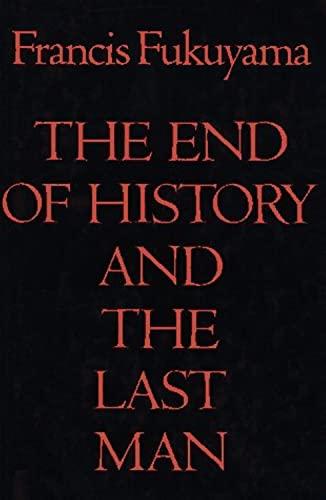
The End of History and the Last Man Cover
Podcast Mentions

The End of History and the Last Man

Francis Fukuyama

Debates whether or not history has an end, defines two forces of human nature that continue to drive civilizations toward democracy, and tries to predict whether or not humankind will want to sustain democracy in the future

Podcasts 12
Quotes 30
The Dan Bongino Show

Dan Bongino highlighted Fukuyama's wellknown work on the "end of history," urging listeners to check out the book.

"

You ever hear of this guy, Francis Fukuyama? If you haven't, you should. He wrote this book about the end of history. He's a very well respected historian.

— Episode: This Is How They Plan To Interfere In Th...

Episode: This Is How They Plan To Interfere In The Next Ele...

Dan Bongino highlighted Fukuyama's wellknown work on the "end of history," urging listeners to check out the book.

"

You ever hear of this guy, Francis Fukuyama? If you haven't, you should. He wrote this book about the end of history. He's a very well respected historian.

The Ezra Klein Show

Krastev referred to Fukuyama's book when discussing how the title reflected a shift away from the idea of history ending.

"

Out of the title of Fukuyama's book, The End of History and the Last Man, probably we parted with the idea of the end of history.

— Episode: Putin May Not Like How He’s Changed Euro...

Episode: Putin May Not Like How He’s Changed Europe

Krastev referred to Fukuyama's book when discussing how the title reflected a shift away from the idea of history ending.

"

Out of the title of Fukuyama's book, The End of History and the Last Man, probably we parted with the idea of the end of history.

Episode: Putin May Not Like How He’s Changed Europe

It was cited while discussing Fukuyama's argument that the 'end of history' meant the end of communist ideology.

"

Fukuyama did not expect Soviet Union to collapse. For him, the end of history was that it was communist leaders that stopped believing in communism.

the title of Fukuyama's book, The End of History and the Last Man, probably we parted with the idea of the end of history.

The Rest Is History

Tom referred to Francis Fukuyama's book The End of History as a slogan summarizing the postCold War era.

"

the famous uh slogan that sums it up uh is the end of history written by francis fukey armor

— Episode: 153. God and the American Empire

Episode: 153. God and the American Empire

Tom referred to Francis Fukuyama's book The End of History as a slogan summarizing the postCold War era.

"

the famous uh slogan that sums it up uh is the end of history written by francis fukey armor

Episode: 69. England v Ukraine

The hosts mentioned interviewing Francis Fukuyama, noting he wrote The End of History and that his thesis claimed the end of history meant England had won.

"

I had to go and interview Francis Fukuyama, author of The End of History.

his whole thesis is that the end of history means that England has won.

Episode: 23. The 90s

This book was suggested as potentially defining the complacency of the 1990s because it seemed to proclaim the end of ideological conflict after the Cold War.

"

So you could tell quite a bleak story about the 90s and you could also tell us I mean that going back to the hubris point you could argue that a defining book of the 90s in some ways is Francis Fukuyama's The End of History

The Weekly Show with Jon Stewart

Jon Stewart recalled that about twentyfive years ago Francis Fukuyama wrote "The End of History".

"

It was only, you know, maybe 25 years ago that Francis Fukuyama wrote the end of, you know, what was it? The, the, the end of history, the end of history.

— Episode: Trump’s New World Disorder with Adam Too...

Episode: Trump’s New World Disorder with Adam Tooze and Iva...

Jon Stewart recalled that about twentyfive years ago Francis Fukuyama wrote "The End of History".

"

It was only, you know, maybe 25 years ago that Francis Fukuyama wrote the end of, you know, what was it? The, the, the end of history, the end of history.

Freakonomics Radio

It was discussed in the context of the author's prediction about the future of liberal democracy, which he has not entirely changed his mind about, despite the recent political shifts.

"

In 1992, Fukuyama wrote a book that became a sensation. It was called The End of History and the Last Man.

— Episode: How to Change Your Mind (Ep. 379 Update)

Episode: How to Change Your Mind (Ep. 379 Update)

It was discussed in the context of the author's prediction about the future of liberal democracy, which he has not entirely changed his mind about, despite the recent political shifts.

"

In 1992, Fukuyama wrote a book that became a sensation. It was called The End of History and the Last Man.

In the late 1980s, as I was following events in the Soviet Union, I said, well, to the extent that there's an end of history, it's going to look like liberal democracy tied to a market economy.

The Megyn Kelly Show

It was discussed as a best-selling book written around the fall of the Soviet Union, where many people believed that totalitarian regimes were a thing of the past.

"

It's not surprising that Francis Fukuyama book, The End of History, was a bestseller.

— Episode: How America Enabled Putin's Atrocities,...

Episode: How America Enabled Putin's Atrocities, and Democr...

It was discussed as a best-selling book written around the fall of the Soviet Union, where many people believed that totalitarian regimes were a thing of the past.

"

It's not surprising that Francis Fukuyama book, The End of History, was a bestseller.

Modern Wisdom

The speaker noted that Fukuyama published this 1992 book, which argued that liberal democracy represents the final form of human government.

"

He, in 1992, published this book called The End of History and the Last Man. What he famously argued in that text is that the final form of human government is liberal democracy.

— Episode: #1032 - Joshua Citarella - The Dark Subc...

Episode: #1032 - Joshua Citarella - The Dark Subcultures of...

The speaker noted that Fukuyama published this 1992 book, which argued that liberal democracy represents the final form of human government.

"

He, in 1992, published this book called The End of History and the Last Man. What he famously argued in that text is that the final form of human government is liberal democracy.

Episode: #1032 - Joshua Citarella - The Dark Subcultures of...

The book was cited as a historically influential work that argued liberal democracy would be the final form of human government.

"

He, in 1992, published this book called The End of History and the Last Man. What he famously argued in that text is that the final form of human government is liberal democracy.

Behind the Bastards

It was mentioned that the book's theories haven't aged well, as liberal democracies are declining instead of thriving as predicted in the 1990s.

"

not just the passing of a particular period of post-war history, but the end of history as such that is the endpoint of mankind's ideological evolution and the universalization of Western liberal demo...

— Episode: The Bastard Manifesto

Episode: The Bastard Manifesto

It was mentioned that the book's theories haven't aged well, as liberal democracies are declining instead of thriving as predicted in the 1990s.

"

not just the passing of a particular period of post-war history, but the end of history as such that is the endpoint of mankind's ideological evolution and the universalization of Western liberal democracy as the final form of human government.

Episode: The Bastard Manifesto

It was discussed as a 1989 essay turned into a 1992 book, where the author predicted the end of history with liberal democracy's global dominance, but it has aged poorly.

"

not just the passing of a particular period of post-war history, but the end of history as such that is the endpoint of mankind's ideological evolution and the universalization of Western liberal democracy as the final form of human government.

Episode: The Bastard Manifesto

It was written in 1989 as an essay, and later expanded into a book in 1992 after the fall of the Soviet Union. It was mentioned as having not aged well, as it predicted the universalization of Western liberal democracy as the final form of human government.

"

not just the passing of a particular period of post-war history, but the end of history as such that is the endpoint of mankind's ideological evolution and the universalization of Western liberal democracy as the final form of human government.

Episode: The Bastard Manifesto

Robert explained that Fukuyama turned his 1989 essay into a 1992 book, claiming humanity was witnessing the endpoint of ideological evolution.

"

In 1989, Francis Fukuyama, a political scientist and author, wrote an essay titled The End of History.

Now he turned his essay into a book in 1992 after the fall of the USSR... In The End of History, he wrote that humanity was witnessing the end of history as such, that is the endpoint of mankind's ideological evolution and the universalization of Western liberal democracy as the final form of human government.

Episode: The Bastard Manifesto

It was mentioned that Fukuyama's book, published in 1992, proposed the idea that Western liberal democracy was the endpoint of mankind's ideological evolution, a theory that hasn't aged well in the intervening years.

"

not just the passing of a particular period of post-war history, but the end of history as such that is the endpoint of mankind's ideological evolution and the universalization of Western liberal democracy as the final form of human government.

Philosophize This!

This book was described as taking an oversimplification of Hegel's concept of absolute knowledge and applying it to the early 1990s political climate. Fukuyama argued that the fall of the Soviet Union marked the end of ideological conflict and the triumph of liberal democratic capitalism as the ultimate form of political organization.

"

Fukuyama took an oversimplification of Hegel, his concept of absolute knowledge, the dialectical change of Hegel, and applied it to the political climate of the early 1990s.

— Episode: Episode #198 ... The truth is in the pro...

Episode: Episode #198 ... The truth is in the process. - Zi...

This book was described as taking an oversimplification of Hegel's concept of absolute knowledge and applying it to the early 1990s political climate. Fukuyama argued that the fall of the Soviet Union marked the end of ideological conflict and the triumph of liberal democratic capitalism as the ultimate form of political organization.

"

Fukuyama took an oversimplification of Hegel, his concept of absolute knowledge, the dialectical change of Hegel, and applied it to the political climate of the early 1990s.

Fukuyama in 1992 made the claim that if you look at the history of human ideas for a long time we've been in this battle that's been going on between different ideologies that say what the best way is to organize people in a society.

And Fukuyama in 1992 says maybe we've arrived at that ultimate system. And that system is liberal democratic capitalism or the combination of classical liberalism democracy and capitalism.

He said they thought we were living in a post ideological age.

Tijijek Fukuyama was wrong.

Odd Lots

Podcast

Odd Lots

The book was referenced during a discussion about whether the liberal democratic order still holds as the ultimate societal model, with the guest noting they were halfway through it and found it interesting. The conversation highlighted recent geopolitical events that appear to challenge Fukuyama's thesis, suggesting a possible shift away from the "end of history" mindset. Overall, the episode treated the title as a thought‑provoking backdrop rather than a definitive guide.

Episode: Brevan Howard's Top Economist Sees Three Huge Macr...

The book was mentioned as a reference for a discussion on the end of the 'end of history' era. It explores the idea of liberal democracy as the ultimate expression of society, but the podcast guest argued that recent events have challenged this thesis.

"

I'm like halfway through the Fukuyama book right now. I started reading it about two weeks ago. Setting aside whether it's right or wrong, it's a very interesting book.

It's evident that deterrence didn't work for Putin invading Ukraine. It's evident that deterrence didn't work for Hamas and then perhaps what's going on with Hezbollah against Israel, big question mark, whether deterrence is enough for maintaining the status quo with Taiwan. These are all questions that you have to ask yourself. The end of the end of history, for me, means, do we have to have a completely different security architecture in the immediate aftermath of the in the Cold War period?

In the post-World War Two period, we had NSC-68, which said we need to develop the H-bomb, we need to be able to fight two and a half wars and we ended up not doing deterrence, we ended up fighting multiple wars in order to enforce the liberal democratic order. I worry that we're moving back into an era where the end of the end of history means that we can't just, as my friend Neil Ferguson says, talk softly and carry a big stick, that we'll have to actually use the use the stick.

I think this cohort of policymakers in the mainstream, certainly of US policymakers, believes that the post-Cold War architecture either doesn't really demand the US to do that much or deterrence is enough, but it's evident that deterrence didn't work for Putin invading Ukraine.

In Fukuyama's telling, liberal democracy is like the logical endpoint for society, that's the ultimate sort of the expression of society with the least internal contradictions and so what you're saying now is like actually there is competition, there are people and there are countries, etc., maybe there is a different way. Listen, surveys of the global south and if you don't trust the surveys, just look at what the leadership does, whether it's Brazil or India, they're not taking sides, they're seeing the dialectic between liberal democracy and illiberal tendencies and they are not so sure about signing up with the post-Cold War liberal order, just by revealed preference. So you're seeing this play out in real time in a very important way, even with allies who we've hugged closer in certain spheres, like like India. So I think this is a real you're seeing the manifestation of it right in front of your right in front of our eyes.
Note: The book recommendations on this page are discovered automatically from podcast transcripts, and may be incorrect or incomplete.