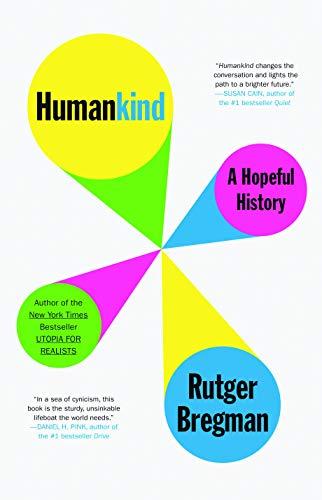

Humankind: A Hopeful History Cover
Podcast Mentions

Humankind A Hopeful History

Rutger Bregman

AN INSTANT If there is one belief that has united the left and the right, psychologists and philosophers, ancient thinkers and modern ones, it is the tacit assumption that humans are bad. It's a notion that drives newspaper headlines and guides the laws that shape our lives. From Machiavelli to Hob...

Podcasts 5
Quotes 15
My Favorite Murder with Karen Kilgariff and Georgia Hardstark

It was mentioned as a hopeful book about human nature, using examples like 9/11 and the Titanic to illustrate the idea that people are inherently good.

"

With a long history chock full of slavery, genocide and war, it's easy to start thinking that perhaps human beings are inherently bad, but author and historian Rutger Bregman has an entirely different...

— Episode: 275 - Raise The Snail: Steven’s 5th Anni...

Episode: 275 - Raise The Snail: Steven’s 5th Anniversary!

It was mentioned as a hopeful book about human nature, using examples like 9/11 and the Titanic to illustrate the idea that people are inherently good.

"

With a long history chock full of slavery, genocide and war, it's easy to start thinking that perhaps human beings are inherently bad, but author and historian Rutger Bregman has an entirely different view. He believes that most people deep down are pretty decent and he's rounded up a slew of examples from many of the worst moments in recorded human history to back up his claim from the tragedy of 9-11 to the sinking of the Titanic, from the aftermath of Hurricane Katrina to the horrors of the Nazi concentration camps. Bregman explains how unwavering human kindness and genuine altruism have always triumphed, even in the most horrifying situations.

What Now? with Trevor Noah

The hosts referenced Rutger's latest book Humankind, noting they had it in their hands and were impressed by its hopeful take on human nature.

"

my new book in my hands are like, oh this is awesome.

— Episode: Human-Kind or Human Evil with Rutger Bre...

Episode: Human-Kind or Human Evil with Rutger Bregman [VIDE...

The hosts referenced Rutger's latest book Humankind, noting they had it in their hands and were impressed by its hopeful take on human nature.

"

my new book in my hands are like, oh this is awesome.

Modern Wisdom

The book was mentioned as discussing the concept of "puppification" of humans.

"

Rutger Bregman wrote a book called Humankind. And in that, he talked about the puppification of humans.

— Episode: #580 - Dr Tania Reynolds - What Use Are...

Episode: #580 - Dr Tania Reynolds - What Use Are Female Fri...

The book was mentioned as discussing the concept of "puppification" of humans.

"

Rutger Bregman wrote a book called Humankind. And in that, he talked about the puppification of humans.

Pivot

Podcast

Pivot

No quotes extracted yet.

The Jordan Harbinger Show

It was mentioned as having a similar viewpoint to Christakis's work, that kindness and social connection are heavily rewarded in society due to human evolution.

"

yes yeah I couldn't recollect it but in fact it's right over there I can look over and see his book but yes he was on episode 494 and his point was the same that look yes it looks like psychopaths and...

— Episode: 524: Nicholas Christakis | Pandemic Impa...

Episode: 524: Nicholas Christakis | Pandemic Impacts and Co...

It was mentioned as having a similar viewpoint to Christakis's work, that kindness and social connection are heavily rewarded in society due to human evolution.

"

yes yeah I couldn't recollect it but in fact it's right over there I can look over and see his book but yes he was on episode 494 and his point was the same that look yes it looks like psychopaths and sociopaths whatever are rewarded in society but much more so do we reward people who are kind and connect well with others and it's uh quote unquote always been that way because of the way that we evolved to live in groups

Episode: 494: Rutger Bregman | Humankind: A Hopeful History

It was argued that, contrary to popular belief, humans are mostly decent and crises tend to bring out the best in people, not the worst, using the London Blitz and Hurricane Katrina as examples.

"

I love the idea that people are not, this is like an Anne Frank thing, right? People really are good at heart.

It's just that that's what we see. And we'll talk about the reason we have this bias.

The science of disasters actually says the opposite so we now have more than 700 K studies done by sociologists from around the globe and they studied again and again in different countries how people respond to an earthquake or tsunami or a flooding or something like that and again and again you see the same phenomenon people start cooperating on a massive scale.

A wonderful book about this has been written by Rebecca Solnit called 'A Paradise Built in Hell'. I think the title says it all is that people really sort of miss this paradise often the disasters ended.

I'm actually working on on a bit of a self-helpy book right now but if I would write a self-help book it would not be about how to live a happier life or how to live a more successful life or how to live a more mindful life or something like that but how to live a more difficult life you know how to make life more difficult for yourself because to be honest it's going to be a best-seller man.

Episode: 524: Nicholas Christakis | Pandemic Impacts and Co...

It was mentioned as it also explores how humans are rewarded for kindness and connection in society, much like the episode's discussion about social networks and their impacts.

"

have you read Rutger Braggman's work humankind yes yeah I couldn't recollect it but in fact it's right over there I can look over and see his book but yes he was on episode 494 and his point was the same that look yes it looks like psychopaths and sociopaths whatever are rewarded in society but much more so do we reward people who are kind and connect well with others

Episode: 494: Rutger Bregman | Humankind: A Hopeful History

It was argued that humans are mostly decent, and that crises often bring out the best in people, rather than the worst, as commonly portrayed in media and some psychology studies.

"

It's a really fascinating story because basically everything is in there.

The science of disasters actually says the opposite, so we now have more than 700,000 studies done by sociologists from around the globe and they studied again and again in different countries how people respond to an earthquake or tsunami or a flooding or something like that and again and again you see the same phenomenon, people start cooperating on a massive scale.

A wonderful book about this has been written by Rebecca Solnit called 'A Paradise Built in Hell.' I think the title says it all, is that people really sort of miss this paradise often the disasters ended.

It's really the two sides of human nature. On the one hand, we've evolved to be one of the friendliest species in the animal kingdom with the ability to cooperate on a scale that pretty much no other animal can do, but on the other hand, we're incredibly groupish, we're incredibly tribal, we just want to be liked, we don't want to be left alone, we want to be part of our own group.

I think that in reality it's pretty much the opposite, as we wrap here, I got to ask about bullying, right? Because that's something that's taken front and center and I worry about it, right?

Note: The book recommendations on this page are discovered automatically from podcast transcripts, and may be incorrect or incomplete.