
Podcast
Huberman Lab
Andrew Huberman repeatedly highlighted the book as a key source that clearly distinguished between state and trait changes from meditation and summarized recent scientific findings. He noted that it offered practical descriptions of various meditation lengths and emphasized its neuroscience focus, crediting the authors' expertise. The discussion conveyed strong endorsement of the book’s relevance for listeners interested in meditation and its long‑term effects.
Episode: How Meditation Works & Science-Based Effective Med...
It is a book that distinguishes between state changes and trait changes and discusses how meditation can impact both.
This is a theme that I've picked up from a terrific book that I'll refer to later, but the more that you can get into specific neural circuits quickly actually the less you need to meditate in order to drive the benefits of meditation.
It's a wonderful book where they very clearly distinguish between state changes and trait changes.
I would say that circa 2016 2017 this book really captured what I believe to be the most essential elements of the science of meditation.
A lot of the history of it as well today we're focusing on much of what's covered in this book but also a lot of things that have happened.
It's also born out in all the recent studies that have come out since that book was published consistency is key.
Episode: Tools to Improve Your Focus & Concentration
This book describes various meditation practices, including ones that are 17 minutes, 30 minutes, and even 60 minutes in length.
In fact, I invite you to interpret every time that you focus off that location about one inch behind your forehead as an opportunity to refocus and think about the refocusing as the trigger for teaching your neural circuits how to focus for extended periods of time.
In fact, I would prefer to call such a practice a refocus focus meditation or a constantly refocusing or maybe you all can come up with a better name for it.
So much so that in the beautiful book, Altered States they describe a number of different meditation practices.
Some a little bit longer than the one that I described, one that's 17 minutes and another one that's 30 minutes some people meditate as long as 60 minutes a day although that's quite a long time in my opinion.
The point here isn't how long you focus or somehow trying to achieve total focus for the entire 13 minute or 17 minute or 60 minute out of meditation while that would be wonderful and I think many people aspire to do that.
Episode: ADHD & How Anyone Can Improve Their Focus
It was recommended for its focus on neuroscience, meditation, default mode networks, and related topics.
It's a book by Daniel Goldman and Richard Davidson.
Goldman is a well known author; he's written books on emotional intelligence and so forth.
Richard Davidson is also a PhD; he's a professor of psychology and psychiatry and he's at the University of Wisconsin-Madison; he's done a lot of work on brain states and the modulation of brain states, and so forth.
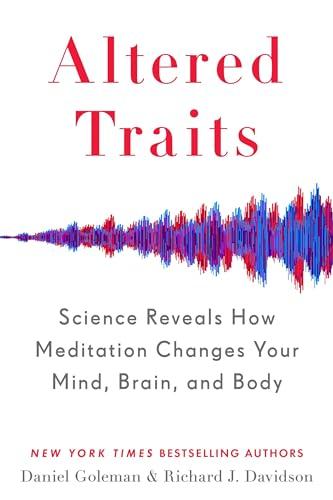
The book is called 'Altered Traits: Science Reveals How Meditation Changes Your Mind, Brain, and Body,' and no, I'm not going to try and convince you to meditate; I'm going to share with you a small passage in the book that relates some research data related to focus that are very important if you want to meditate; that's your choice; that's a separate matter.
Episode: How to Control Your Metabolism by Thyroid & Growth...
The book discussed how meditation changes the mind, brain, and body, and was highlighted for its discussion of how certain meditation types can access slow-wave sleep-like brain states.
it's really kind of interesting it's not focused on growth hormone but the book is called altered traits this is the book it's an excellent book altered traits by goleman and davidson science reveals how meditation changes your mind brain and body very interesting book for those of you they're interested in meditation and perhaps those of you who are not but are considering it they what they talk about in this book is the fact that meditation has two separate lines of effects one of those lines of effects are things that change your state so your stress you sit down you meditate and you relax and you go into a particular state the other are the changes that occur over time those are changes in trait so personality can actually change with long bouts of of TM meditation or repeated meditation in any case the reason we're talking about altered traits today is because certain types of meditation can get people's brains into states that very closely mimic slow wave sleep