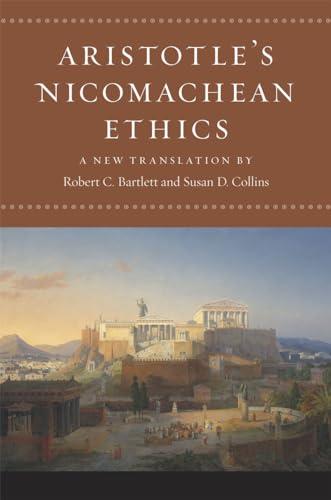

Aristotle's Nicomachean Ethics Cover
Podcast Mentions

Aristotle's Nicomachean Ethics

Aristotle

The

Podcasts 9
Quotes 22
The Ezra Klein Show

Brooks said he had taught Aristotle's Nicomachean Ethics for many weeks and learned a great deal from it.

"

Certainly, the Nicomachean Ethics, which I taught many, many times. 20 weeks, four hours a week, we barely finished.


— Episode: Timeless Wisdom for Leading a Life of Lo...

Episode: Timeless Wisdom for Leading a Life of Love, Friend...

Brooks said he had taught Aristotle's Nicomachean Ethics for many weeks and learned a great deal from it.

"

Certainly, the Nicomachean Ethics, which I taught many, many times. 20 weeks, four hours a week, we barely finished.

Freakonomics Radio

Jeff Sachs referred to Aristotle's Nicomachean Ethics, emphasizing the importance of a balanced and virtuous life that incorporates the fulfillment of material needs and a focus on relationships, mental and physical health, and good governance, rather than a singular pursuit of wealth.

"

I go with Aristotle. He's my guy. He's my favorite philosopher. And he pointed out in the Nicomachean Ethics 2,300 years ago that to be happy requires the good benefit of having material needs met.

— Episode: How to Be Happy (Rebroadcast)

Episode: How to Be Happy (Rebroadcast)

Jeff Sachs referred to Aristotle's Nicomachean Ethics, emphasizing the importance of a balanced and virtuous life that incorporates the fulfillment of material needs and a focus on relationships, mental and physical health, and good governance, rather than a singular pursuit of wealth.

"

I go with Aristotle. He's my guy. He's my favorite philosopher. And he pointed out in the Nicomachean Ethics 2,300 years ago that to be happy requires the good benefit of having material needs met.

Episode: 660. The Wellness Industry Is Gigantic — and Mostl...

The classic work was referenced to highlight Aristotle's focus on friendship and its relevance to a good life.

"

Aristotle knew this, right? Two books of his famous Nicomachean Ethics are devoted to friendship.

Hidden Brain

This book describes what it takes to be a flourishing human being, taking into account everything Aristotle knew. It includes the single-line summary of virtue being acquired through habit.

"

And his views about what it is to live a good life have survived in an extraordinary volume, basically, of lecture notes known as the Nicomachean Ethics.

— Episode: What Would Socrates Do?

Episode: What Would Socrates Do?

This book describes what it takes to be a flourishing human being, taking into account everything Aristotle knew. It includes the single-line summary of virtue being acquired through habit.

"

And his views about what it is to live a good life have survived in an extraordinary volume, basically, of lecture notes known as the Nicomachean Ethics.

He says that virtue is acquired through habit.

Modern Wisdom

Aristotle's ethics was praised as the most useful philosophy book even after 2000 years, with a realistic focus on virtues and friendship; the speaker urged listeners to get a copy of a good translation.

"

I would say, go on and get yourself a copy. They're great. There are some excellent translations. And the most recent Penguin one is an excellent translation. And Aristotle's ethics is, I think, one o...

— Episode: #1012 - Alex O’Connor & Joe Folley - Is...

Episode: #1012 - Alex O’Connor & Joe Folley - Is Being Smar...

Aristotle's ethics was praised as the most useful philosophy book even after 2000 years, with a realistic focus on virtues and friendship; the speaker urged listeners to get a copy of a good translation.

"

I would say, go on and get yourself a copy. They're great. There are some excellent translations. And the most recent Penguin one is an excellent translation. And Aristotle's ethics is, I think, one of its real strengths is that it's incredibly realistic.

Episode: #974 - Joe Folley - Existential Philosophy, Nietzs...

A chapter from this classic work was mentioned when comparing philosophical ideas to modern habitbuilding.

"

There's a chapter in Nicomachean Ethics that whenever I'm sort of teaching it, I occasionally go to speak at schools and teach things.

The Jordan B. Peterson Podcast

Aristotle's work was referenced many times throughout the podcast, including his ideas on friendship, contemplation, and the highest human good.

"

Aristotle writes that we're more garrious comes to the Greek word for flock that horses or bees right and that means and so it's this nature of man but then logos is not when we talk we can see you kn...

— Episode: 276. The Best of Conservative Education...

Episode: 276. The Best of Conservative Education | Larry P....

Aristotle's work was referenced many times throughout the podcast, including his ideas on friendship, contemplation, and the highest human good.

"

Aristotle writes that we're more garrious comes to the Greek word for flock that horses or bees right and that means and so it's this nature of man but then logos is not when we talk we can see you know how to get from A to B.

Aristotle says the younger particularly given to that their bodies are really great and getting better all the time.

In book 10 of the ethics he describes this beautiful activity and you have to become you have to get the moral virtues first you have to be courageous and you have to be moderate you have to be just and you have to be what you have to be wise.

Aristotle says if you're afraid of the bees buzzing around you you will not be capable of this you see it requires all the virtues and years of work.

the highest human activity in Aristotle is a secular version of the highest human activity or any religion communion with God and that's contemplation is called and it's hard to get your soul to state to be able to do that.

The Ben Shapiro Show

This book was referenced as the source for understanding the classical definition of courage. The speaker noted that Aristotle spent a significant amount of time defining what makes a person courageous in this work.

"

First of all, Aristotle's Nicomachean ethics. It's a book about virtue.

— Episode: Ep. 1271 -  For Biden, Being Transgender...

Episode: Ep. 1271 -  For Biden, Being Transgender Is The Ne...

This book was referenced as the source for understanding the classical definition of courage. The speaker noted that Aristotle spent a significant amount of time defining what makes a person courageous in this work.

"

First of all, Aristotle's Nicomachean ethics. It's a book about virtue.

Aristotle's idea of a good person later adopted by both Thomas Aquinas and Maimonides. His basic idea is instead that the way you become a good person is you cultivate virtues within you.

The Aristotelian definition of courage involves a few things.

which again is the point that Aristotle is making throughout Nicomachean ethics.

Philosophize This!

The book was referenced across multiple episodes as a source of philosophical insight. Stephen West expressed his love for learning about it and how it enriches his life, while the hosts quoted passages to illustrate Aristotle’s views on inductive versus deductive reasoning and the focus on means rather than ends. These mentions highlighted its relevance to understanding ethical deliberation, and the overall tone was positive and appreciative.

Episode: Episode #100 ... Heidegger pt. 1 - Phenomenology a...

The podcast briefly mentioned this book as an example of philosophy the speaker enjoys learning about, contrasting it with ontological questions. It was mentioned as an area of philosophy that enriches the speaker's life.

"

I love learning about the existentialists and their approach to life. I love learning about the Nicomachean ethics. That's interesting.

Episode: Episode #006 ... Aristotle Pt. 2

The narrator quotes Aristotle from the Nicomachean Ethics, discussing the relationship between inductive and deductive reasoning and the distinction between knowledge of fact and knowledge of reasoned fact.

"

We must suppose it to be mere theory

Episode: Episode #005 ... Aristotle Pt. 1

A quote from Book 3, Part 3, was used to illustrate Aristotle's concept of deliberation focusing on means rather than ends in achieving life goals.

"

We deliberate not about ends but about means. For a doctor does not deliberate whether he shall heal, Nor an orator whether he shall persuade, Nor a statesman whether he shall produce law and order...

No Stupid Questions

It was mentioned as a source of comfort for Jenny, suggesting that compared to Aristotle, everyone else is pretty awesome.

"

I will leave Jenny with one thought if she's looking for ammunition for why she's right to think that young people are terrible. This is from Aristotle who did his thinking many centuries ago. He wrot...

— Episode: 76. Why Can’t Baby Boomers and Millennia...

Episode: 76. Why Can’t Baby Boomers and Millennials Just Ge...

It was mentioned as a source of comfort for Jenny, suggesting that compared to Aristotle, everyone else is pretty awesome.

"

I will leave Jenny with one thought if she's looking for ammunition for why she's right to think that young people are terrible. This is from Aristotle who did his thinking many centuries ago. He wrote, And for the record, That is true. Aristotle wrote, Aristotle is really cranky. I think he's throwing everyone under the bus.

So I guess if Jenny wants to feel better, she should read some Aristotle and say that compared to him, everybody is actually pretty awesome. I think that's a good antidote.

Timothy Keller Sermons Podcast by Gospel in Life

Aristotle's Ethics was one of the first major books on ethics, and it had a huge section on self-control. Aristotle believed the only way to be a free and independent person was to have self-control.

"

Aristotle in his Ethics, and this is one of the very first major comprehensive books on ethics, had a huge section on self-control.

— Episode: Self-Control (Part 1)

Episode: Self-Control (Part 1)

Aristotle's Ethics was one of the first major books on ethics, and it had a huge section on self-control. Aristotle believed the only way to be a free and independent person was to have self-control.

"

Aristotle in his Ethics, and this is one of the very first major comprehensive books on ethics, had a huge section on self-control.

Note: The book recommendations on this page are discovered automatically from podcast transcripts, and may be incorrect or incomplete.