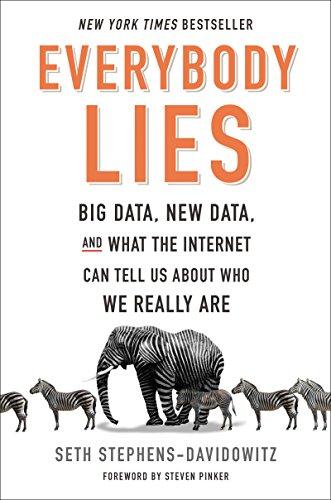
Everybody Lies: Big Data, New Data, and What the Internet Can Tell Us About Who We Really Are Cover
Podcast Mentions

Everybody Lies Big Data, New Data, and What the Internet Can Tell Us About Who We Really Are

Seth Stephens-Davidowitz

An Blending the informed analysis of

Podcasts 5
Quotes 33
Freakonomics Radio

It explored how Google searches reveal people's true selves and desires, contradicting what they say in surveys, and provided many examples of these behaviours, including searches related to sex, racism, and anxiety.

"

The book you've written is called Everybody Lies. Big Data, New Data and What the Internet Can Tell Us About Who We Really Are.

— Episode: 286. How Big is My Penis? (And Other Thi...

Episode: 286. How Big is My Penis? (And Other Things We Ask...

It explored how Google searches reveal people's true selves and desires, contradicting what they say in surveys, and provided many examples of these behaviours, including searches related to sex, racism, and anxiety.

"

The book you've written is called Everybody Lies. Big Data, New Data and What the Internet Can Tell Us About Who We Really Are.

The title that I wanted for my book was How Big Is My Penis? What Google Searches Reveal About Human Nature.

So it's not all Google data. I use data from anonymous and aggregate data from a porn hub. I scraped some websites. So I scraped a hate site, Stormfront. I scraped Wikipedia. I use some Facebook advertising data and some other sources.

You write in the book, the microscope showed us there is more to a drop of pond water than we think we see. The telescope showed us there's more to the night sky than we think we see. And new digital data now show us there's more to human society than we think we see.

Stevens-Davidowitz's book is stuffed with examples of the behaviors that, according to him, everybody lies about, especially on traditional surveys.
Hidden Brain

The book was highlighted for demonstrating how Google search data can predict community-level hate crimes, suicide rates, and reveal hidden thoughts that people rarely share. Host Shankar Vedantam and author Seth Stephens‑Davidowitz discussed its insights across several episodes, emphasizing its value for understanding human behavior through big data. Listeners were presented with the title as a key source for uncovering what people truly think but seldom say.

Highly Recommended

Episode: The Air We Breathe

It was discussed in the context of how big data from Google searches can predict things like hate crime rates and suicide rates within communities.

"

In his book, Everybody Lies, Seth explains how big data from Google searches can predict with great accuracy things like the suicide rate in a community or the chances that a hate crime will take place.

We've shown that you can predict hate crimes against Muslims based on searches people make.

People make very, very, very disturbing searches, searches such as kill Muslims or I hate Muslims.

And these searches can predict on a given week how many hate crimes there will be against Muslims.

But I think the right approach to this is not to target any particular individual to show up at the door of any particular individual who make these searches.

Episode: Radio Replay: The Mind of the Village

It was mentioned as an example of how big data from Google searches can be used to predict things like hate crimes in a community, based on the searches people are making.

"

In his book, Everybody Lies, Seth explains how big data from Google searches can predict with great accuracy things like the suicide rate in a community or the chances that a hate crime will take place.

We've shown that you can predict hate crimes against Muslims based on searches people make. People make very, very, very disturbing searches, searches such as kill Muslims or I hate Muslims. And these searches can predict on a given week how many hate crimes there will be against Muslims.

Episode: Radio Replay: I, Robot

It was discussed in detail throughout the podcast, and focuses on the insights big data can provide about human behavior based on online searches, contradicting what people often report in surveys.

"

He used to be a data scientist at Google, and he's the author of the book Everybody Lies, Big Data, New Data, and What the Internet Can Tell Us About Who We Really Are.

Seth Stevens-Davidowicz is a former Google data scientist and the author of Everybody Lies, Big Data, New Data, and What the Internet Can Tell Us About Who We Really Are.

Seth Stevens-Davidowitz is a former data scientist at Google and the author of the book Everybody Lies, Big Data, New Data, and What the Internet Can Tell Us About Who We Really Are.

Episode: In The Air We Breathe

It was discussed how big data from Google searches can be used to predict things like the suicide rate or the likelihood of hate crimes within a community, using Google search data as a way to assess the collective sentiment of a community.

"

We've shown that you can predict hate crimes against Muslims based on searches people make.

People make very, very, very disturbing searches. Searches such as kill Muslims or I hate Muslims and these searches can predict on a given week how many hate crimes there will be against Muslims.

But I think the right approach to this is not to target any particular individual to show up at the door of any particular individual who make these searches.

That's what you're really saying, that you're picking up on things that are in the ether, if you will, in the community that might not show up in the individual but are likely to show up in the aggregate.

Yeah, and I think you don't really know the reason that any particular person makes a search, right? Someone could be searching kill Muslims because they're doing research or they're just curious about something or they made a mistake in their typing.

Episode: Ep. 70: Who We Are At 2 A.M.

It was discussed as a source of information on how big data, and the internet, can reveal our deepest thoughts and secrets, particularly things we wouldn't say out loud.

"

He's the author of the book Everybody Lies, Big Data, New Data, and What the Internet Can Tell Us About Who We Really Are.

Seth Stevens-Davidowitz is a former data scientist at Google and the author of the book Everybody Lies, Big Data, New Data, and What the Internet Can Tell Us About Who We Really Are.

Modern Wisdom

The book was highlighted as a seminal work that revealed how people disclose information to Google that they hide from friends, partners, or even themselves. Hosts Rudyard Lynch, Chris, Alex, and Richard each referenced it when discussing how market research can be misleading, data‑driven personal optimization, and the contrast between stated preferences and actual behavior. The overall tone was enthusiastic, presenting it as a must‑read for understanding hidden human psychology.

Highly Recommended

Episode: #735 - Rory Sutherland - Hidden Psychology Of The...

The book was mentioned in reference to the idea that people don't always say what they think, and that market research can sometimes be misleading. It was suggested that the book could provide insights into engagement rings and their history.

"

Did you read Seth Stevens Davidowitz's book, Everybody Lies?

Episode: #832 - Rudyard Lynch - Is This The Most Absurd Tim...

It was described as a great book whose thesis is that people tell Google things they don't even tell their partner, their friends, or sometimes themselves.

"

Did you ever read Everybody Lies by Seth Stevens?

So basically the thesis is that people tell Google things that they don't even tell their partner, their friends, or sometimes themselves.

Episode: #593 - Alex DatePsych - Why Is No One Having Sex?

The book was listed as one of the works by Seth StephensDavidowitz that the host had on the show, illustrating datadriven personal appearance optimization.

"

I had a Seth StephensDavidowitz on the show who wrote Everybody Lies and Don't Trust Your Gut.

Episode: #592 - Richard Shotton - 8 Fascinating Psychologic...

They noted it was the first book that uncovered surprising data about people's true preferences versus what they say, and referenced the author's newer work.

"

Everybody Lies was the first one. And then his most recent book ... Don't trust your gut.

Episode: #548 - Tim Harford - Why Is Thinking Clearly So Di...

He described the book as interesting for showing how Google searches reveal true interests while Facebook posts reflect selfpresentation, using relationshiprelated examples.

"

But Everybody Lies, I thought was really interesting that, that kind of insight that what people type into Facebook and what people type into Google are different. And what people type into Google tells you what they really want to know.

Habits and Hustle

Tony Robbins mentioned the book in two episodes, noting that it was written by a Google engineer and highlighted its claim that people lie in face‑to‑face interactions while Google searches reveal the truth. He pointed out that the title explores surprising search trends and how big data can expose hidden aspects of human behavior. The discussion was brief and informational rather than a strong endorsement.

Episode: Episode 409: Sarah Jane Ho: Mastering Etiquette fo...

They mentioned the book as being written by a Google engineer and noted its claim that everyone lies when asked facetoface, whereas Google search never lies.

"

And you would be surprised that, okay, so there's this book and it's called Everybody Lies and it's written by a Google engineer. And he says, everybody lies if you ask them face to face, but Google search never lies.

Episode: Episode 335: Sara Jane Ho: Netflix’s “Mind Your Ma...

The conversation noted that Everybody Lies is a book written by a Google engineer that discusses surprising search trends.

"

and it's called Everybody Lies

and it's written by a Google engineer

The Jordan Harbinger Show

It was mentioned as an example of how Google search data can be used to predict and track diseases, specifically in relation to the loss of smell as a symptom of COVID-19.

"

a guy named Seth Stevens-Davidowitz who's a data scientist and a Google alum and a best-selling author or your best-selling author who's done very well has got a great book called Everybody Lies

— Episode: 510: Rob Reid | Why the Future is a Good...

Episode: 510: Rob Reid | Why the Future is a Good Kind of S...

It was mentioned as an example of how Google search data can be used to predict and track diseases, specifically in relation to the loss of smell as a symptom of COVID-19.

"

a guy named Seth Stevens-Davidowitz who's a data scientist and a Google alum and a best-selling author or your best-selling author who's done very well has got a great book called Everybody Lies

Episode: 510: Rob Reid | Why the Future is a Good Kind of S...

It was mentioned as a book written by a data scientist and Google alum. The author used Google search data to plot a correlation between people searching 'I can't smell' and the prevalence of COVID.

"

a guy named Seth Stevens Davidowitz who's a data scientist and a Google alum and a best-selling author or your best-selling author who's done very well has got a great book called Everybody Lies

Note: The book recommendations on this page are discovered automatically from podcast transcripts, and may be incorrect or incomplete.