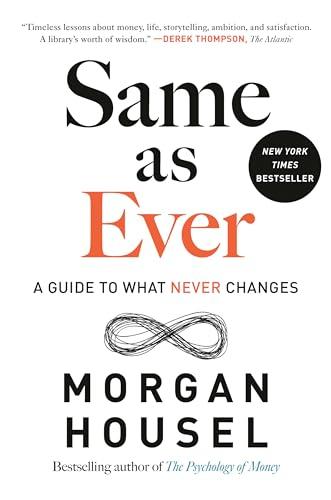
Same as Ever: A Guide to What Never Changes was an instant bestseller and explored the things that never change. It was discussed in the context of investing, the importance of being aware of the unpredictability of the world and the role of emotions in decision-making.
"
The second, last month's Same as Ever, was an instant bestseller and explores the things that never change.
You have a new book, which I think is super interesting for a lot of reasons. It's called Same as Ever, A Guide to What Never Changes.
I try to keep two things in mind in a world that's vulnerable to chance and accident. One is highlighting this book's premise to base predictions on how people behave rather than on specific events.
Predicting what the world will look like 50 years from now is impossible, but predicting that people will still respond to greed, fear, opportunity, exploitation, risk, uncertainty, tribal affiliations and social persuasion in the same way is a bet I'd take.
Forecasting events is hard because it's easy to skip the question, and then what?
You've also commented on this debate and it's confusing to me. I don't know how to think about it. So lots of experts talk about data and evidence and that's how they make their decisions.
But people also talk about stories, right? And narratives and anecdotes. And someone once pointed out that Jeff Bezos has suggested that when anecdotes and data disagree, the anecdotes are usually right.
You've also written, I think that generally speaking, and although you're not a psychologist, you have the word psychology in one of your two books, that if you were generally unhappy before you had money, you're going to probably be unhappy after you have money.
And the reverse is also true. Do you stand by that?