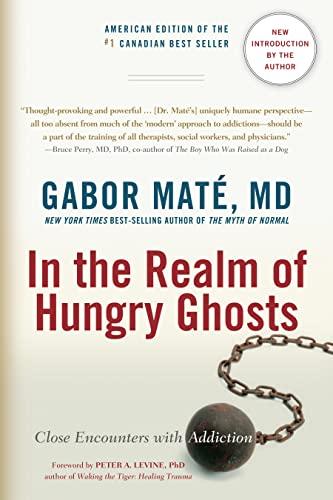
In the Realm of Hungry Ghosts: Close Encounters with Addiction Cover
Podcast Mentions

In the Realm of Hungry Ghosts Close Encounters with Addiction

Gabor Mate Md

A “thought-provoking and powerful” study that reframes everything you’ve been taught about addiction and recovery—from the

Podcasts 7
Quotes 15
The Mel Robbins Podcast

Mel referenced Gabor Mat's book Hungry Ghosts while discussing his personal struggles, indicating it as a source of his insights.

"

And you mention your own struggles in your book, Hungry Ghosts, you mention your own struggles.
— Episode: Dr. Gabor Maté: The Shocking Link Betwee...

Episode: Dr. Gabor Maté: The Shocking Link Between ADHD, Ad...

Mel referenced Gabor Mat's book Hungry Ghosts while discussing his personal struggles, indicating it as a source of his insights.

"

And you mention your own struggles in your book, Hungry Ghosts, you mention your own struggles.
Behind the Bastards

It was mentioned as a book about famine in the Soviet Union that discussed Lysenko's impact on agricultural practices and food shortages.

"

All these ideas helped transform a rich farming nation into one beset by permanent food shortages.

— Episode: Part One: The Russian Scientist Who Help...

Episode: Part One: The Russian Scientist Who Helped Kill 30...

It was mentioned as a book about famine in the Soviet Union that discussed Lysenko's impact on agricultural practices and food shortages.

"

All these ideas helped transform a rich farming nation into one beset by permanent food shortages.

On the collectives, farmers could use neither chemical fertilizers nor the hybrid corn that America was using to boost yields by 30 percent. Lysenko didn't believe you should use fertilizers either at all.

Furthermore, the fields were left fallow most of the time. And when the crops were sown, the vernalized wheat did not sprout. Nor did Lysenko's frost-resistant wheat and rye seeds or the potatoes grown in summer or the sugar beets planted in the hot plains of Central Asia. They all rotted.

Another hero of the Lysenko school was the son of an American engineer, Facile Williams, who became a professor at the Moscow Agricultural Academy. Williams thought that capitalism and American-style commercial farming based on the application of chemical fertilizers were taking the world to the brink of catastrophe.

Episode: Part One: The Russian Scientist Who Helped Kill 30...

The podcast mentioned the book as a source about famine, including the impact of Lysenko's agricultural theories on the Soviet Union, and how it transformed a rich farming nation into one with permanent food shortages.

"

All these ideas helped transform a rich farming nation into one beset by permanent food shortages.

On the collectives, farmers could use neither chemical fertilizers nor the hybrid corn that America was using to boost yields by 30 percent.

Furthermore, their fields were left fallow most of the time. And when the crops were sown, the vernalized wheat did not sprout. Nor did Lysenko's frost resistant wheat and rye seeds or the potatoes grown in summer or the sugar beets planted in the hot plains of Central Asia. They all rotted.

Another hero of the Lysenko school was the son of an American engineer, Facile Williams, who became a professor at the Moscow Agricultural Academy. Williams thought that capitalism and American style commercial farming based on the application of chemical fertilizers were taking the world to the brink of catastrophe.

Armchair Expert with Dax Shepard

It was highlighted as his previous book focused heavily on addiction, drawing from his experiences on Vancouver's downtown east side.

"

Your last book, In the Realm of Hungry Ghosts, that's very addiction heavy in that book.

— Episode: Gabor Maté (on trauma & addiction)

Episode: Gabor Maté (on trauma & addiction)

It was highlighted as his previous book focused heavily on addiction, drawing from his experiences on Vancouver's downtown east side.

"

Your last book, In the Realm of Hungry Ghosts, that's very addiction heavy in that book.

10% Happier with Dan Harris

He argues that addiction is not an inherited disease, or a disease at all, and certainly not a choice, but a response to trauma.

"

my book on addiction is called in the realm of hungry ghosts close encounters over the addiction in which I point out that addiction is not an inherited disease or a disease at all and certainly not a...

— Episode: Modern Life Is Making You Sick, But It D...

Episode: Modern Life Is Making You Sick, But It Doesn’t Hav...

He argues that addiction is not an inherited disease, or a disease at all, and certainly not a choice, but a response to trauma.

"

my book on addiction is called in the realm of hungry ghosts close encounters over the addiction in which I point out that addiction is not an inherited disease or a disease at all and certainly not a choice but it's a response to trauma

Episode: Modern Life Is Making You Sick, but It Doesn’t Hav...

In his book on addiction, Dr. Mat argued that addiction is not a disease or a choice but a response to trauma.

"

My book on addiction is called in the realm of hungry ghosts, close encounters with addiction, which I point out that addiction is not an inherited disease or a disease at all and certainly not a choice but it's a response to trauma

The Bobby Bones Show

A book about addiction, it blends personal stories of addicts with scientific analysis of addiction's causes. One host found it deeply impactful and emotionally resonant.

"

It's called in the realm of ghosts and it's in right now in the realm of hungry ghosts is what it's called and it's all about addiction and this guy who was a he is a doctor and he worked at a clinic...

— Episode: Tuesday Post Show (2-13-24)

Episode: Tuesday Post Show (2-13-24)

A book about addiction, it blends personal stories of addicts with scientific analysis of addiction's causes. One host found it deeply impactful and emotionally resonant.

"

It's called in the realm of ghosts and it's in right now in the realm of hungry ghosts is what it's called and it's all about addiction and this guy who was a he is a doctor and he worked at a clinic and Where that he works work a lot of addicts and then right now it's in the science part of it where it's all about neurotransmitters, you know and Like the science behind fiction. No, no. No, this is I'll go fiction on oh, you're back to I'm doing that. Yeah and it's like All the drugs that we have are all really based in a plant a chemical that people had found and you know hundreds and hundreds of years ago in Certain parts of the world they would chew the cocoa leaves because they if they had to go on long voyages They needed something to keep them from being hungry and give them energy Oh, wow, but we have figured out a way to make it into cocaine which then goes and you know What happens whenever you know the happy chemical? With that. Yeah. I know you know what that is. You know, it's happy. Come on. I mean trip to me Yeah, I was gonna ask him. Yes. All right. No, that's right. Oh, oh, I thought you were just calling it the happy chemical Dopamine dopamine it talks about how some people's brains You know because addiction is a disease and how some people's brain chemistry Like it takes one time and it's like injured Injured brain matter and some brains are more susceptible to addiction and they go and they talk about all a lot of the people in the Vietnam War were doing a lot of heroin just like feel okay It was being opioids past like soldiers and that like 8% came back addicted of those that did it and that everyone doesn't have that addictive either the brain isn't Predisposed to having that condition or they didn't do it so much but it's just that and at times it's really good But at times I feel like I'm learning it's 800 pages. I Didn't know it was 800 pages. That's a lot. It's good So will you what if you just decide to move on? Let me read you I won't do it You have to know I'll suffer. Yeah, I'll suffer it out. I'm not suffering. It's good I just hate the number at the bottom of the page that says, you know 312 of 850 Here you go It's the real-life story of addicts who are so often denied the space to do so alongside science-based analysis of why people get addicted It's really great My therapist is who recommended it to me. It helps would help people have more compassion for absolutely To me when I started reading it, I started to feel It hit really really like close to home like it felt like someone was punching a bruise I didn't know I had like a spot but yeah, it's called in the realm of hungry ghosts and It's hardcore.

On Being with Krista Tippett

It was praised for its storytelling, which intersected themes of race, community, social change, failure, and insecurity. One listener described it as the story of their life.

"

He said that he picked up Ghost just a couple of years ago and was immediately drawn by the way you told stories that intersected themes of race, community, social change, failure, insecurity, etc. He...

— Episode: Jason Reynolds — Imagination and Fortitu...

Episode: Jason Reynolds — Imagination and Fortitude

It was praised for its storytelling, which intersected themes of race, community, social change, failure, and insecurity. One listener described it as the story of their life.

"

He said that he picked up Ghost just a couple of years ago and was immediately drawn by the way you told stories that intersected themes of race, community, social change, failure, insecurity, etc. He said it was the story of my life.

Episode: [Unedited] Jason Reynolds with Krista Tippett

It was praised for its storytelling, intersecting themes of race, community, social change, failure, and insecurity; it resonated deeply with a young man who found it reflected his own life experiences.

"

He said it was the story of my life

Note: The book recommendations on this page are discovered automatically from podcast transcripts, and may be incorrect or incomplete.