Slow Productivity: The Lost Art of Accomplishment Without Burnout Cover
Podcast Mentions

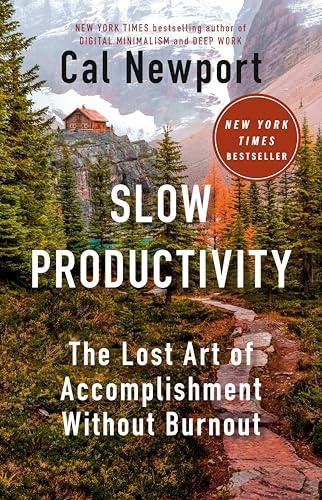
Slow Productivity The Lost Art of Accomplishment Without Burnout

Cal Newport

A Our current definition of “productivity” is broken. It pushes us to treat busyness as a proxy for useful effort, leading to impossibly lengthy task lists and ceaseless meetings. We’re overwhelmed by all we have to do and on the edge of burnout, left to decide between giving into soul-sapping hust...

Podcasts 10
Quotes 39
Huberman Lab

The book focuses on avoiding burnout and achieving high-quality work over a long period of time.

"

Cal also has a new book out now, it's one that I'm currently reading, entitled Slow Productivity, The Lost Art of Accomplishment Without Burnout.

— Episode: Dr. Cal Newport: How to Enhance Focus an...

Episode: Dr. Cal Newport: How to Enhance Focus and Improve...

The book focuses on avoiding burnout and achieving high-quality work over a long period of time.

"

Cal also has a new book out now, it's one that I'm currently reading, entitled Slow Productivity, The Lost Art of Accomplishment Without Burnout.

And as the title suggests, it gets into specific protocols to avoid burnout and to bring about one's highest quality work over the greatest amount of time.
The Mel Robbins Podcast

Cal Newport's latest book, Slow Productivity, The Lost Art of Accomplishment Without Burnout, was highlighted as his newest bestseller and read from during the episode.

"

Cal himself has authored eight bestselling books, including his latest work, Slow Productivity, The Lost Art of Accomplishment Without Burnout.

— Episode: How to Get Things Done, Stay Focused, an...

Episode: How to Get Things Done, Stay Focused, and Be More...

Cal Newport's latest book, Slow Productivity, The Lost Art of Accomplishment Without Burnout, was highlighted as his newest bestseller and read from during the episode.

"

Cal himself has authored eight bestselling books, including his latest work, Slow Productivity, The Lost Art of Accomplishment Without Burnout.

I'm going to read you from your book, Slow Productivity. This is on page 59, and it's in the section where you're really unpacking this concept of do fewer things.

Everybody get out there and get this incredible bestselling book, slow productivity, the lost art of accomplishment without burnout.

10% Happier with Dan Harris

Cal Newport discussed his most recent book Slow Productivity, and the core principles within it: do fewer things, work at a natural pace, and obsess over quality.

"

His latest book and the reason for his return is called slow productivity in this conversation. We talk about how we got into this mess a mess that he calls overload culture, the difference between ps...

— Episode: How To Be Productive Without Burning Out...

Episode: How To Be Productive Without Burning Out | Cal New...

Cal Newport discussed his most recent book Slow Productivity, and the core principles within it: do fewer things, work at a natural pace, and obsess over quality.

"

His latest book and the reason for his return is called slow productivity in this conversation. We talk about how we got into this mess a mess that he calls overload culture, the difference between pseudo productivity and slow productivity and the three tenants of slow productivity do fewer things work at a natural pace and obsess over quality.

You take on and this is where we're saying sort of obviously take on less take on less big projects have fewer big projects that you're trying to do better contain the small says how do you deal with all the other small stuff that's a part of life the stuff that Georgia O'Keefe and like George and after worry about the emails the meetings the HR department needs you to fill this or that out and there are all detectors I give are around containment.

The answer more generally is we need alternative definitions to pseudo productivity and I'm pretty clear in the conclusion of the book we're going to need a lot of those answers like so the important thing here is not trying to find some exact answer because as we've navigated throughout this interview a different philosophies will apply here, here, and here kind of here, not there. This philosophy will apply here, here, and here, and not there. But what we need, what everyone who's overloaded needed is a recognition that what we're doing now is not working. This implicit understanding of I don't know activity just means useful effort. That's not working. And we have to stand up and say let's be clear about what we want to do instead and let's name it and let's give principles to it and let's talk about it. And for a lot of people it might be slow productivity for other people. It might be a completely different thing, but clarity is what's needed here. We can no longer just sort of assume we all intuitively know what productivity means and work is just work. We have to be clear about productivity if we want to solve our issues with it. And so slow productivity is just as much about a particular philosophy that might help you as it is a tip of a bigger movement that hopefully will generate many more philosophies each of them much more intentional and much more humanistic than simply pseudo-productivity and effort for the sake of effort.

Well, the new book is Slow Productivity, the Lost Art of Accomplishment without Burnout and I've also written Deep Work, Digital Minimalism, a World Without Email.

The Prof G Pod with Scott Galloway

The book was highlighted as a framework for achieving meaningful work without burnout, with Scott introducing Cal's ideas about reducing constant task-switching and the potential of AI to ease administrative burdens. In a later interview, Cal explained that "slow productivity" counters the unsustainable "pseudo productivity" of modern knowledge work, emphasizing depth over busyness. Both hosts endorsed the book as a valuable guide for sustainable productivity.

Highly Recommended

Episode: Conversation with Claire Hughes Johnson — Building...

The book argues for a more mindful approach to work, aiming to achieve productivity without experiencing burnout, and discusses the potential impact of AI on work.

"

Cal Newport, a professor of computer science at Georgetown University and author of Slow Productivity, The Lost Art of Accomplishment Without Burnout.

This is a big part of my thinking about digital knowledge work is the degree to which the humans have to keep switching our attention back and forth between many different administrative overhead tasks, so emails and chats and meetings and forms. And so I'm interested in what the impact of AI is going to have there because there is an optimistic scenario in which it could take a significant amount of that off the plate of the average knowledge worker. That would be a huge impact. I think we underestimate the degree to which we are reducing the cognitive and productive capacity of knowledge workers by forcing them to be in this continual state of constantly switching our attention back and forth, the servicing all these different administrative tasks. So if you could offload that, that could be a major productivity boon. And I mean productivity in the economic macro sense of just looking at the whole sector itself and dollars produced per worker in the sector. That could be a huge boon.

Episode: Conversation with Cal Newport — The Key to Product...

Cal Newport discusses "slow productivity" as an alternative to the current understanding of productivity, which he calls "pseudo productivity."

"

In your new book, Slow Productivity, the Lost Art of Accomplishment Without Burnout, you share your philosophy for creating great work at a sustainable pace.

Slow productivity is an alternative to that because my argument is that might have been okay for a while, but it really began to falter when combined with the front office IT revolution that picked up steam in the late 90s, pseudo productivity became less sustainable.

I think this is absolutely right. When we focus on activity, we really narrow what work can really mean, what successful work can really mean.

So I think a trap that people get in is that during this period of busyness, they focus it on things that aren't actually pushing forward their value to the market.

His latest book, Slow Productivity, the Lost Art of Accomplishment without burnout is out now.

Money Rehab with Nicole Lapin

Nicole Lapin mentions that her third book was about burnout, and that she may write a second part focusing on mental health to improve success in career and life.

"

My third book, as you might know, was focused all around burnout. This was an area that I didn't look into potentially there's a part two of it.

— Episode: Why Silicon Valley is Obsessed with Micr...

Episode: Why Silicon Valley is Obsessed with Microdosing

Nicole Lapin mentions that her third book was about burnout, and that she may write a second part focusing on mental health to improve success in career and life.

"

My third book, as you might know, was focused all around burnout. This was an area that I didn't look into potentially there's a part two of it.

Young and Profiting with Hala Taha

It was introduced as his latest book that outlines three principles for sustainable productivity: doing fewer things, working at a natural pace, and obsessing over quality.

"

His latest book, Slow Productivity, has sold millions of copies and been translated into over forty languages.

— Episode: Cal Newport: How Entrepreneurs Can Cut D...

Episode: Cal Newport: How Entrepreneurs Can Cut Distraction...

It was introduced as his latest book that outlines three principles for sustainable productivity: doing fewer things, working at a natural pace, and obsessing over quality.

"

His latest book, Slow Productivity, has sold millions of copies and been translated into over forty languages.

Back when you released Deep Work in 2016, and now you've got a newly released book called Slow Productivity, which I really, really enjoyed getting to read.

My most recent book, Slow Productivity, really gets into this.

The three principles of Slow Productivity are do fewer things, work at a natural pace, and obsess over quality.

I love this. It's the fastest way to get people to slow down and focus on depth.

The Learning Leader Show With Ryan Hawk

Cal Newport's newest title, Slow Productivity, was presented as a guide to the lost art of accomplishment, emphasizing quality over speed.

"

Professor and the author Slow Productivity, The Lost Art of Accomplishment.

— Episode: 582: Cal Newport - Obsess Over Quality,...

Episode: 582: Cal Newport - Obsess Over Quality, Create Tim...

Cal Newport's newest title, Slow Productivity, was presented as a guide to the lost art of accomplishment, emphasizing quality over speed.

"

Professor and the author Slow Productivity, The Lost Art of Accomplishment.

Some of my favorite books that he's written are So Good They Can't Ignore You, Deep Work, and his latest is called Slow Productivity.

It's called slow productivity, the lost art of accomplishment without burnout.

So, you know, I really think making craft and quality at the center of how you think about your work, especially if you have a lot of autonomy is the recipe for like a much more meaningful professional life in this portion of your book, slow productivity, when you're writing about obsessing over quality.

The Jordan Harbinger Show

It was discussed how Cal Newport's book, 'Slow Productivity', captures the growing sentiment that people are fed up with doing more. The book offers an alternative definition to "pseudo productivity" and suggests that we should aim to accomplish fewer things and obsess over quality.

"

Yeah, I mean I think people aren't anti-productivity really so much as their anti-overlook, this idea of I have too much to do which doesn't just mean I'm really busy because I have a lot of things to...

— Episode: 975: Cal Newport | Reclaiming Time and F...

Episode: 975: Cal Newport | Reclaiming Time and Focus with...

It was discussed how Cal Newport's book, 'Slow Productivity', captures the growing sentiment that people are fed up with doing more. The book offers an alternative definition to "pseudo productivity" and suggests that we should aim to accomplish fewer things and obsess over quality.

"

Yeah, I mean I think people aren't anti-productivity really so much as their anti-overlook, this idea of I have too much to do which doesn't just mean I'm really busy because I have a lot of things to do but it also means that the administrative overhead that comes with each of these tasks is now starting to pile up to the point where I'm barely actually making progress on any work like the state of overload is uniquely deranging and I think the pandemic put a lot of knowledge workers into that mode and they personify that frustration by saying well you know screw your productivity right because I mean you think about loosely what is productivity I don't know like trying to do more like trying to produce more and more is the absolute less thing I need so I mean I think the pandemic a lot of people had your same experience which is overload got to a place where its side effects became intolerable something has to change the hard part was figuring out what but I think most people agreed something had to change.

And I think you're you sort of captured that in this latest book is like people are fed up with doing more.

I mean it makes all of the difference. It's a light switch difference in both what you're producing, but in just the subjective well-being you experience while working. Like getting fewer things on your plate at once is like the biggest positive change you could make in your knowledge work life.

And I think that's as important of a consequence of what I'm trying to do as even the details of my particular pitch is break people out of this mold teach the fish what water is hey pseudo productivity is not destiny and in fact it's a pretty terrible way to organize cognitive labor like let's start thinking of alternatives.

Slow productivity is a alternative definition to pseudo productivity but probably the larger project here is to have alternative definitions writ large and there could be many of them but just to get people thinking what is my definition of productivity what are its principles how do I pursue it like to have a menu that's not just you should be jumping off and on calls about funnel marketing or whatever like have options that are not just pseudo productivity that I think that's as important of a consequence of what I'm trying to do as even the details of my particular pitch is break people out of this mold teach the fish what water is hey pseudo productivity is not destiny and in fact it's a pretty terrible way to organize cognitive labor like let's start thinking of alternatives.

On with Kara Swisher

Haidt recommends this book by Cal Newport to his college students to help them improve their focus and regain control of their attention. It was mentioned alongside 'Deep Work' as a helpful resource in managing phone usage and improving focus.

"

Cal Newport has these wonderful books, Deep Work, Slow Productivity.

— Episode: Kids and Phones: Moral Panic or Time to...

Episode: Kids and Phones: Moral Panic or Time to Panic? wit...

Haidt recommends this book by Cal Newport to his college students to help them improve their focus and regain control of their attention. It was mentioned alongside 'Deep Work' as a helpful resource in managing phone usage and improving focus.

"

Cal Newport has these wonderful books, Deep Work, Slow Productivity.

The Daily Stoic

Cal Newport's book was discussed in relation to the benefits of walking and productivity.

"

And actually I had Cal Newport on the podcast recently and we were talking about his book Slow Productivity, and I asked him specifically about the relationship between productivity and walking.

— Episode: Listen To Your Own Soul’s Warning | Cal...

Episode: Listen To Your Own Soul’s Warning | Cal Newport On...

Cal Newport's book was discussed in relation to the benefits of walking and productivity.

"

And actually I had Cal Newport on the podcast recently and we were talking about his book Slow Productivity, and I asked him specifically about the relationship between productivity and walking.

Episode: Richard Dawkins’ Perspective on Faith, Philosophy,...

Someone was reading this book at Krause Springs, which the host thought was the perfect place to be reading it.

"

Someone was reading Cal Newport's book, Slow Productivity, which I just thought was the absolute perfect place to be doing that.

Episode: Seasonality and Understanding Pseudo-Productivity...

The podcast discussed Cal Newport's book, "Slow Productivity," focusing on its concepts of accomplishment without burnout, autopilot, indispensability, and seasonality in work and life. The discussion highlighted the importance of prioritizing deep work and identifying the most impactful tasks.

"

Cal always does subtitles well.

We talked about Slow Productivity. We talked about autopilot. We talked about how to be indispensable. When to take that big swing when to really bet on yourself at use the leverage you've accumulated. And then we talked about pseudo productivity in the thing.

There's a time and place you go through phases. You're not just doing the same thing every day, which is more my style. And I think Cal really spoke well about seasonality.

His book Slow Productivity, Digital Minimalism, Deep Work and one of my favorites so good they can't ignore you.

Episode: Slow Productivity and Anticipating Consequences |...

Ryan Holiday discussed Cal Newport's book, "Slow Productivity: The Lost Art of Accomplishment Without Burnout." He mentioned enjoying the book and highlighted stories within it about John McFee, a favorite author of his.

"

Cal came out to the bookstore to do the podcast, he's on tour for his incredible new book, Slow Productivity which I absolutely loved. The subtitle is The Lost Art of Accomplishment Without Burnout and by the way some great stories in this book about John McFee who was one of my all time favorite authors.

Note: The book recommendations on this page are discovered automatically from podcast transcripts, and may be incorrect or incomplete.