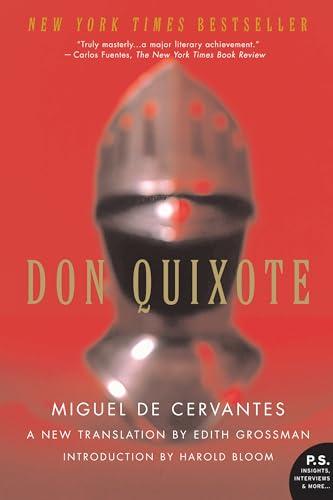

Don Quixote Cover
Podcast Mentions

Don Quixote

Miguel de Cervantes

Edith Grossman's definitive English translation of the Spanish masterpiece, in an expanded P.S. edition Widely regarded as one of the funniest and most tragic books ever written,

Podcasts 11
Quotes 17
Huberman Lab

Asi Wind mentioned this book as one of his favorites. He specifically references a quote about perfection in writing, which relates to his own views on magic, highlighting the importance of believable, restrained exaggeration.

"

i quote servantess from donkey holly about magic you know someone wrote a book in the 1600s and he talks about the two what we like to call the two impossible theory not the two perfect theory the two...

— Episode: Asi Wind: What Magic & Mind Reading Reve...

Episode: Asi Wind: What Magic & Mind Reading Reveal About t...

Asi Wind mentioned this book as one of his favorites. He specifically references a quote about perfection in writing, which relates to his own views on magic, highlighting the importance of believable, restrained exaggeration.

"

i quote servantess from donkey holly about magic you know someone wrote a book in the 1600s and he talks about the two what we like to call the two impossible theory not the two perfect theory the two impossible theory and he talks about that perfection in writing is is restraining exaggeration and it's a whole paragraph about that art needs to be believable there has to be truth in it to be enjoyed so and it's so much true for magic i can't just even when we do something that's impossible i still want the ground to be plausible maybe maybe this could happen therefore i need to restrain exaggeration i need to restrain the impossibility and that again this is a novel from the 1600s donkey over my favorite book of all time teaching us about magic

Pardon My Take

The hosts referenced the book when comparing a futile challenge to the protagonist's impossible quest, using it as a metaphor for battling the Patriots' dominance. One host also noted they had begun the audiobook but were still deciding how to approach the chapters. Both mentions were light‑hearted and did not constitute a formal endorsement.

Episode: Clayton Kershaw, Joakim Noah In Studio, CFP Rankin...

The speaker mentioned starting the audiobook version of the book but then reconsidered that format and planned to dive into some chapters soon.

"

Hank, what do you think about Don Quixote? Have you started reading it yet? I got a... You guys said audiobook didn't count. Yeah. So I started audiobook, reconsidered that. We're going to dive into some chapters soon, maybe.

Episode: NFL Championship Sunday, Patriots Are All The Way...

The speaker referenced this book when suggesting that fighting against the inevitable success of the New England Patriots was like dreaming the impossible dream, referencing the character's story.

"

That's another Don Quixote reference, Hank. I'm sure you've finished that book by now because it's been so long.

Conan O’Brien Needs A Friend

They compared the characters in their shows to Don Quixote, noting that the characters fully believe in themselves and are on a quixotic quest.

"

Don Quixotes they're ... on this quest ... I think one of the things that makes Don Quixote ... compelling ... is that the character fully believes it ... the character is completely invested ...

— Episode: Danny McBride

Episode: Danny McBride

They compared the characters in their shows to Don Quixote, noting that the characters fully believe in themselves and are on a quixotic quest.

"

Don Quixotes they're ... on this quest ... I think one of the things that makes Don Quixote ... compelling ... is that the character fully believes it ... the character is completely invested ...

The Ezra Klein Show

The book was highlighted as a foundational masterpiece in the novel form, with particular praise for its recent translation by Edith Grossman that made it especially accessible to English readers. Salman Rushdie recommended it for many listeners, noting its enduring significance. The hosts conveyed strong enthusiasm, presenting it as a must‑read classic.

Highly Recommended

Episode: Best Of: Salman Rushdie Is Not Who You Think He Is

It was recommended as a classic masterpiece, especially in Edith Grossman's new translation.

"

I would recommend Don Quixote for many people, the first great masterpiece in the novel form, especially because there's now a wonderful new translation of it by Edith Grossman.

Episode: Salman Rushdie Is Not Who You Think He Is

Rushdie recommended Don Quixote as a seminal novel, highlighting Edith Grossman's vivid new translation that makes it highly accessible.

"

So I would recommend Don Quixote for many people, the first great masterpiece in the novel form... and there's now a wonderful new translation of it by Edith Grossman, which makes it very accessible to English readers.

Episode: Wilco’s Jeff Tweedy Wants You to Be Bad at Somethi...

Ezra called it a lifeaffirming classic that explains a lot about the world and said it was one of the three books he would recommend.

"

The book that I feel embarrassed to say it again because it's almost always the book that comes to mind is Don Quixote. I just think that it explains a lot about the world... it's kind of lifeaffirming and sad at the same time.

The Rest Is History

Don Quixote was listed among classic works referenced during the book discussion.

"

So you've got Don Quixote and all kind of things.

— Episode: 309: Columbus: Villain or Hero? (Part 4)

Episode: 309: Columbus: Villain or Hero? (Part 4)

Don Quixote was listed among classic works referenced during the book discussion.

"

So you've got Don Quixote and all kind of things.

Office Ladies

It was discussed as the top-selling fiction book, having sold approximately 500 million copies and translated into 145 languages, and was mentioned as a book the co-host had to read for a college class.

"

It is Don Quixote by Cervantes. And it was published in 1605. It has sold approximately 500 million copies, and it has been translated into 145 languages. I had to read Don Quixote, by the way, in my...

— Episode: Mafia

Episode: Mafia

It was discussed as the top-selling fiction book, having sold approximately 500 million copies and translated into 145 languages, and was mentioned as a book the co-host had to read for a college class.

"

It is Don Quixote by Cervantes. And it was published in 1605. It has sold approximately 500 million copies, and it has been translated into 145 languages. I had to read Don Quixote, by the way, in my college Spanish class.

Behind the Bastards

It was discussed in the context of Jordan Peterson's views, with the hosts mentioning that Cervantes wrote it as a critique of simplistic stories about medieval knights, a genre that Peterson's worldview appears to be based on.

"

It's really funny to me because Cervantes... if you look up like what the author why he wrote Don Quixote, it was because he was really pissed at the popular fiction that existed at the day, which was...

— Episode: Part Two: Robert and Cody Watch Jordan B...

Episode: Part Two: Robert and Cody Watch Jordan B. Peterson...

It was discussed in the context of Jordan Peterson's views, with the hosts mentioning that Cervantes wrote it as a critique of simplistic stories about medieval knights, a genre that Peterson's worldview appears to be based on.

"

It's really funny to me because Cervantes... if you look up like what the author why he wrote Don Quixote, it was because he was really pissed at the popular fiction that existed at the day, which was mostly these like really shitty and derivative stories of like medieval knights and, you know, doing night shit.

He specifically framed Don Quixote as an attack on, quote, vain and empty books of chivalry.

He was trying to destroy a genre of fiction that he found tepid and not engaging and not particularly like intellectually valuable.

And it's exactly the kind of fiction that Jordan B. Peterson has based his entire life view on.

Armchair Expert with Dax Shepard

The hosts referenced the novel as an epic tale, comparing its sagalike quality to their own jellyshoe story and later noted that the phrase they used originated from the book.

"

Don Quixote. It's an epic tale. And here you are. I was like the second chance at love. I'm not saying no twice. And I bought them.

— Episode: Synced: PJ Buffer

Episode: Synced: PJ Buffer

The hosts referenced the novel as an epic tale, comparing its sagalike quality to their own jellyshoe story and later noted that the phrase they used originated from the book.

"

Don Quixote. It's an epic tale. And here you are. I was like the second chance at love. I'm not saying no twice. And I bought them.

The phrase is thought to originate from Don Quixote. What? Wait, stop. That's crazy. I haven't thought about Don Quixote in like 18 years since high school English class.

Fresh Air

Podcast

Fresh Air

Herzog referenced Don Quixote as another literary example of a grand metaphor while discussing extreme pursuits.

"

there is a big metaphor like in literature you have it, for example, the white whale, Moby Dick, and the hunt for it or Don Quixote attacking the windmills with his lance.

— Episode: Werner Herzog

Episode: Werner Herzog

Herzog referenced Don Quixote as another literary example of a grand metaphor while discussing extreme pursuits.

"

there is a big metaphor like in literature you have it, for example, the white whale, Moby Dick, and the hunt for it or Don Quixote attacking the windmills with his lance.

No Stupid Questions

It was referenced as a source for the idiom 'the pot calling the kettle black', with an early written version appearing in a 1620 translation of the book.

"

one of the earliest written versions of the phrase appears in Thomas Shelton's 1620 translation of Don Quixote

— Episode: 120. Why Are Rich Countries So Unhappy?

Episode: 120. Why Are Rich Countries So Unhappy?

It was referenced as a source for the idiom 'the pot calling the kettle black', with an early written version appearing in a 1620 translation of the book.

"

one of the earliest written versions of the phrase appears in Thomas Shelton's 1620 translation of Don Quixote

Note: The book recommendations on this page are discovered automatically from podcast transcripts, and may be incorrect or incomplete.