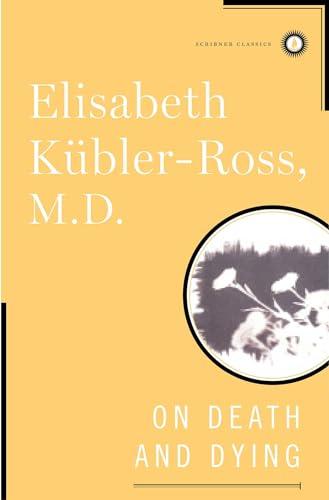

On Death and Dying (Scribner Classics) Cover
Podcast Mentions

On Death and Dying (Scribner Classics)

Elisabeth Kubler-Ross

One of the most famous psychological studies of the late twentieth century,

Podcasts 4
Quotes 8
Huberman Lab

It was mentioned as a pioneering work in the understanding of grief stages, but modern science has shown that not everyone experiences them all or in a linear fashion.

"

Some of the myths and misunderstandings arrived from the beautiful work of Elizabeth Kubler-Ross, a psychologist who wrote the famous book on Death and Dying...

— Episode: The Science & Process of Healing from Gr...

Episode: The Science & Process of Healing from Grief

It was mentioned as a pioneering work in the understanding of grief stages, but modern science has shown that not everyone experiences them all or in a linear fashion.

"

Some of the myths and misunderstandings arrived from the beautiful work of Elizabeth Kubler-Ross, a psychologist who wrote the famous book on Death and Dying...

The different stages of grief very quickly are denial, anger, bargaining, depression and acceptance.

In the Kubler-Ross model denial is always the first stage and denial is just as it sounds this disbelief it cannot be there's no way a refusal to accept the new reality that the person or animal is gone.

And we now know based on neuroimaging based on more in-depth psychological evaluation and frankly more researchers and clinicians moving into this area and observing that while much of what Kubla Ross described does hold true it's not always the case.

I do want to tip our hats to the incredible work of Elizabeth Kubla Ross by no means am I or do other researchers try and discount her incredible contributions but I think nowadays we have a different and frankly a better understanding of what the grief process is like and as a consequence better tools to move through grief.


We Can Do Hard Things

It was mentioned that the author read this book months before her mother's death, as part of her efforts to prepare, in an attempt to mitigate the impact of grief and loss.

"

I did all of my grief research. I was reading Elizabeth Kubler-Ross's On Death and Dying months before my mom died.

— Episode: 110. Why Grief – like Love – is Forever...

Episode: 110. Why Grief – like Love – is Forever with Maris...

It was mentioned that the author read this book months before her mother's death, as part of her efforts to prepare, in an attempt to mitigate the impact of grief and loss.

"

I did all of my grief research. I was reading Elizabeth Kubler-Ross's On Death and Dying months before my mom died.

Chasing Life

The book was referenced in two episodes where the hosts explained its five stages of grief model, noting that it resonated in certain situations but was not a universal or linear experience for everyone. They highlighted both its usefulness as a framework and its limitations, emphasizing that people may not follow the stages in order or at all.

Episode: Learning to Live After Loss

The book's five stages of grief were discussed, and the speaker noted that, while sometimes applicable, it is not universally experienced in that order or at all.

"

I always, I read the book and there were times when I felt like, wow, that really seems to fit in this particular scenario. And there's other times when people did not seem to go through the stages or they didn't go through the stages in order or they didn't go through the stages at all.

Episode: Learning to Live After Loss

The book's five stages of grief were mentioned and discussed; the speaker found it relatable in some scenarios but not universally applicable, and acknowledged the limitations of a prescribed model for grief.

"

I always, I read the book and there were times when I felt like, wow, that really seems to fit in this particular scenario. And there's other times when people did not seem to go through the stages or they didn't go through the stages in order or they didn't go through the stages at all.

Note: The book recommendations on this page are discovered automatically from podcast transcripts, and may be incorrect or incomplete.