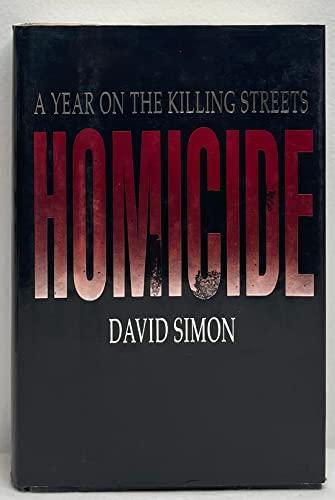
Homicide: A Year on the Killing Streets Cover
Podcast Mentions

Homicide A Year on the Killing Streets

David Simon

An account of a year inside a city homicide unit focuses on three detectives investigating murders in Baltimore--a city torn by racial tensions and plagued by drugs and crime

Podcasts 5
Quotes 29
Modern Wisdom

It was the book that inspired Gad Saad to apply evolutionary psychology to consumer behavior and marketing after reading it as a doctoral student.

"

he assigned a book by two of the pioneers of evolutionary psychology, a husband and wife team, Martin Daly and Margo Wilson, where the book is titled Homicide, where they looked at patterns of crimina...

— Episode: #686 - Dr Gad Saad - 8 Strategies For Av...

Episode: #686 - Dr Gad Saad - 8 Strategies For Avoiding A L...

It was the book that inspired Gad Saad to apply evolutionary psychology to consumer behavior and marketing after reading it as a doctoral student.

"

he assigned a book by two of the pioneers of evolutionary psychology, a husband and wife team, Martin Daly and Margo Wilson, where the book is titled Homicide, where they looked at patterns of criminality around the world and across time periods and demonstrated that there are some very, very elegant, parsimonious, theoretically coherent ways by which you could explain these using an evolutionary lens.

My mind was blown. That's where I had my epiphany.

The Diary Of A CEO with Steven Bartlett

This book applies an evolutionary framework to study patterns of criminality, showing that certain crimes happen similarly across cultures and time periods, transcending cultural and era factors. It was assigned as reading in an advanced social psychology course and served as a eureka moment for the podcast guest.

"

this is from a book called Homicide by Martin Daly and Margo Wilson a husband and wife team who are two of the pioneers of evolutionary psychology.

— Episode: The Cancelled Professor: Husbands Are Mo...

Episode: The Cancelled Professor: Husbands Are More Dangero...

This book applies an evolutionary framework to study patterns of criminality, showing that certain crimes happen similarly across cultures and time periods, transcending cultural and era factors. It was assigned as reading in an advanced social psychology course and served as a eureka moment for the podcast guest.

"

this is from a book called Homicide by Martin Daly and Margo Wilson a husband and wife team who are two of the pioneers of evolutionary psychology.

What they did in the book is apply an evolutionary framework to study patterns of criminality and in a second now I'll unpack what that means.

So there are certain patterns of crime that happen in exactly the same way for the exact same reasons irrespective of which culture it happens in and irrespective of time period.

Small Town Murder

The hosts, especially James Pietragallo, repeatedly cited the book as a benchmark for understanding homicide investigations, noting its detailed accounts of detective diligence, case prioritization, and the complexities of arson and interrogation. They used it to illustrate how real‑world police work compares to the scenarios discussed in each episode, highlighting its relevance to the podcast's focus on murder cases. Overall, the book was portrayed as a valuable reference that deepened their analysis of crime scene evidence and investigative strategies.

Highly Recommended

Episode: #76 - Don't Wear Overalls To Court in Cincinnati,...

The book was mentioned as an example of a detective who spent hours analyzing a crime scene, specifically the placement of a lady's slippers, before concluding it was a suicide.

"

Like in the David Simon homicide book, there's this guy, a detective, and he's talking about he spent like six hours in a crime scene, but made all the medical guys wait and everything because something wasn't right about this lady hung herself and something wasn't right about the placement of the slippers.

And he spent like six hours figuring out why it was like that before he could go, OK, it's a suicide.

And before he felt OK about it because he had to figure out, OK, she took her slipper off with one foot and then wrapped the other one.

Well, that's how it fall. But he had to like figure it out.

Episode: #71 - An Extra Terrible Person in Kittery, Maine

The podcast host references David Simon's book "The Homicide", which focuses on Baltimore crime in 1988, and compares the events of the episode to the book's timeline, given the episode takes place in 1987.

"

That's basically the David Simon homicide book. That takes place in 1988. Wow.

Like I hate to say this, but some of the stuff that happens here, I really wish would have happened a year later because I would have already known about it before when I read about it.

So this is this is fucking amazing. Like I hate to say this, but some of the stuff that happens here, I really wish would have happened a year later because I would have already known about it before when I read about it.

They actually talk about how they had they actually had a murder of somebody at the Inner Harbor and basically it came down from on high that this shit would be solved yesterday. Everyone will get convicted and this will never fucking happen again. And they found that motherfucker that day and around him in the heart and drowned him in the harbor.

They actually talk about that. They actually talk about how they had they actually had a murder of somebody at the Inner Harbor and basically it came down from on high that this shit would be solved yesterday. Everyone will get convicted and this will never fucking happen again. And they found that motherfucker that day and around him in the heart and drowned him in the harbor. Absolutely.

Episode: #61 - The Mannequin Murders in Elkridge, Maryland

The book, written by David Simon, the creator of the Wire, talks about how the Baltimore police department handled high-profile cases and how they prioritized the cases that were considered 'red balls'.

"

they talk about when they have, in the city at least in Baltimore, they call it a red ball. That is a case that is highly attentive. There are people know about it. The fucking, it's on the mayor's radar. He's saying I want that case solved.

And that's all hands on deck. And every day the mayor asks. Oh no, not just ask. Every day you have to have reports that then go to Europe's superiors who then write reports on that. It goes up the chain. The chief wants to be kept involved.

And that's a completely different thing than just like a drug dealer in an alley. You know what I mean? That's just like, if you find it, you find it. If not, if not. If it's an old lady who everybody loves, we're finding this fucker yesterday.

So that's a big deal. So even a year later, they still have a full time detective on all this, which is insane because in the Homicide book, they talk about an 11 year old girl who was sexually assaulted and killed and left in an alley.

And that was a big red ball. But six months later, three months later, the detective, the lead detective was going back in the rotation on other shit. That wasn't the priority anymore. Like the red ball turns yellow. They'd go back to it after a while.

Episode: #29 - A Grinch Of A Killer in Santa Claus, Georgia

It was mentioned in relation to the idea that killers often sleep soundly after committing crimes, whereas innocent people struggle to rest.

"

They talk about that a lot. That's an actual thing. It's becoming clich now, but they actually will put a suspect in the room and let him sit there.

They like to let him stew anyway and get them, you know, get them, let them get scared, let them get worked up.

But they want to see what they do. Yeah, because if he goes to sleep, that's your guy.

They all say that because a man who's caught goes to sleep because they're like, I'm caught. They go to sleep. Now I can rest.

Episode: #23 - A Nasty Pair Of Murders in Ocean Grove, New...

It was mentioned in relation to police interrogation techniques, particularly the importance of not keeping a suspect for extended periods without breaks.

"

I always talk about the David Simon homicide life on the street.

Episode: #10 - A British Tourist Murdered in Monticello, Fl...

It was mentioned as a book that Baltimore homicide detectives would listen to while on the job, specifically the 'Shaft' soundtrack in the book.

"

They used to do this back in Baltimore. The homicide book they talk about they would drive down the street to whatever the detectives with the shaft soundtrack.

Episode: #8 - A Trail Of Ashes & Bodies in Otisco, New York

It was mentioned in relation to the difficulty of proving arson cases, specifically how difficult it is compared to other crimes with more obvious evidence.

"

If you read, I brought this book up before the homicide. The Year on the Killing Streets by David Simon, who's the guy who made the wire and made homicide life on the street and all that shit. He wrote a book where he followed the homicide department of Baltimore in 1988.

Fresh Air

Podcast

Fresh Air

The book was cited as the source material that inspired the TV series and was used as a launching pad for the show's development.

"

It was based on a book by David Simon, who later wrote for the show, then created a string of his own brilliant TV series starting with The Wire.

— Episode: Police Procedural 'Homicide' (Finally) C...

Episode: Police Procedural 'Homicide' (Finally) Comes To St...

The book was cited as the source material that inspired the TV series and was used as a launching pad for the show's development.

"

It was based on a book by David Simon, who later wrote for the show, then created a string of his own brilliant TV series starting with The Wire.

And we had David Simon's book, A Homicide a Year on the Killing Streets as a launching pad.

And it's a book by David Simon, Homicide, The Year on the Killing Streets.

Note: The book recommendations on this page are discovered automatically from podcast transcripts, and may be incorrect or incomplete.