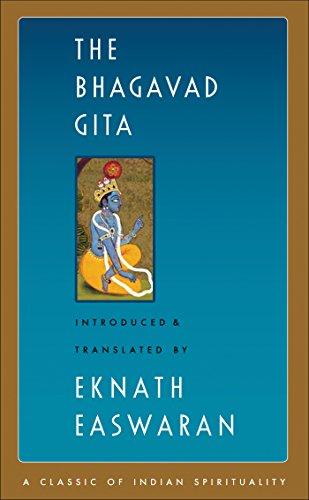
The Bhagavad Gita (Easwaran's Classics of Indian Spirituality Book 1)
Eknath Easwaran
The Bhagavad Gita is the best known of all the Indian scriptures, and Eknath Easwaran’s best-selling translation is reliable, readable, and profound.
Easwaran's 55-page introduction places the Bhagavad Gita in its historical setting, and brings out the universality and timelessness of its teachings...
The book was referenced as a source of Hindu philosophy that Jonathan Haidt had read and that Ethan’s father used to spark conversations about inner thought management. The hosts highlighted its role in fostering curiosity about Buddhism, Hinduism, and meditation, describing it as an illustrative example rather than a direct endorsement.
Episode: Escaping the Matrix
It was mentioned as a book on Hinduism that Jonathan Haidt read.
"
And I'd been interested in Buddhism and Hinduism for a long time. I read the Bhagavad Gita.
Episode: You 2.0: Befriending Your Inner Voice
It was mentioned as a book Ethan's father read and discussed with him, fostering an early interest in introspection and managing inner thoughts.
"
But when he wasn't doing all those things, he was reading Eastern philosophy and the Bhagavad Gita and meditating.
Episode: You 2.0: Befriending Your Inner Voice
It was mentioned as a book that Ethan's father enjoyed reading and discussing with him, fostering his interest in the mind and its management.
"
But when he wasn't doing all those things, he was reading Eastern philosophy and the Bhagavad Gita and meditating.
Jay Shetty repeatedly highlighted the book as a timeless guide that illustrated human challenges, motivation, and the concept of dharma, often quoting it in his own work and recommending it to guests. He and other contributors such as Rob Dial, Will Smith, and Kunal Nayyar praised its insights on overcoming fear, mastering the mind, and living purposefully, describing it as a universal manual for personal growth. The overall tone was strongly endorsing, presenting the title as a highly recommended source of spiritual and practical wisdom.
Highly Recommended
Episode: Rob Dial: How to Break the Cycle of Procrastinatio...
The book was mentioned as an example of how to overcome fear. The speaker said they read it while traveling.
"
And I remember you told me in 2017, like, you should read the Bhagavad Gita.
And so there was that. And as I was writing the book, I was like, what's the thing? Because the original title of the book was The Psychology of Taking Action. Because I was looking at the Mindset Mentor podcast, like 1,400 episodes, and I was like, it's just me speaking for almost every single one of them. And I was like, what do I teach? Like, what do people want from me? And I was like, it's almost all like tips and tricks to understand yourself to take action.
Episode: Jay and His Wife Radhi: 3 Simple Ways to Get Over...
They quoted a famous line from this book about purpose, stating that it is better to do your own purpose imperfectly than to try to do someone else's perfectly. It was emphasized that doing your own thing is much better than trying to do someone else's.
"
It's better to do your own purpose imperfectly than to try to do someone's perfectly.
Because the point is doing your thing is way better than trying to do someone else's.
Episode: 3 Ways to Stop Feeling Stuck and Start Turning You...
It was mentioned as an ancient text that exemplifies human challenges, and the speaker hoped to make it as popular as Stoicism.
"
The Bhagavad Gita which I would love to do for Vedic knowledge what Ryan's done for Stoicism and the Bhagavad Gita over 5000 years old and that book really exemplifies human challenge
Episode: 12 Lessons Learned in the Last 12 Months - Special...
Jay Shetty referred to the Bhagavad Gita when discussing the four types of motivation: fear, results, responsibility, and love, stating that it was a text he quoted frequently in his book, 'Think Like a Monk'.
"
And the Bhagavad Gita, from which I quote a lot in my book, Think Like a Monk, it talks about four different types of motivation.
Episode: 9 Ways You’re Blocking Your Own Growth & How To Ge...
It was mentioned as a book Jay Shetty studied as a monk, where it was said that the mind can be our best friend or worst enemy.
"
In the Bhagavad Gita, the book I studied as a monk, it beautifully says our mind can be our best friend or our worst enemy.
Episode: Will Smith ON: Owning Your Truth and Unlocking the...
Will Smith discussed his love for the Bhagavad Gita and how it has impacted his life, citing Jay Shetty as a catalyst for his deeper study of it.
"
I fell in love with the Bhagavad Gita and Jay and I have been spending time. We've been hanging, we've been traveling together and Jay has really been the catalyst for this next phase of my life.
We have committed to one another in a brotherhood of service and support. I guess we've been in the gym. We've been in the soul gym working out for the past eight months and this is our first time doing anything that's public facing.
A new smith starts to study with Jay and also our teacher Radhanath Swami. It's been a beautiful year and I'm very excited to start talking to people about what we've been studying and learning and doing together.
And the Gita filled in that concept of what it really means. It doesn't mean don't do anything. Yeah. Let go and let God doesn't mean don't do anything. It means do your divine duty, whatever that may be.
And just for whatever reason, the study of the Gita at this particular point in my life really clarified a lot of ideas of how to move through a world where you almost can't do it right.
Episode: 3 Myths About Finding Your Purpose and 3 Ways to A...
It was mentioned as a book Jay Shetty loved and studied as a monk, emphasizing the importance of doing one's own 'dharma' even imperfectly, rather than another's perfectly.
"
Now, in the Bhagavad Gita, a book that I absolutely love, that I studied as a monk and I also teach so much from, it said that it's better to do one's own dharma, even if imperfectly, than to do another's dharma perfectly.
And dharma is spoken about as our true eternal nature, our true natural inclination, the element in which we thrive or our purpose, but it's so much bigger than the word purpose.
Episode: #1 Way To Attract Calm, Stillness and Peace In Lif...
It was described as a kind of universal and timeless life manual, and Jay Shetty frequently refers to it in his book and life.
"
In my life and in this book, I frequently refer to the Bhagavad Gita, which means song of God.
This is loosely based on the Upanishads, writings from around 800 to 400 BCE.
The tale isn't told about a monk or meant for a spiritual context. It's spoken to a married man who happens to be a talented archer.
It wasn't intended to apply only to one religion or region. It's for all humanity.
Eknath Eswaran, spiritual author and professor who has translated many of India's sacred texts, including the Bhagavad Gita, calls it India's most important gift to the world.
Episode: Lori Gottlieb ON: How To Deal With Difficult Emoti...
It was referenced as a book containing the four austerities of speech, which were mentioned as a good way to guide speech and communication.
"
In the Bhagavad Gita, the book from India, it's called the four austerities of speech.
Episode: Kunal Nayyar ON: How To Stop Obsessing About The F...
Kunal Nayyar recalled reading this book, where he gained the perspective that he is not his thoughts or clothes, helping him to understand that he could change his thoughts as easily as he could change his clothes.
"
Oh my God, when I experienced that, I thought I have, this is it, I'm free. Yeah, boy was I wrong.
I remember the first time I read that in the Bhagavad Gita like you're not your clothes. You know, we just change our clothes every day and you can change your thoughts every day.
Episode: Jada Pinkett Smith : ON How To Heal Your Past & Lo...
It was mentioned as Jada's book, and Jay also considers it his book, specifically in relation to the concepts of attachment and aversion as two sides of the same coin.
"
That in the Gita it said that attachment and aversion are two sides of the same coin.
Episode: 3 Myths About Finding Your Purpose and 3 Ways to A...
It was mentioned as a book the speaker absolutely loved, studied as a monk, and teaches from, stating it's better to do one's own dharma imperfectly than another's perfectly.
"
Now, in the Bhagavad Gita, a book that I absolutely love, that I studied as a monk and I also teach so much from,
The Bhagavad Gita was mentioned as a text that Jay Shetty's father introduced him to and was a book that he studied as a monk, contributing to his journey of personal development.
"
And at the same time, there were spiritual texts that my father was introducing me to, whether it was the Bhagavad Gita or whether it was the story of Arjun in the Bhagavad Gita.
— Episode: Live Episode! Wellness Coach and Podcast...
Episode: Live Episode! Wellness Coach and Podcaster: Jay Sh...
The Bhagavad Gita was mentioned as a text that Jay Shetty's father introduced him to and was a book that he studied as a monk, contributing to his journey of personal development.
"
And at the same time, there were spiritual texts that my father was introducing me to, whether it was the Bhagavad Gita or whether it was the story of Arjun in the Bhagavad Gita.
And my first video I made was actually a script and made up of scripts that I'd written and shared for years before that I'd already tested out in audiences and people had heard me share those messages. And my friend was a wedding and corporate videographer. And I said to him, you got to come out with me. And actually, he was always very encouraging of me. He always said to me like, Jay, you should make more videos and media. And so we went out. We always try and figure this out. It was either New Year's Eve or New Year's Day. We went out really early in the morning. And literally London was empty. So we could shoot in some of the most phenomenal locations in London for free without a permit. So we had no permits. We had none of the professional things that we could have. We had a boom mic that I was using my backpack to make it stand upright. And he brought his camera and he had a brilliant eye for like backgrounds and lenses because that was his profession. He did it for free for me. And we shot four videos that day in different locations. I took my t-shirts in my backpack and I would change my t-shirts. And we put up my first video, which was called Three Lessons I Learned from the Bhagavad Gita, which was the book that I studied as a monk.
The interviewee's experience with the Bhagavad Gita profoundly altered his understanding of God, revealing a vastness he had not previously conceived. He worked extensively with this text, translating it and becoming deeply familiar with the writings of Ramana Maharshi.
"
Later when I began to experience the texts of Hinduism, I guess that was what came first, the Bhagavad Gita and the Pana Shads. My whole sense of God blew to smithereens. There was something much vast...
— Episode: [Unedited] Stephen Mitchell with Krista...
Episode: [Unedited] Stephen Mitchell with Krista Tippett
The interviewee's experience with the Bhagavad Gita profoundly altered his understanding of God, revealing a vastness he had not previously conceived. He worked extensively with this text, translating it and becoming deeply familiar with the writings of Ramana Maharshi.
"
Later when I began to experience the texts of Hinduism, I guess that was what came first, the Bhagavad Gita and the Pana Shads. My whole sense of God blew to smithereens. There was something much vaster than what I had thought that I was praying to.
So it's not the text itself but at what what it's directing your attention to that the text feels as important.
In some of the paths, in the path of devotion for example, pray to Krishna and eventually if with enough love and persistence you become one with Krishna.
So for instance the Bhagavad-gita says just as a river town at the edge of a river doesn't need a well. So somebody who has seen the truth doesn't need this even the greatest written scriptures and and the doubted in likewise will say you know I call it the doubt because for lack of a better word.
The speaker mentioned this book as an example of Stoic philosophy resonating across cultures.
"
There's the Bhagavad Gita there.
— Episode: Do You Really Have Time For This? | GitH...
Episode: Do You Really Have Time For This? | GitHub Q&A
The speaker mentioned this book as an example of Stoic philosophy resonating across cultures.
"
There's the Bhagavad Gita there.
Episode: Francis Ford Coppola Opens Up About How Philosophy...
It was mentioned among other ancient myths and epics as examples of timeless stories that have resonated through history.
"
the Bhagavad Gita is of course, another one. Just these myths.
Episode: Rainn Wilson On How His Deepest Struggles Led To H...
The book was mentioned in relation to spirituality and overcoming adversity, with the speaker referencing the idea that one is "entitled to the labor but not the fruits of the labor."
"
Lord Krishna was talking about...3000 years ago, 3500 years ago...that is in the Talmud, that is in the Bhagavad Gita...
you are not entitled to the fruits of the labor, just the labor
I'm going to read from the second greatest book next to the Bhagavad Gita...
Episode: Paul Kix On The Civil Rights Movement And What It...
Ryan Holiday mentioned reading this book and noted its recurrent idea about everything being a process, and that being results-driven is misaligned with oneself.
"
I had just finished reading the bag of a uh Gita mm-hmm and if you read that mm-hmm so just this recurrent idea through all of it about how it's like basically looks like everything is a process and as soon as you become results driven you are no longer aligned with yourself or aligned with god
Note: The book recommendations on this page are discovered automatically from podcast transcripts, and may be incorrect or incomplete.