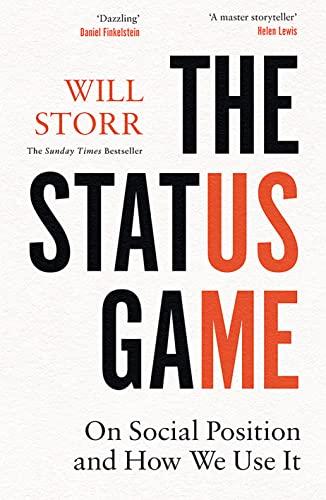

The Status Game Cover
Podcast Mentions

The Status Game

Will Storr

‘Will Storr is one of our best journalists of ideas … The Status Game might be his best yet’ James Marriott, Books of the Year, The TimesWhat drives our political and moral beliefs? What makes us like some things and dislike others? What shapes how we behave, and misbehave, in groups? What makes you...

Podcasts 4
Quotes 24
The Ezra Klein Show

Ezra noted that the book makes a distinction between our conscious storytelling mind and our unconscious gameplaying mind, arguing that brains act as status scorekeepers.

"

The journalist Will Storr has this great book, The Status Game.

— Episode: We Build Civilizations on Status. But We...

Episode: We Build Civilizations on Status. But We Barely Un...

Ezra noted that the book makes a distinction between our conscious storytelling mind and our unconscious gameplaying mind, arguing that brains act as status scorekeepers.

"

The journalist Will Storr has this great book, The Status Game.

Modern Wisdom

The book was highlighted as a phenomenal exploration of how people choose their status game in life and the trade‑offs involved. Hosts and guests, including Jimmy Carr and Chris Williamson, praised its fascinating insights and cited vivid examples such as a tribe that grew massive yams to signal status. The discussion emphasized the book’s relevance to understanding personal and societal competition for status.

Highly Recommended

Episode: #691 - Jimmy Carr - The Secret Hacks For Living A...

It was described as phenomenal. It focuses on how you pick your status game in life and how you can't have everything.

"

I thought was phenomenal the status game.

It's wonderful but that thing of like going well actually you pick what status game you play in you can have anything you can't have everything.

Episode: #690 - Michael Easter - Why Can’t Humans Do Anythi...

It was recommended as a book that would be of interest due to its focus on status and how it impacts individuals and society.

"

Do you read Will Stor's book, The Status Game?

You'd love it. You would fall in love with it. It's absolutely fascinating.

Episode: #668 - David Pinsof - How To Leverage The Psycholo...

It was referred to when discussing the concept that people will find new ways to compete for status, even if the current system is flattened, like the group in the book who grew yams to give to their enemies.

"

You've read Will Storsbach, the status game where he talks about that group that has yams. They grow the biggest yam and then they give it to their enemy.

Episode: #661 - Sam Harris - How To Take Control Of Your Mi...

Will Storr's book "The Status Game" talks about this tribe that grows massive yams and they have to take four men to wheelbarrow them in because they are so big. It is almost like this yam shaped middle finger that you are giving.

"

Will Storr who wrote that great book The Status Game you know there's this tribe somewhere that grows yams they grow massive yam these unbelievably huge yams and they have to take four men to wheelbarrow these yams in and I'm pretty sure that what you do is you give the yam to your greatest enemy or something like that and it's almost like this yam shaped middle finger that you

Episode: #1021 - Louise Perry & Mary Harrington - The Perfo...

The book was mentioned as a work that explains how people are constantly navigating and competing for social status, influencing many aspects of life.

"

If you've read Will Storr's The Status Game, you've probably interviewed him at some point, his really, really good piece of work is that everyone is completely blessed with status.

Episode: #953 - Jimmy Carr - Decoding The Secrets Of A Mean...

The conversation referenced Will Storr's book about status dynamics, describing it as a "status game book" that the speakers admired.

"

It's that Will Storr thing, that status game book, which is again, I mean, it's just, he's such a genius writer. I love him.

Episode: #948 - Matt Abrahams - The Secret To Becoming A Co...

It was referenced as another book authored by Will Storr, mentioned alongside his other works.

"

Will Storr, do you know him? He wrote The Science of Storytelling, The Status Game. So he was on the show yesterday, his new book, A Story is a Deal.

The Diary Of A CEO with Steven Bartlett

The hosts referenced the book while discussing human status seeking and its impact on modern challenges like dopamine addiction and burnout. They noted that it explored how status drives behavior, aligning with the episode themes, but did not elaborate further or endorse it strongly.

Episode: The Brain Rot Dr: Porn Is A Dopamine Disaster, How...

Steven referred to an author who had written a book called Status.

"

He wrote a book called Status.

Episode: The More Successful You Are The Longer You’ll Live...

Will's latest book, The Status Game, was praised as a profound, eyeopening guide to how status drives health, behavior and society, offering practical ways to navigate status pursuits.

"

Your 2021 book, The Status Game. This is the book that when I was reading through all of my notes, I have by far the most amount of notes on. Great. Because maybe it's just, you know, the way I'm compelled or whatever, but it was really, really fascinating and felt very relevant.

the status game is one of those that isn't tremendously illuminating because it explains so much. It turned on a light in a huge room that I didn't even know was there.

I've had a lot of people specifically, cause you've had a few conversations with some friends of mine really raving about this book. So I highly recommend everybody checks it out.

The Jordan Harbinger Show

It was discussed at length, focusing on the evolutionary roots of status-seeking and how it manifests in various social settings. The book explores the three main types of status games: dominance, virtue, and success.

"

I did read the book and I really enjoyed it.

— Episode: 552: Will Storr | Understanding Social P...

Episode: 552: Will Storr | Understanding Social Position an...

It was discussed at length, focusing on the evolutionary roots of status-seeking and how it manifests in various social settings. The book explores the three main types of status games: dominance, virtue, and success.

"

I did read the book and I really enjoyed it.

one of the things I do in the book is I delineate three kinds of different status game that people tend to play there are dominance games so we blame dominance games for millions of years and most animals you know play dominance games and that's physical that's fear strength so that's a one kind of status and other kind of status is virtue you know part of our being a tribal species is that we would compete to be seen as virtuous generous putting the tribe first and you can see that in the storytelling of you know thousands of years heroes in stories are ones that put the tribe first want to put their own interests behind and the interests of the people that they care about in front that's a hero and then there's success you know competence you know when we're evolving being a competent honey finder a competent storyteller a competent you know tuber digger this was really good a really useful to the tribe so again we've evolved to attach status to competence and so your game is as a podcaster that's driving you I want to be a better podcaster you know you've been talking to me about the software that you've got is the best software it's much better than I was other bits of software for the past seven or before true I've no other let's quite cast add FM yeah exactly and that's all part of the status game so you can see dismissing it as just status no stages is driving you to be a better man a better person more competent more successful that is a gift to the world that is an entertainment for all of your listeners that is a gift to your family who are supported by your work in the broad of you you know he's taking Jeff Bezos and Richard Branson to the edge of space this week this drive for status who's going to be the first and these are fantastic things you know I'd you know the need for status whether it's competence or success based status or virtue based status all of the good that's done in the world is based on this strivings that people have for status

one of the things I do in the book is I go back to the very first the early days of social media which is to go back to the 80s the mid 80s probably the first social media website as we'd recognize it today was called The Well you can only get on it by you know it was like I feel war games where he put the phone in the modem and if it's a dial-in and there was only sort of it got to this you're about 500 regular users and the first internet trial turns up and starts attacking them all you know it's incredible how little things have changed they are having rouse about pronouns they're exactly the same as the rouse we're having about pronouns today like literally they were doing this and so you can see it doesn't take Mark Zuckerberg or Jack the Twitter dude to create this toxicity he just creates connecting people together and just setting them free and they'll start trying to boost their own status trying to drop off of the people's status and that's going to become toxic and you're going to get this cancel culture that we're seeing today you know it's in our human nature it's what we've done with the internet status gives us meaning in many ways and it's as necessary as oxygen or water

one of the ideas when we've become depressed it's because we're doing badly in the game we're failing to find status and because status is such a fundamental need where we feel we're lacking in status to the subconscious kind of evolve brain that signals what we're doing badly in this tribe we're going to start losing resources we're going to start losing security and so what happens is we kind of moved in a back of the cave as it were and sheltered and we the minds try to stop us going into battle with higher status people because it's too dangerous out there when people study the causes of suicide again you know incredibly complex subject it's not as simple as people have lost status but certainly in a lot of cases that's what is found it's people who have you know lost significant amounts of status and I think the people who are most vulnerable often are the ones who have lost the most status rapidly this is why I think Geoffrey Epstein did kill himself because he's just a textbook example of somebody who was up here and went down there with enormous rapidity and now that's why I suspect that I don't believe these conspiracies that it was a it was a fit-up he's just a classic case of somebody that you could expect to take their own lives and that's what they find so it's when people are going to rapidly lose status this is why the financial crisis lots of people ended up committing suicide again it's incredibly important and also when we left behind it would people become vulnerable to suicide ideation so when we stay still in all our friends and everybody around us accelerates on that could be very bad for our mental health as he says not because there's anything wrong with this is because our brains are functioning correctly their brains are putting us into an emergency mode because when we lack status that's a dangerous situation for the human animal to be in

and another sort of paper that I thought was fascinating that I quote that linked in the book was by this US lawyer former big firm lawyer now a judge in he writes an amazing detail about the process of corruption that junior kind of lawyers go through and he writes that basically you know you join your big name law firm and in two or three years you're going to become corrupted you're going to start lying and cheating as a matter of course and he says it happens to me I did it and the reason for that is that you're going to be introduced to this world in which you're comparing yourself on the basis of money to all the other all the other lawyers and twice a year the legal magazines post you know leak tables of what everyone's earning and if when get obsessed with these things and the thing about lawyers they work just incredibly hard they work every hour God sends and more you know so how do you get the edge and so the only way you can really get the edges by building four more hours and you've actually worked by making sure that you know sometimes not cooperating with the discovery process making sure documents you know go missing and stuff and he says this becomes such kind of part of second nature that it's just this inevitable process that happens for young lawyers and he says there's a line something in two or three years you go from somebody being really genuinely happy about being able to afford your first car stereo to somebody furious that you've only got a $400,000 bonus you know that's what happens to you and so that shows the power of the status game and just this idea that money is just a way we keep scoring that game that's what money is a proxy right yeah once we've got enough to survive and raise our children safely and feed ourselves the rest of it is just the status game and it was just the power that the game has to corrupt you know I thought it was very interesting paper because it just shows how easily the need for status can kind of not just since becoming less ethical people

Episode: 552: Will Storr | Understanding Social Position an...

It was discussed at length, and the main points were that status is fundamental to human nature and that it drives us to innovate and achieve, though it can also be a source of negativity and depression.

"

The book is called The Status Game because, you know, to our subconscious mind, it is like he's playing a game.

I think one of the main takeaways from doing all the research for me was that you're right, we don't like to admit that we were interested in our own status.

I delineate three kinds of different status game that people tend to play: there are dominance games, virtue games, and success games.

I think Geoffrey Epstein did kill himself because he's just a textbook example of somebody who was up here and went down there with enormous rapidity.

Status is relative, it's not in a fixed place, feeling on who we're with and who we're thinking about is bouncing around all over the place.

Note: The book recommendations on this page are discovered automatically from podcast transcripts, and may be incorrect or incomplete.