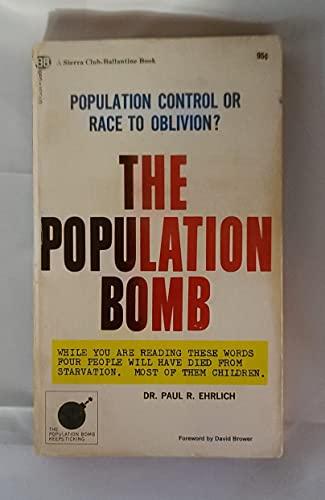

The Population Bomb Cover
Podcast Mentions

The Population Bomb

Paul R. Ehrlich

The Population Bomb by Paul R. Ehrlich.

Podcasts 10
Quotes 50
The Joe Rogan Experience

Published in 1968, this book predicted exponential population growth, leading to resource depletion and widespread famine.

"

You know, 50 years ago or whatever, 1968, Paul Ehrlich writes the "Population Bomb", and it's just the population is just going to exponentially grow.

— Episode: #2190 - Peter Thiel

Episode: #2190 - Peter Thiel

Published in 1968, this book predicted exponential population growth, leading to resource depletion and widespread famine.

"

You know, 50 years ago or whatever, 1968, Paul Ehrlich writes the "Population Bomb", and it's just the population is just going to exponentially grow.

Stuff You Should Know

It was published in 1968 and discussed the idea of exponential human population growth, which was a popular idea at the time, and it was mentioned as a book that scared a lot of people.

"

And I don't think we mentioned too that Christian initially said that they had been, he and his people had been working on this idea for 20 years.

— Episode: The Georgia Guidestones: The Elite Have...

Episode: The Georgia Guidestones: The Elite Have a Laugh

It was published in 1968 and discussed the idea of exponential human population growth, which was a popular idea at the time, and it was mentioned as a book that scared a lot of people.

"

And I don't think we mentioned too that Christian initially said that they had been, he and his people had been working on this idea for 20 years.

And it turned out to not be correct at all.

But at the time again, people were worried about it.

Freakonomics Radio

Stephen Dubner discussed the book "The Population Bomb" by Paul R. Ehrlich, which warned about the dangers of overpopulation and its potential to lead to global famine and environmental collapse in the 1960s. He noted that the book's predictions didn't come true, but the environmental movement shifted its focus to climate change.

"

If you were an environmentalist in the 1960s, your main concern wasn't climate change. It was overpopulation.

— Episode: 581. What Both Parties Get Wrong About I...

Episode: 581. What Both Parties Get Wrong About Immigration

Stephen Dubner discussed the book "The Population Bomb" by Paul R. Ehrlich, which warned about the dangers of overpopulation and its potential to lead to global famine and environmental collapse in the 1960s. He noted that the book's predictions didn't come true, but the environmental movement shifted its focus to climate change.

"

If you were an environmentalist in the 1960s, your main concern wasn't climate change. It was overpopulation.

And listeners who were old enough might remember the book, The Population Bomb, the fear that the world was going to start to death because there were too many people.

Episode: 346. Two (Totally Opposite) Ways to Save the Plane...

It was described as a book that warned of impending famines and overpopulation, with predictions that were ultimately not accurate in the way they were originally presented, though some of its warnings on issues like nitrogen pollution were later corroborated.

"

There was a warning on the cover. While you are reading these words, it said, four people will have died from starvation, most of them children.

And I thought, oh, my gosh. In the edition I read, which is the first edition, said there would be massive famines in the 1970s. Basically, it said we were in deep, deep trouble.

Environmentalists were saying humankind was pushing the Earth's limits. Technologists, meanwhile, said those limits were nowhere in sight.

books like, you know, the Population Bomb and Al Gore's first book, Earth in the Balance, Limits to Growth, all these great environmental classics all stem directly from his work.

Hidden Brain

It was discussed as a book with a central message of unsustainable population growth, potentially reaching 24 billion, due to uncontrolled reproduction, ultimately influencing policies and fears across the world.

"

In 1968, Sarah, a Stanford University biologist named Paul Ehrlich published a book, and it was titled The Population Bomb. What was its central message?

— Episode: The Bomb That Didn't Explode

Episode: The Bomb That Didn't Explode

It was discussed as a book with a central message of unsustainable population growth, potentially reaching 24 billion, due to uncontrolled reproduction, ultimately influencing policies and fears across the world.

"

In 1968, Sarah, a Stanford University biologist named Paul Ehrlich published a book, and it was titled The Population Bomb. What was its central message?

The central warning of that book was that we were going to have massive out-of-control population growth, so much so that we were going to increase to about 24 billion people on the planet and that that was just going to be totally unsustainable.

If we do not by humane means limit our numbers, then numbers are going to be limited by more famines and shortages and consequent social conflicts.

That was the time when we actually thought that maximum world population was going to hit about 24 billion by the end of this century.

The story reveals why you see vast changes in fertility rates within a short time frame. To be sure, these changes are uneven across the planet, not just between countries, but within them. But the concerns raised in books such as The Population Bomb or in John Calhoun's terrifying experiment with mice that we wouldn't be able to feed ourselves, that famine and war were inevitable, that horror story has largely not come to pass.

The Jordan B. Peterson Podcast

The book was repeatedly cited as a classic example of failed overpopulation warnings, with Jordan Peterson noting Ehrlich's infamous bet on commodity prices and the missed prediction of mass starvation by the year 2000. Hosts highlighted that the anticipated resource shortages never materialized, using the title to illustrate the shortcomings of radical environmental alarmism. Alex Epstein also referenced it to show how such doomsday narratives can be employed to further anti‑human agendas.

Critiqued

Episode: 465. Alberta: The Promised Land for Canada’s Futur...

The author, Paul Ehrlich, made a famous bet with economist Julian Simon about the price of commodities in the year 2000, which he predicted would be much higher due to resource scarcity. He lost the bet because the price of commodities actually decreased, and Simon won.

"

Paul Ehrlich, who wrote the Population Bomb and is still kicking around, made a very famous bet with an economist Julian Simon.

He asked Simon to propose a basket of commodities and they bet on whether those would be less or more expensive by the year 2000 because that was the doomsday date as far as Dr. Ehrlich was concerned.

And he famously, Simon, who was an absolute genius as opposed to Ehrlich who certainly presumed he was one, famously collected on that bet shortly after the millennium switch because the basket of commodities became far less expensive rather than more expensive.

There was more of everything.

And of course, the entire economic history of the world since that point has indicated exactly that.

Episode: 339. The Future: Vision and Invitation

It was mentioned in the context of past predictions of environmental collapse and overpopulation, which, according to Peterson, did not come to pass.

"

Paul Airelec for example at Stanford who wrote the population bomb in the club of Rome who were the original apocalyptic doom sayers on the environmentalist front claiming that by the year 2000 there'd be mass starvation we'd be running out of basic commodities and that life was going to get a hell of a lot worse quickly

Episode: 338. The Epidemic That Dare Not Speak Its Name | S...

It was mentioned in relation to the author's views on overpopulation and its potential negative consequences. It was also noted that the predictions from this book regarding global starvation did not occur.

"

Ehrlich set up an organization, author of the population bomb of course, called ZPG which evolved into an organization.

Ehrlich and his population bomb and the club of Rome, etc. these anti-population zealots started beating the drum back in 1965, saying that we were all going to starve to death by the year 2000 when we'll have four billion people, God help us and now have eight.

Episode: 333. Konstantin Kisin and the Counter-Woke Revolut...

It was mentioned in the context of doomsaying in the 1960s, which was proven incorrect as resources became more plentiful and the population increased.

"

...most famously who wrote the population bomb that by the year 2000 we'd be out of all our primary resources and everyone would be starving...

Episode: 312. The Great Climate Con | Alex Epstein

It was written in 1968 and discussed the impact of human population growth on the planet. It was used as an example of how the radical environmental movement can appeal to human flourishing to gain support while having an anti-human agenda.

"

how did early become famous he became famous through the 1968 book the population bomb where he's telling human beings not hey the planet is going to become more impacted and that's intrinsically bad he's saying you're all going to starve and his close colleague Sean Holdren who was Obama's chief science advisor no he probably would have been a great person.

Behind the Bastards

It was mentioned as a book that significantly influenced the modern fear of overpopulation and was criticized for its racist implications and focus on the Global South.

"

It points out that the Population Bomb, a 1968 book by Paul Ehrlich that was probably the single most influential inspiration behind modern fears of overpopulation, was also profoundly racist.

— Episode: Part Two: The Population Control Movemen...

Episode: Part Two: The Population Control Movement

It was mentioned as a book that significantly influenced the modern fear of overpopulation and was criticized for its racist implications and focus on the Global South.

"

It points out that the Population Bomb, a 1968 book by Paul Ehrlich that was probably the single most influential inspiration behind modern fears of overpopulation, was also profoundly racist.

Episode: Part Two: The Population Control Movement

It was mentioned as a 1968 book that was extremely influential in promoting modern overpopulation fears, and was described as being racist.

"

What Ehrlich fails to mention, however, is that while Delhi's population was just shy of 3 million, both New York and Paris housed about 8 million at the time.

Episode: Part Two: The Population Control Movement

It was described as a profoundly racist book that influenced modern fears of overpopulation, particularly targeting the global south.

"

What Ehrlich fails to mention, however, is that while Delhi's population was just shy of 3 million, both New York and Paris housed about 8 million at the time.

Ehrlich's emphasis on an Indian city as the exemplification of overpopulation was part of a large and continuing pattern of focusing blame on the global south and mostly the non-white people who live there as affluent Western Europeans and Americans.

Pivot

Podcast

Pivot

Elon Musk discussed this book, suggesting that its predictions about overpopulation are outdated and no longer reflect current demographic trends, particularly the declining birth rate.

"

But a lot of people are still stuck with, you know, Paul Oleg's book, Population Bomb. It's like, ah, that was a long time ago.

— Episode: BONUS EPISODE: Elon Musk at Code Confere...

Episode: BONUS EPISODE: Elon Musk at Code Conference 2021

Elon Musk discussed this book, suggesting that its predictions about overpopulation are outdated and no longer reflect current demographic trends, particularly the declining birth rate.

"

But a lot of people are still stuck with, you know, Paul Oleg's book, Population Bomb. It's like, ah, that was a long time ago.

Morning Brew Daily

It was mentioned in the context of a 1968 book that predicted a 20th-century starvation catastrophe, which did not come to pass due to technological advancements and decreasing birth rates.

"

if we go back to the 1968 book that we all know Population bomb that book forecasted a 20th century starvation Catastrophe but obviously that hasn't come to pass because technological advances have me...

— Episode: Bullish or Bearish: The Great Debate

Episode: Bullish or Bearish: The Great Debate

It was mentioned in the context of a 1968 book that predicted a 20th-century starvation catastrophe, which did not come to pass due to technological advancements and decreasing birth rates.

"

if we go back to the 1968 book that we all know Population bomb that book forecasted a 20th century starvation Catastrophe but obviously that hasn't come to pass because technological advances have met increased need and worldwide people have Started to have less kids

Verdict with Ted Cruz

It was discussed in the context of Malthusian theory, mentioned as a book from 1970 that made incorrect predictions about global famine and overpopulation, advocating for more abortion and contraception.

"

There was a book that came out in 1970 by Paul Ehrlich, a still admired in some corners and still honored scientist, that was just completely bogus. And it was called The Population Bomb. It said that...

— Episode: Take Your Damn Mask Off, LIVE in Madison...

Episode: Take Your Damn Mask Off, LIVE in Madison, WI

It was discussed in the context of Malthusian theory, mentioned as a book from 1970 that made incorrect predictions about global famine and overpopulation, advocating for more abortion and contraception.

"

There was a book that came out in 1970 by Paul Ehrlich, a still admired in some corners and still honored scientist, that was just completely bogus. And it was called The Population Bomb. It said that within a decade or two, there were going to be famines. It was inevitable.

Stuff They Don't Want You To Know

The book, published in 1968, is described as polemical and alarmist. It warns of common famine, resource wars, and the end of days. The book is said to have primed the public to think about overpopulation in such terms.

"

And then in 1968, in the same sort of social milieu or context, Paul Ehrlich publishes the population bomb.

— Episode: Universe 25: The Parable of Rodent Utopi...

Episode: Universe 25: The Parable of Rodent Utopias and Beh...

The book, published in 1968, is described as polemical and alarmist. It warns of common famine, resource wars, and the end of days. The book is said to have primed the public to think about overpopulation in such terms.

"

And then in 1968, in the same sort of social milieu or context, Paul Ehrlich publishes the population bomb.

It is polemical.

It is an alarmist work.

It is meant to shake you when you read it.

And he says it's common famine resource wars, the end of days.

Episode: The Overpopulation Conspiracy

It was described as neo-Malthusian and predicted mass starvation and environmental disaster in the 1970s, later revised to the 1980s, leading to the creation of numerous conspiracy theories.

"

He says there's gonna be mass starvation environmental catastrophe Civilization as you dear reader know it will plummet just like the Stephen King book The Stand and interestingly enough in the

original publication of the book old doc early predicts this happening in the 1970s later predictions later editions of the book would move that up a decade to the 1980s, but this

Episode: India and Sterilization

It was mentioned as a book that fuelled the fears of overpopulation, especially in the 1970s. It was said to be very dystopian and pessimistic, making predictions about starvation and societal collapse.

"

Okay so a lot of the fear of overpopulation can be traced back to Malthusian theory but a lot of the fear in the modern era can be traced back to a single book written in 1968 by a biologist from Stanford named Paul Ehrlich he wrote a book called the population bomb very very dystopian very pessimistic because he thought that he was talking about an existential crisis.

he said India is doomed you just have to deal with that he said 65 million Americans are going to starve to death and that by his one of his more specific predictions that by the year 2000 England will not exist.

Ehrlich was obviously incorrect but because the book came out in 1968 just a few years before a lot of these policies get western support we can tell you his beliefs the things he espoused in the population bomb got super popular especially with the privileged the hires up at institutions like the World Bank and foundations like Ford and Rockefeller and so they started putting their money and their expertise where their eyes were started like taking this book is inspiration and pushing toward making real world steps that they thought were the perfect steps to eliminate the threat of overpopulation.

Episode: India and Sterilization

It was discussed as a book that contributed to the fear of overpopulation and influenced policies in the 1970s, including in India, with very pessimistic predictions that did not come true.

"

a lot of the fear in the modern era can be traced back to a single book written in 1968 by a biologist from Stanford named Paul Ehrlich he wrote a book called the population bomb very very dystopian very pessimistic because he thought that he was talking about an existential crisis

he said India is doomed you just have to deal with that he said 65 million Americans are going to starve to death and that by his one of his more specific predictions that by the year 2000 England will not exist

Ehrlich was obviously incorrect but because the book came out in 1968 just a few years before a lot of these policies get western support we can tell you his beliefs the things he espoused in the population bomb got super popular especially with the privileged the hires up at institutions like the World Bank and foundations like Ford and Rockefeller and so they started putting their money and their expertise where their eyes were

Episode: The Overpopulation Conspiracy

It was discussed as a neo-Malthusian text predicting mass starvation and environmental collapse, initially set for the 1970s and later revised to the 1980s.

"

He says there's gonna be mass starvation environmental catastrophe Civilization as you dear reader know it will plummet just like the Stephen King book The Stand

later editions of the book would move that up a decade to the 1980s

Episode: India and Sterilization

It was discussed as a book that popularized the fear of overpopulation in the modern era, and influenced policies related to population control in places like India.

"

Okay so a lot of the fear of overpopulation can be traced back to Malthusian theory but a lot of the fear in the modern era can be traced back to a single book written in 1968 by a biologist from Stanford named Paul Ehrlich he wrote a book called the population bomb very very dystopian very pessimistic because he thought that he was talking about an existential crisis.

he said India is doomed you just have to deal with that he said 65 million Americans are going to starve to death and that by his one of his more specific predictions that by the year 2000 England will not exist.

Ehrlich was obviously incorrect but because the book came out in 1968 just a few years before a lot of these policies get western support we can tell you his beliefs the things he espoused in the population bomb got super popular especially with the privileged the hires up at institutions like the World Bank and foundations like Ford and Rockefeller and so they started putting their money and their expertise where their eyes were started like taking this book is inspiration and pushing toward making real world steps that they thought were the perfect steps to eliminate the threat of overpopulation and yeah of course there is there is such thing as overpopulation it's happening but there are other methods other ways to stem the tide I think is what we're saying here.

Note: The book recommendations on this page are discovered automatically from podcast transcripts, and may be incorrect or incomplete.