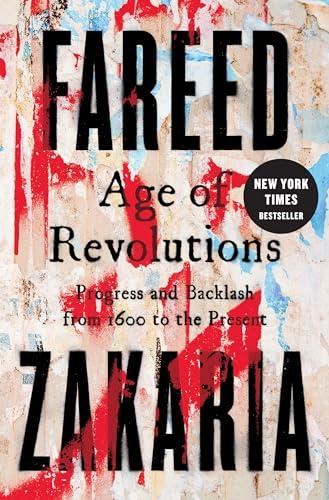
Age of Revolutions: Progress and Backlash from 1600 to the Present Cover
Podcast Mentions

Age of Revolutions Progress and Backlash from 1600 to the Present

Fareed Zakaria

A Populist rage, ideological fracture, economic and technological shocks, war, and an international system studded with catastrophic risk―the early decades of the twenty-first century may be the most revolutionary period in modern history. But it is not the first. Humans have lived, and thrived, th...

Podcasts 8
Quotes 36
The Ezra Klein Show

The host noted that the book, freshly issued in paperback, explores the historical roots of today's far‑right populism by comparing it to earlier eras of political upheaval. He highlighted that the author traces cycles of progress and backlash from the 1600s onward, presenting it as a useful lens for understanding current politics. The tone was appreciative of its relevance to the conversation.

Episode: Fareed Zakaria Thinks Steve Bannon Got One Thing R...

The book examined the historical roots of the current rise of far-right populism by looking at past periods of political upheaval when established certainties crumbled. The paperback version of the book was recently released, marking the occasion for the recorded conversation.

"

Age of Revolutions, which just came out in paperback. Age of Revolutions examines the historical roots for the ongoing rise of far-right populism, but it does so by looking back at other periods in which politics began to topple and fall into upheaval when the things people thought were possible, the things they knew were true, stopped being true.

author of the great book Age of Revolutions, Progress and Backlash from 1600 to the Present, which came out in paperback on November 4th.

Episode: The Dark Heart of Trump's Foreign Policy

Ezra Klein introduced Fareed Zakaria as the author of the bestselling book Age of Revolutions.

"

So I'm joined today by Fareed Zakaria, the host of GPS and CNN, a Washington Post columnist and the author of the bestselling book Age of Revolutions.

Episode: The Civilization Trump Destroys May Be Our Own

Ezra introduced Fareed Zakaria as the author of the book, noting it among Zakaria's other works. The mention was brief and factual.

"

Joining me now is Freed Zakaria, the host of Freed Zakaria GPS on CNN, a columnist for The Washington Post and the author of, among other books, The Age of Revolutions.
Freakonomics Radio

Zakaria's book explores the history of revolutions from 1600 to the present, highlighting the progress and backlash associated with each. He expressed a sense of sadness and surprise about the world's current state of peril, marked by populism and closed thinking.

"

So my sense of reading you overall, particularly reading your new book Age of Revolutions, is a sense of sadness and surprise that the world finds itself today in a state of peril.

— Episode: 583. Are We Living Through the Most Revo...

Episode: 583. Are We Living Through the Most Revolutionary...

Zakaria's book explores the history of revolutions from 1600 to the present, highlighting the progress and backlash associated with each. He expressed a sense of sadness and surprise about the world's current state of peril, marked by populism and closed thinking.

"

So my sense of reading you overall, particularly reading your new book Age of Revolutions, is a sense of sadness and surprise that the world finds itself today in a state of peril.

This one, age of revolutions is subtitled progress and backlash from 1600 to the present.

It's all interesting and well written and insightful but it is the present that I wanted to speak about with Zakaria.

We are living through possibly the most revolutionary period in human history.

Here's what Zakaria writes about Russia Vladimir Putin has harnessed identity politics and ginguism as a response to his nation's structural decline and Zakaria says Putin has done this masterfully.

Pivot

Podcast

Pivot

Zakaria's book, The Age of Revolutions, explores the current state of the world, highlighting the rapid rise of women globally. It emphasizes the significant progress women have made in education, political representation, and economic empowerment, contrasting it with the decline of young men in certain regions, particularly in the United States.

"

I'm reading Fried Zakaria's, what's it called, Age of Revolutions

— Episode: TikTok Ban Approaches, China's App Crack...

Episode: TikTok Ban Approaches, China's App Crackdown, and...

Zakaria's book, The Age of Revolutions, explores the current state of the world, highlighting the rapid rise of women globally. It emphasizes the significant progress women have made in education, political representation, and economic empowerment, contrasting it with the decline of young men in certain regions, particularly in the United States.

"

I'm reading Fried Zakaria's, what's it called, Age of Revolutions

If you look at the United States, the group that has fallen furthest fastest is young men, but if you look at globally the group that hands down has ascended the fastest over the last several decades is women.

Episode: Disney's Victory Lap, Online Privacy, and Guest Ru...

The book discusses how certain conservative wings of religion are uncomfortable with women's ascent, and that defunding is a means of putting them back in their place.

"

And this is both a professor Guyatt and Fridt Zakaria's new book, "The Age of Revolutions," I think it's called.

NPR News Now

The sponsor announced the book Age of Revolutions by Reed Zakaria, describing it as an exploration of past and present revolutions that define the polarized age and stating it was available wherever books are sold.

"

Publishers of Age of Revolutions by best selling author for Reed Zakaria who explores the revolutions past and present that define the polarized age in which we live, available wherever books are sold...

— Episode: NPR News: 04-02-2024 8PM EDT

Episode: NPR News: 04-02-2024 8PM EDT

The sponsor announced the book Age of Revolutions by Reed Zakaria, describing it as an exploration of past and present revolutions that define the polarized age and stating it was available wherever books are sold.

"

Publishers of Age of Revolutions by best selling author for Reed Zakaria who explores the revolutions past and present that define the polarized age in which we live, available wherever books are sold.

The Prof G Pod with Scott Galloway

The book was praised as a fantastic read, with the host noting he was already echoing its thought leadership. In a conversation with the author, it was highlighted for tracing major revolutions from the economic to the modern era, emphasizing the industrial revolution as the most transformative force that lifted humanity out of poverty. The discussion underscored the central argument that each wave of technological and economic change sparks both identity and political revolutions, making the title especially relevant for understanding current global shifts.

Highly Recommended

Episode: Office Hours: Is Nuclear Power the Future?, Is the...

The book was described as a fantastic read, discussing progress and backlash from 1600 to the present.

"

And it's called The Age of Revolutions, Progress and Backlash from 1600 to the present by Fareed Zakaria. It's fantastic and I'm already sort of parroting some of Fareed's thought leadership.

Episode: Conversation with Fareed Zakaria — Revolutions & G...

It walks the reader through pivotal revolutions that have shaped world history, including the economic, French, industrial, and modern-day revolutions of globalization, technology, identity, and geopolitics. The industrial revolution is highlighted as the most transformative, significantly increasing human income since the 18th century.

"

Your new book Age of Revolutions Progress and Backlast from 1600 to the present walks the reader through pivotal revolutions that have shaped world history- the economic revolution, the French revolution, the industrial revolution, and for present day revolutions globalization technology identity and geopolitics.

It would be the industrial revolution. The industrial revolution changed the world.

if you ask yourself what is the single thing that has changed the course of human history? The most discontinuous feature of human life. It is the industrial revolution where finally human beings were able to get themselves out of poverty, out of real grinding medieval poverty and almost on a sustained basis keep raising their standards of living for 250 years.

The central argument of the book is every time you have these massive changes and technology and economics propelling some societies forward dramatically you get two things happen, you get an identity and a political revolution the identity revolution because you start to think of yourself differently.

I think India is probably the next most important one I know India is having a kind of moment in the sun but it's basically justified it's because there's no other country that has the scale that China has and India has that scale and it has an incredibly vibrant economy it's growing from a very slow a small base people don't completely understand when they sort of talk about India as the next China so Chinese economy is still four and a half times bigger than the Indian economy and so it's India is going to have to take a take a while to catch up but it is on that scale.

StarTalk Radio

It was discussed as a near-term techno-thriller that explores brain-computer interfaces and other brain technologies, and was nominated for a Philip K. Dick Award in 2016.

"

And your book 'Revolution', which we will wave here, has just been nominated for the Philip K. Dick Awards for 2016.

— Episode: StarTalk All-Stars at NY Comic Con – The...

Episode: StarTalk All-Stars at NY Comic Con – The Science o...

It was discussed as a near-term techno-thriller that explores brain-computer interfaces and other brain technologies, and was nominated for a Philip K. Dick Award in 2016.

"

And your book 'Revolution', which we will wave here, has just been nominated for the Philip K. Dick Awards for 2016.

Well, this is a near-term techno-thriller, so it's science fiction in the sense that I use real science to see what's happening with the future of brain-computer interfaces and other kinds of brain technologies.

Episode: StarTalk All-Stars at NY Comic Con – The Science o...

It was nominated for the Philip K. Dick Award in 2016 and explores the future of brain-computer interfaces and the ethical implications of altering human perception.

"

Well, this is a near term techno thriller so it's science fiction in the sense that I use real science to see what's happening with the future of brain computer interfaces And other kinds of brain technologies.

As you know Philip K. Dick was all about reality And I play a lot in my book with if we start messing around with different ways of perception If we start connecting ourselves directly to the internet if we start altering our minds so that we Can think smarter faster quote-unquote better.

What if we don't forget? What will that do to us so because I deal a lot in the trippiness of The protagonist experiencing these things I think that's kind of why the Phil K. Dick people were interested in the book because no one was trippier than mr. Dick.

Stay Tuned with Preet

It was described as a very relevant, important and thoughtful book. It explores a number of revolutionary periods in history, from the 17th century Dutch inventors to the French Revolution, to American coal workers.

"

It's called 'Age of Revolutions: Progress and Backlash from 1600 to the Present.'

— Episode: Revolutions, from 1600 to Trump (with Fa...

Episode: Revolutions, from 1600 to Trump (with Fareed Zakar...

It was described as a very relevant, important and thoughtful book. It explores a number of revolutionary periods in history, from the 17th century Dutch inventors to the French Revolution, to American coal workers.

"

It's called 'Age of Revolutions: Progress and Backlash from 1600 to the Present.'

This is much harder.

The weirdness of the Tea Party movement which was essentially trying to take over and transform the Republican Party.

The fact that you were finding in the Republican Party voices that were fundamentally hostile to kind of the old Reagan formula of free trade, open markets, pro-immigration all that made me realize there's something big going on.

The rise of forces like that ended up leading to Brexit.

Episode: Unraveling Foreign Affairs (with Fareed Zakaria)

It is called Age of Revolutions, Progress and Backlash from 1600 to the Present. He looked at the French Revolution and the Industrial Revolution and drew some lessons. He explained that the book took almost a decade to complete because he had to go back to school, but he is very proud of it.

"

It's called Age of Revolutions, Progress and Backlash from 1600 to the Present. And what I'm trying to do is ask myself, why does it feel like we're living in such revolutionary times where our politics is being upended? The Republican Party of Reagan has turned into the party of Trump, which is almost the opposite. The Democrats coalition has completely shifted from blue collar working class to this. Why does the economics seem so different? There was a period of free trade globalization. Now everyone's talking industrial policy. Why does the world seem like it's... And what I did is in a way of trying to teach myself about it, I went back and asked myself, when have we had previous revolutionary periods in human history and what can we learn from them? So I look at the French revolution, I look at the industrial revolution, and I draw some lessons. And it's taken me almost a decade because I had to go back to school, but I'm very proud of it.

Episode: Unraveling Foreign Affairs (with Fareed Zakaria)

The book looks at previous revolutionary periods in history, like the French Revolution and the Industrial Revolution, and draws lessons from them. It is a book about progress and backlash from 1600 to the present, and attempts to explain why it feels like we are living in such revolutionary times.

"

It's called Age of Revolutions, Progress and Backlash from 1600 to the Present.

And what I'm trying to do is ask myself, why does it feel like we're living in such revolutionary times where our politics is being upended?

The Republican Party of Reagan has turned into the party of Trump, which is almost the opposite.

The Democrats coalition has completely shifted from blue collar working class to this, why does the economics seem so different?

There was a period of free trade, globalization. Now everyone's talking industrial policy.

Big Take

Podcast

Big Take

In an episode about Emmanuel Macron’s plan to transform Europe, the hosts referenced the book to illustrate Macron’s vision for sweeping structural reforms in France, noting how his ideas were later reflected in policy. The discussion highlighted the book’s analysis of historical revolutions as a backdrop for contemporary political change, but did not offer a strong endorsement.

Episode: Emmanuel Macron’s Plan to Transform Europe

The book detailed Macron's vision for big structural reforms in France, which he'd later implemented through various policies.

"

Revolution was also the title of Macron's memoir and in that book and on the campaign trail Macron made the case for big structural reforms for France.

Note: The book recommendations on this page are discovered automatically from podcast transcripts, and may be incorrect or incomplete.