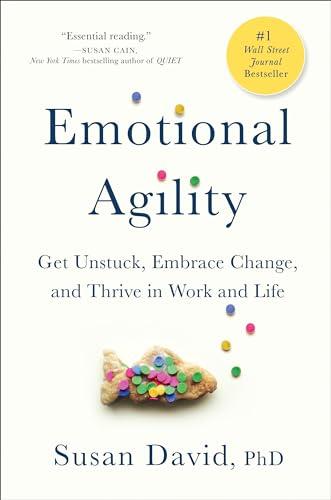

Emotional Agility: Get Unstuck, Embrace Change, and Thrive in Work and Life Cover
Podcast Mentions

Emotional Agility Get Unstuck, Embrace Change, and Thrive in Work and Life

Susan David

#1

Podcasts 5
Quotes 27
The Mel Robbins Podcast

Dr. Susan David, a Harvard Medical School psychologist, has been studying emotions for over 20 years, and this book is about her research and findings. It is the result of decades of work and is a best seller, with her TED Talk being viewed over 10 million times.

"

Her groundbreaking research has concluded that it is your ability to navigate your inner world, meaning your thoughts and feelings and self talk because that inner world ultimately impacts your outer...

— Episode: World Leading Psychologist: How to Maste...

Episode: World Leading Psychologist: How to Master Your Emo...

Dr. Susan David, a Harvard Medical School psychologist, has been studying emotions for over 20 years, and this book is about her research and findings. It is the result of decades of work and is a best seller, with her TED Talk being viewed over 10 million times.

"

Her groundbreaking research has concluded that it is your ability to navigate your inner world, meaning your thoughts and feelings and self talk because that inner world ultimately impacts your outer world of actions, careers, relationships, happiness and health.

Her best selling book is Emotional Agility and Harvard Business Review awarded her the Management Idea of the Year.

On Purpose with Jay Shetty

It was discussed as a guide to navigating complex and changing times, with a focus on emotional skills and the importance of understanding one's emotions.

"

Her most recent book, Emotional Agility, describes the psychological skills critical to thriving in times of complexity and change.

— Episode: Susan David ON: Why You Shouldn’t Avoid...

Episode: Susan David ON: Why You Shouldn’t Avoid Difficult...

It was discussed as a guide to navigating complex and changing times, with a focus on emotional skills and the importance of understanding one's emotions.

"

Her most recent book, Emotional Agility, describes the psychological skills critical to thriving in times of complexity and change.

Even though you wrote this book five years ago, so much of it is so integral to what we're experiencing today.

It's right here. I wanted to ask you this question, just not because I don't judge books by their cover, but I'm fascinated by choice and art and imagery.

If you want to dive deeper, can grab a copy of Susan's book, Emotional Agility, Get Unstuck, Embrace Change and Thrive in Work and Life.

Firstly, Jay has mentioned my book Emotional Agility.

10% Happier with Dan Harris

This book was mentioned as being paired with the current episode's topic as Susan David is an author from Harvard.

"

so we're dedicating this week to emotions and how to surf them rather than drown in them if you missed Monday's episode, go check it out.

— Episode: The Science of Emotional Intelligence |...

Episode: The Science of Emotional Intelligence | Daniel Gol...

This book was mentioned as being paired with the current episode's topic as Susan David is an author from Harvard.

"

so we're dedicating this week to emotions and how to surf them rather than drown in them if you missed Monday's episode, go check it out.

Episode: 4 Ways Not To Be Owned By Your Sh*t | Susan David

This book was introduced as the work authored by the guest, Susan David, Ph.D., a psychologist at Harvard Medical School. It presents an approach called emotional agility for navigating unpleasant emotions, viewing them as data rather than directives.

"

author of a book called Emotional Agility.

Money Rehab with Nicole Lapin

It was discussed in the context of developing emotional skills and navigating challenging emotions in the workplace and personal life. The speaker mentioned it as being more helpful in her business than anything she'd learned on Wall Street.

"

honestly dr. david this has been more helpful to me in business than anything I learned on wall street anything I learned in a book the emotional regulation and the interpersonal effectiveness have by...

— Episode: The Secret to Breaking the Stress Cycle...

Episode: The Secret to Breaking the Stress Cycle with Dr. S...

It was discussed in the context of developing emotional skills and navigating challenging emotions in the workplace and personal life. The speaker mentioned it as being more helpful in her business than anything she'd learned on Wall Street.

"

honestly dr. david this has been more helpful to me in business than anything I learned on wall street anything I learned in a book the emotional regulation and the interpersonal effectiveness have by far been the things that have helped me more in my business in my career than anything else

and bringing that back from like pie in the sky I guess pun intended but to say like those two things can be true in an interpersonal relationship like I can be really pissed at you or I can feel pissed at you but also love you at the same time or like I can have a deal fall through but also feel like in a good place in my business and those opposing things can both be true at the same time and that has really really helped me effectively navigate challenges in business

it was fucking money your money and what she meant is it connected with this value of hers of autonomy and she was basically saying to me suzie you can never be in a situation where you are being mistreated in the workplace or when you're in a relationship where you depended on someone you've always always got to be able to say fuck you

The Jordan Harbinger Show

It was discussed how emotional agility involves accepting and understanding emotions as data points rather than directives. It was also stated that the book discusses how our brains create narratives based on our experiences.

"

In emotional agility, one of the things that I talk about is how our emotions are absolutely fundamental and absolutely functional.

— Episode: 311: Susan David | How to Improve Your E...

Episode: 311: Susan David | How to Improve Your Emotional A...

It was discussed how emotional agility involves accepting and understanding emotions as data points rather than directives. It was also stated that the book discusses how our brains create narratives based on our experiences.

"

In emotional agility, one of the things that I talk about is how our emotions are absolutely fundamental and absolutely functional.

What sometimes happens is we start fusing with our emotions. And what I mean by fusing with our emotions is we might say something like 'I am sad.'

And what does that mean? That means all of me, 100% of me is sad. There's no other space for anything else.

So our emotions are data. Yes, they are signposted things that we care about and our values and they help us to adapt. But they're not directives.

I talk about in my book Emotional Agility is this idea that so often what happens is we land up being hooked, being on autopilot. We learn it becoming very rigid with eye motion.

Episode: 311: Susan David | How to Improve Your Emotional A...

It was discussed that emotional agility is not the same as positive thinking, and it was suggested that the latter can be harmful. It was also mentioned that the book explores how our brains age prematurely if we are emotionally inflexible.

"

I love her work on emotional agility. I think it's absolutely brilliant and answers questions like why do we have emotions in the first place, especially if they're unreliable.

You stayed in the book. What does that actually mean?

Well emotional rigidity what I talk about in my book Emotional Agility is this idea that so often what happens is we land up being hooked, being on auto pilot.

Well you know one of the things that I focus on a lot in my work is really what does emotional health look like and I don't mean emotional health simply from the perspective of mental health you know yes that but what does it fundamentally look like to be healthy with ourselves to be healthy with ourselves to be healthy with our thoughts our emotions and who we are we are to essentially breathe into the wisdom that exists in all of us about how we come to our lives and yet we live in a world in which we are constantly pulled away from that technology and so on as the most obvious example but where there are so many narratives that are you know you're unhappy in your job at least you've got a job so you should just get on with it or you feeling upset about something but don't be too upset because you might be toxic and if you're toxic I don't want to be with you or you know you're going through something really difficult but you've just got to be positive with this thing and so what happens is there's all these countervailing experiences that we have that are stressful for us because really what they do is they take us away from the essence of what emotional health looks like and what is so fundamental to all of us the way we deal with our inner lives drives everything how we love how we come to our relationships how we live how we lead how we parent and so this ability to navigate ourselves effectively is I think one of the most critical components to anything you know it doesn't matter how smart we are it doesn't matter how motivated we are it's this how do we navigate our inner worlds

and you mention in the book that taking this stuff at home bringing your cell phone to the table is your example but trying always really hard to be right or not being flexible and what you're doing. This shows up in our brains age ages are brain and that's a high price to pay it's not just like oh I fight a little bit more with my wife and kids which is bad enough it's and you're probably giving yourself what Alzheimer's or something like that I mean that's bad.

Episode: 311: Susan David | How to Improve Your Emotional A...

It was discussed that emotional agility is not about forcing positivity but rather accepting a full range of emotions, and it was explained how this concept impacts brain health and relationships.

"

I love her work on emotional agility. I think it's absolutely brilliant and answers questions like why do we have emotions in the first place, especially if they're unreliable.

Well emotional rigidity what I talk about in my book Emotional Agility is this idea that so often what happens is we land up being hooked, being on auto pilot.

it's not just like oh I fight a little bit more with my wife and kids which is bad enough it's and you're probably giving yourself what Alzheimer's or something like that I mean that's bad.

in my book I talk about how often what we do is we learn of either brooding on our emotions we say I'm unhappy in my job but at least I've got a job I shouldn't be unhappy or I shouldn't feel this and you know we learn up having a type one emotions and type two emotions

I talk in emotional agility about what the funk and what I mean by what the funk is what is the function of your story or what is the function of an emotion that you're experiencing is the function to self protect you

Note: The book recommendations on this page are discovered automatically from podcast transcripts, and may be incorrect or incomplete.