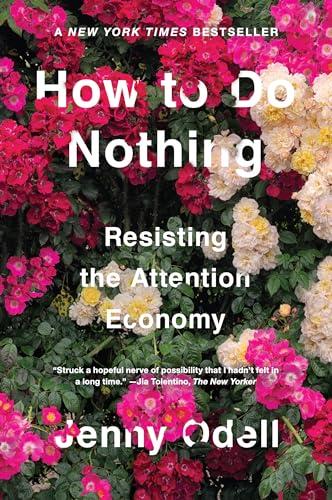
How to Do Nothing: Resisting the Attention Economy Cover
Podcast Mentions

How to Do Nothing Resisting the Attention Economy

Jenny Odell

** A

Podcasts 6
Quotes 28
Pod Save America

It was written as a reaction to the 2016 election, and discussed the importance of resisting the attention economy, suggesting ways to redirect attention to the people and places around us, instead of feeling constantly connected.

"

It's called How to Do Nothing, Resisting the Attention Economy.

— Episode: Offline: Jenny Odell on How to Do Nothin...

Episode: Offline: Jenny Odell on How to Do Nothing

It was written as a reaction to the 2016 election, and discussed the importance of resisting the attention economy, suggesting ways to redirect attention to the people and places around us, instead of feeling constantly connected.

"

It's called How to Do Nothing, Resisting the Attention Economy.

I bought your book a few years ago, but I didn't read it until last September for one of the very reasons that you wrote the book, which is that it's become harder for me to pay attention to anything longer than a tweet.

So I really wanted to thank you for writing it because it's it's changed the way I think about how I spend my time.

What if we spent less time shouting into the void and being washed over with shouting in return and more time talking in rooms to those for whom our words are intended?

I think that's why Barack Obama really liked it, but I do think it's sort of the way that social media operates really is just a lot of people shouting past each other all the time and there's just not a lot of sort of one-on-one conversation, but that's the way we are most of the time.

Episode: Offline: Jenny Odell on How to Do Nothing

It was written as a response to the 2016 election and encourages readers to resist the attention economy by redirecting their focus to their surroundings and communities.

"

It's called How to Do Nothing, Resisting the Attention Economy.

I bought your book a few years ago, but I didn't read it until last September for one of the very reasons that you wrote the book, which is that it's become harder for me to pay attention to anything longer than a tweet.

You start by telling the story of why you wrote How to Do Nothing, which was partly a reaction to the 2016 election.

What if we spent less time shouting into the void and being washed over with shouting in return and more time talking in rooms to those for whom our words are intended?

I first learned about your book because it was on Barack Obama's book list, you know, my former boss and I was like, I'm I was wondering why he was so into this book...
My Favorite Murder with Karen Kilgariff and Georgia Hardstark

It was described as a self-help book that Georgia was reading and hoped would help her leave behind the judgment she felt when not doing anything.

"

I'm reading a book called How to Do Nothing. It's like a self-help book.

— Episode: 363 - Landed In Marshmallows

Episode: 363 - Landed In Marshmallows

It was described as a self-help book that Georgia was reading and hoped would help her leave behind the judgment she felt when not doing anything.

"

I'm reading a book called How to Do Nothing. It's like a self-help book.

Episode: 257 - Monster Machine

It was described as a philosophical self-help manual that encouraged a mindset of self-care, rather than simply completing tasks.

"

It's called How to Do Nothing Resisting the Attention Economy.

The Ezra Klein Show

The book was highlighted as a spiritually rich, distinctive work that offered a collective, radical approach to managing attention. Chris Hayes praised it as a canonical text, and a host later called it the best book on attention for finding space in a distracted era. Both mentions presented it as a top recommendation for listeners seeking to understand the attention economy.

Highly Recommended

Episode: Democrats are Losing the War for Attention. Badly.

It was described as a distinctive, spiritually rich work that offers a collective, radical approach to attention and personal practice.

"

Another book that has been mentioned on your podcast a lot and relevant, which is, again, I feel like I'm sort of citing canonical texts here... Jenny Odell's How to Do Nothing is a fantastic book. It's strange and distinct and is much more spiritually omnivorous than the book that I've written.

Episode: On Children, Meaning, Media and Psychedelics

The conversation highlighted the book as a top recommendation for learning about attention and finding space in a distracted era, calling it the best book on the subject.

"

you mentioned the last answer you said talked about reading how to do nothing which is by Jenny O'Dell and I still think it's the best book about attention and how to find in this era I've enjoyed this so much

Episode: Best Of: Is A.I. the Problem? Or Are We?

The book was presented as a love letter to the neighborhood park and a critique of the attention economy, linking human motivation to AI objective functions.

"

I'm thinking about a book by my friend, Jenny O'Dell called How to Do Nothing, Resisting the Attention Economy.

It's on one level, you know, a love letter to her neighborhood park. And at another level, you know, an invitation to think about a world in which most of our activity is directed at some kind of objective.

We Can Do Hard Things

It was inspired by her experience with social media after the 2016 election and the Oakland Ghost Ship fire, where she felt like the spaces for reflection and art were under threat. She found peace and reflection by spending time in a city rose garden.

"

I felt like I couldn't have a thought and that I was like everyone was upset for very obvious reasons, but I felt like I couldn't even articulate what I wanted, how I felt or what I wanted to mourn or...

— Episode: 261. How to Stretch Time with Jenny Odel...

Episode: 261. How to Stretch Time with Jenny Odell

It was inspired by her experience with social media after the 2016 election and the Oakland Ghost Ship fire, where she felt like the spaces for reflection and art were under threat. She found peace and reflection by spending time in a city rose garden.

"

I felt like I couldn't have a thought and that I was like everyone was upset for very obvious reasons, but I felt like I couldn't even articulate what I wanted, how I felt or what I wanted to mourn or whatever.

It's like a place that capitalism might deem worthless. Right?

And it's like an end in itself. It's not a means to another end.

It's sort of like, I don't think that, you know, just learning to see things differently is the answer or the end of that sort of journey. Right? But it is, I think, a really important preliminary step of sort of like, okay, everything looks different and now you look around.

It's like paying attention to what? I used to become morbidly fascinated with how I would look when I was on social media, around the time that I wrote How to Do Nothing.

Episode: 76. Brandi Carlile: Live From My Couch!

Glennon referred to Jenny Odell's book, How to Do Nothing, as a beautiful book discussing the concept of uselessness and how it can lead to beauty and life, which relates to the Broken Horses concept.

"

It's about this tree and there's this tree. It's like the single standing tree in this park in California somewhere. And the reason it's still standing is because when they came to cut down all the trees to use them for lumber, this tree was so twisty and weird and weak looking that they didn't take it down.

Episode: 19. SISTER ACT: Who is Amanda—and seriously, how d...

Glennon Doyle described it as a life-changing book that she has reread multiple times, focusing on resisting the attention economy and being present in real life instead of online.

"

So what I'm doing right now is I'm rereading for, I think it might be the third time, this book that changes my life over and over again each time I read it because it's so dense that there's so much more I get from it. And it's called How to Do Nothing and it's by Jenny O'Dell.

This book, I think it's what everybody needs because it's about resisting the attention economy, which basically means that we are all living these less than human lives because we are constantly giving all we have to really give to life in this one wild and precious life we have is our attention, what we're paying attention to.

And the world has tricked us into paying attention to these little screens and these hot takes on everything and this angst and terror and fear and division through these little screens.

And really it's not benefiting us in any way, it's only benefiting like a very few social media companies. And so basically we've all been bamboozled and because we are choosing and have become addicted to paying attention to this other thing, we are missing real life, which is so beautiful and much less horrific and scary in many ways to be connected to the moment and to the human beings and to the place that we're in.

It's so good, y'all, it's so good.

Search Engine

This book contains a quote that resonated with Ezra Klein, prompting him to shift his focus from broadcasting to a smaller, more intimate audience.

"

I had been thinking about this line from genie o'dell's wonderful book How to do nothing where she talks about what if she's a Thing where she says what if we spent more time Talking to people who had...

— Episode: Is there a sane way to use the internet?

Episode: Is there a sane way to use the internet?

This book contains a quote that resonated with Ezra Klein, prompting him to shift his focus from broadcasting to a smaller, more intimate audience.

"

I had been thinking about this line from genie o'dell's wonderful book How to do nothing where she talks about what if she's a Thing where she says what if we spent more time Talking to people who had the context to understand us And less time Trying to create things for people who have no context For what we're saying

Note: The book recommendations on this page are discovered automatically from podcast transcripts, and may be incorrect or incomplete.