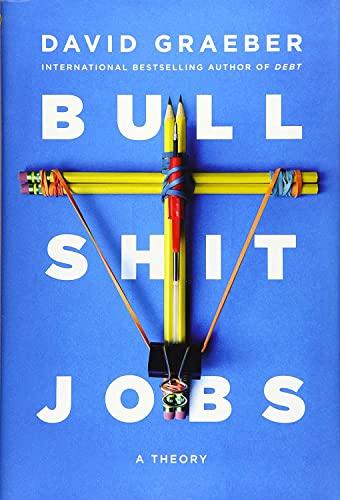
Bullshit Jobs: A Theory Cover
Podcast Mentions

Bullshit Jobs A Theory

David Graeber

From bestselling writer David Graeber, a powerful argument against the rise of meaningless, unfulfilling jobs, and their consequences.

Podcasts 7
Quotes 67
The Joe Rogan Experience

It was mentioned as a great book about the concept of ideas and going to college.

"

rest in peace David Graeber.

— Episode: #2157 - Duncan Trussell

Episode: #2157 - Duncan Trussell

It was mentioned as a great book about the concept of ideas and going to college.

"

rest in peace David Graeber.

I wrote a great book called Bullshit Jobs.

Brilliant mind, man.

Brilliant mind.

But he basically talks about how like, so ideas, I'm gonna go to college.

The Ezra Klein Show

Saunders referenced Graeber's book Bullshit Jobs, explaining that it examines jobs people feel are useless yet still get paid to do.

"

Have you ever read the late David Graeber's book, Bullshit Jobs? ... it's about this idea of jobs that the people doing them think need not exist. There are many jobs, and you can poll people and they...

— Episode: George Saunders on the ‘Braindead Megaph...

Episode: George Saunders on the ‘Braindead Megaphone’ That...

Saunders referenced Graeber's book Bullshit Jobs, explaining that it examines jobs people feel are useless yet still get paid to do.

"

Have you ever read the late David Graeber's book, Bullshit Jobs? ... it's about this idea of jobs that the people doing them think need not exist. There are many jobs, and you can poll people and they will tell you this, where they think that what they are doing is useless.

Hidden Brain

It was discussed at length, and was described as an anthropological theory behind the concept of jobs that feel pointless.

"

David Graeber has spent quite a bit of time thinking about the many, many real-life versions of Michael Scott. He's a professor of anthropology at the London School of Economics, and he's the author o...

— Episode: BS Jobs

Episode: BS Jobs

It was discussed at length, and was described as an anthropological theory behind the concept of jobs that feel pointless.

"

David Graeber has spent quite a bit of time thinking about the many, many real-life versions of Michael Scott. He's a professor of anthropology at the London School of Economics, and he's the author of the book, Bullshit Jobs, A Theory.

So you wrote this essay a couple of years ago that has now turned into a book, and you described an entire category of jobs you call these bullshit jobs.

You teach at the London School of Economics, but before that, you worked at Yale University in your book, David, you point out that the cost of education has skyrocketed in many parts of the world.

David Graeber is a professor of anthropology at the London School of Economics. He studies theories of value and social constructs. He's the author of the book Bullshit Jobs.

Episode: Bullshit Jobs

The book discussed the rise of pointless jobs and how they impact individuals, emphasizing the negative psychological consequences and societal effects of such roles.

"

So you wrote this essay a couple of years ago that has now turned into a book, and you described an entire category of jobs you call these bullshit jobs.

And they're not necessarily menial jobs or boring jobs, but they're almost always pointless jobs.

David Graeber is a professor of anthropology at the London School of Economics, and he's the author of the book, Bullshit Jobs, A Theory.

David Graeber is a professor of anthropology at the London School of Economics. He studies theories of value and social constructs. He's the author of the book Bullshit Jobs.

Modern Wisdom

The book was cited across three episodes as a vivid illustration of absurd bureaucratic procedures and the toll of meaningless work. Hosts used it to explain how such jobs can lead to burnout and reduce productivity, and one guest called it a good read on the subject. Overall, the discussions highlighted the book’s insightful critique of pointless labor and its relevance to listeners seeking purpose in their work.

Highly Recommended

Episode: #660 - Peter Akkies - 7 Hacks To Master Your Produ...

The book "Bullshit Jobs" was mentioned in the discussion of productivity purgatory and how some people engage in tasks that don't align with their values or goals. The conversation hinted at the concept of meaningless work and the potential for burnout.

"

what was this guy who wrote this this book called bullshit jobs I think yeah fantastic concept if you have a bullshit job you don't care about it and you're close to burnout and you're starting to make yourself go on walks just to calm down so you don't burn out like now you're doing the thing that you're describing which I think is really really bad

Episode: #1008 - Angelo Sommers - Why Life Feels So Pointle...

The book was mentioned while illustrating an absurd bureaucratic process involving moving a computer.

"

There was a story in David Graeber's bullshit jobs about a guy that wanted to move his computer ... it included like four different companies, two moving vans, ... six people, like a few thousand dollars

Episode: #1004 - Sam Corcos - Inside DOGE, The IRS & How t...

The book was mentioned as a good read about meaningless work, though the guest admitted they hadn't read it but were familiar with its premise.

"

There's a really good book. Do you ever read the book? Bullshit jobs.

Shell Game

Podcast

Shell Game

In the episode, the hosts explained that the book argued a large portion of modern employment consists of pointless, unnecessary roles, which the author termed "bullshit jobs." They noted his analysis suggested up to half of all jobs, especially many white‑collar positions, might fall into this category, and discussed how such roles affect workers and society. The discussion was informational rather than a strong endorsement.

Episode: Episode 8: Launch

Graeber argued that a large share of modern employment consists of pointless, unnecessary roles he called "bullshit jobs," and he examined how this phenomenon affects workers and society.

"

Over a decade ago, the anthropologist David Graeber wrote an essay in a small magazine called Strike titled On the Phenomenon of Bullshit Jobs. Later, he expanded it into a book called Bullshit Jobs, a Theory. The theory tried to explain a strange reality that Graeber felt he'd encountered in the world. A surprising number of people who described their own jobs as pointless.

Graeber collected and analyzed survey data that led him to suggest that as many as a third or even a half of all jobs, especially many whitecollar jobs, were in fact bullshit jobs. He defined them as employment that is so completely pointless, unnecessary, or pernicious that even the employee cannot justify its existence.

Behind the Bastards

The author's most famous book, it focuses on bureaucracy and the impact it has on work.

"

Bureaucratic knowledge is all about schematization. In practice, bureaucratic procedure invariably means ignoring all the subtleties of real-life existence and reducing everything to preconceived mech...

— Episode: It Could Happen Here Weekly 69

Episode: It Could Happen Here Weekly 69

The author's most famous book, it focuses on bureaucracy and the impact it has on work.

"

Bureaucratic knowledge is all about schematization. In practice, bureaucratic procedure invariably means ignoring all the subtleties of real-life existence and reducing everything to preconceived mechanical or statistical formula.

Bureaucratic violence should consist first and foremost on attacks on those who insist on alternative schemas or interpretations.

Episode: It Could Happen Here Weekly 61

The book highlighted how many jobs, particularly in the service economy, are practically worthless.

"

If you've read Bullshit Jobs by David Graeber, you'll see that a lot of particularly service economy jobs are practically worthless.

Episode: It Could Happen Here Weekly 11

It was discussed as a great modern resource about anti-work ideas. The book was partially inspired by 'The abolition of work', and it was mentioned in the context of the argument that a lot of work isn't necessary.

"

Bullshit jobs by David Graeber and Bullshit jobs was also kind of partially inspired by Bob Black's the the abolition of work

The bullshit jobs is definitely very timely and even even even crime thinks workbook Also also addresses stuff or even though it's wasn't not written within the past I I think it is maybe slightly older than a decade

One of the things he's argues in bullshit jobs. Is that basically? You know, okay. So so if you have

And another part of like anti-work theories is looking is looking at our society as it's built, you know Because it is it is tied to anarchism be like how much of this is actually necessary

The amount of extra energy we have by not having 10-hour horrible shifts that drain ourselves mentally and physically and More in with you know with the amount of most of the work that we people do as shown in David Graeber's

Episode: It Could Happen Here Weekly 11

Bullshit Jobs was said to be a great resource for a modern outlook on anti-work ideas, and was partially inspired by Bob Black's "The Abolition of Work".

"

Also "Bullshit Jobs" by David Graeber and "Bullshit Jobs" was also kind of partially inspired by Bob Black's "The" the abolition of work.

The bullshit jobs is definitely very timely and even even even crime thinks workbook Also also addresses stuff or even though it's wasn't not written within the past I I think it is maybe slightly older than a decade

One of the things he's argues in "Bullshit Jobs" Is that basically? You know, okay, So so if you have like you have the Soviet economy, right?

And you know what it points to is it like yeah, you know a graver called this total bureaucratization which is that you know What we did instead of like giving ourselves more free time is created this just like endless enormous incredibly violent bureaucracy

And another part of like anti-work theories is looking is looking at our society as it's built, you know Because it is it is tied to anarchism be like how much of this is actually necessary like how do we do we really need a McRib?

Episode: It Could Happen Here Weekly 11

The book "Bullshit Jobs" by David Graber was mentioned as a great modern anti-work resource that was partially inspired by "The Abolition of Work" by Bob Black.

"

And also Bullshit Jobs by David Graber.

And the Bullshit Jobs is definitely very timely.

And I think this is one of the things speaking of you talk about David Graeber earlier, who's an anarchist, anthropologist and widely seen to be like one of the most brilliant anthropologists of his generation. He recently deceased. But a book that he wrote before he died with another and another fellow came out recently called The Dawn of Everything that talks a lot about how, yeah, these ideas that kind of capitalism has a vested interest in you believing that the world was always hard in the way that it's hard.

And I think also even if you go towards things that like look more like labor to us, right, like I don't know, like look like if you look at like feudal levies, right, you're a peasant. You have to give some amount of grain to your lord. But like, OK, we work way longer than medieval peasants did. And not only do we work longer, it is something Graber and David Wenger talk about in that book is like, yeah, like not only do we work much longer, like the amount that we work would have been considered absolutely like even even a feudal lord would look at that much work and go, no, like this is this is this is like.

And this is also something that comes up in tribe by younger, the way in which like during the early period of colonization of North America, it was very common for, you know, Europeans to leave the cities and towns being established behind and join up with the tribes. Yeah. The reverse never happened. Like, yeah, like not willingly, not without kidnapping being a part of it. And it's because like their attitude was they were looking at the lives these people were living in these cities and like, well, why would you agree to do that?

One of the things he argues in bullshit jobs is that basically. You know, OK, so so if you have like you have the Soviet economy, right? OK, so the Soviet economy has has a policy of full employment. And for a little bit, they were like, OK, what if we make everyone work less? And then they stopped and then like everything went to shit. So, you know, OK, but if you can't make people work less hours and everyone has to work, what do you do?

And one of the great is like funniest points that he brings up is that the total number of bureaucrats in the ex USSR like increased dramatically after the USSR fell. Which is incredible.

And another part of like anti work theory is looking is looking at our society as it's built, you know, because it is it is tied to anarchism and be like, how much of this is actually necessary? Like, how do we do we really need a McRib? Like, do we do? Well, what do you what do you what do you do?

And there's been some criticisms of that, but it is undoubted that a very significant amount of total labor time spent is stuff that isn't necessary for any reason of like making people's lives better.

Yeah, there's like there's some quibbling about because the book was based off of a study, like a survey that kind of showed a lot of very significant chunk of the workforce thinks their job is like pointless and doesn't do anything.

And, you know, with the amount of most of the work that we people do, as shown in David Graper's bullshit jobs, is like not necessary. Like a lot of like a lot of the work that we do as a whole is not.

And I think the best thing about what you've said, in my opinion, is the idea that like this is not. The importance is not on whether or not this this causes everyone to stop having to work immediately, like whether or not it leads to, you know, directly to like the measure of success of this movement isn't that nobody ever has to work again. That's a that's a long term goal.

The measure of the success of this movement is that people accept in mass that know the American dream as it's sold to people is not a good thing. It's not a thing to aspire to. Work is bullshit and we should aspire to a society that doesn't do it.

Episode: It Could Happen Here Weekly 11

It was mentioned as a good resource for a modern outlook on the anti-work movement, with the author's insights on the pointless nature of work in modern society.

"

Bullshit Jobs by David Graber.

And Bullshit Jobs was also kind of partially inspired by Bob Black's "The Abolition of Work".

And the Bullshit Jobs is definitely very timely.

And I think this is one of the things speaking of you talk about David Graeber earlier, who's an anarchist, anthropologist and widely seen to be like one of the most brilliant anthropologists of his generation.

And in fact, most of human civilization, people have not done a thing that we would recognize as labor.

And I think also even if you go towards things that like look more like labor to us, right, like I don't know, like look like if you look at like feudal levies, right, you're a peasant.

And not only do we work longer, it is something Graber and David Wenger talk about in that book is like, yeah, like not only do we work much longer, like the amount that we work would have been considered absolutely like even even a feudal lord would look at that much work and go, no, like this is this is this is like.

He wrote a piece called Turning Modes of Production Inside Out where he has this argument that like, OK, so if you take, you know, if you take like Plato, right, you're like you take any of the Greek philosophers, even the conservative ones, and you show them this, the thing the thing that we do every day.

And I think the specific thing with Greece is that like, you know, you the only way you could do that to someone in Greece is if you owned them.

But it's just to say that, like the kinds of things that we think of as normal, like are things that like the people who, you know, the people who run the system and the people who, you know, get cited all the time, justify stuff would have looked at as like the worst thing that could possibly have happened to a society.

Like it's it's and if you think about it that way, like one of the things Graber does a good job of going into is like the way in which and this is also something that comes up in tribe by younger, the way in which like during the early period of colonization of North America, it was very common for, you know, Europeans to leave the cities and towns being established behind and join up with the tribes.

And this is turning anyway, Garrison, you should you should take us back on the rails.

And I think, you know, but I think the specific thing with Greece is that like, you know, you the only way you could do that to someone in Greece is if you owned them.

One of my favorite ways to think about anti work is just like anti capitalism put into actual practice.

So it's sort of, you know, just debating online about anti capitalism as some, you know, future things like, no, like what can you do to actually, you know, make capitalism a less important part of how you live your life every day, which means, you know, not obsessing over careers and all these kind of other things.

And another part of like anti work theory is looking is looking at our society as it's built, you know, because it is it is tied to anarchism and be like, how much of this is actually necessary?

And I think, you know, it's humans.

So, you know, the the main point, one of the main points of the abolition of work, I say by Bob Black is about like no one should work because because work is as defined as like as like as like a forced labor practice is you can kind of track this to being the source of most of the misery in the world from, you know, in individual people who are forced to do this.

So, you know, I I kind of I kind of I kind of look at this as like the I kind of look at this as like whenever I have to turn the compost, which is not my favorite thing to do.

It's not the problem is not the individual tasks necessarily.

And again, one of the things and I think this is one of the things speaking of you talk about David Graeber earlier, who's an anarchist, anthropologist and widely seen to be like one of the most brilliant anthropologists of his generation.

Odd Lots

Podcast

Odd Lots

It was described as dystopian and compared to the work of Sherry Turkle. The book details how much dissatisfaction people seem to have with a lot of modern day jobs.

"

I've been reading oh I'm gonna have to censor myself BS jobs by David Graber and it's sort of like a dystopian studs turkle in the sense that it just details how much dissatisfaction people seem to ha...

— Episode: How The American Workforce Got Hooked on...

Episode: How The American Workforce Got Hooked on Adderall

It was described as dystopian and compared to the work of Sherry Turkle. The book details how much dissatisfaction people seem to have with a lot of modern day jobs.

"

I've been reading oh I'm gonna have to censor myself BS jobs by David Graber and it's sort of like a dystopian studs turkle in the sense that it just details how much dissatisfaction people seem to have with a lot of modern day jobs where you feel like you're not really doing anything there's a lot of bureaucracy involved and yet you have to pay attention per Danielle's point so I think there's an aspect of that in there.

Note: The book recommendations on this page are discovered automatically from podcast transcripts, and may be incorrect or incomplete.