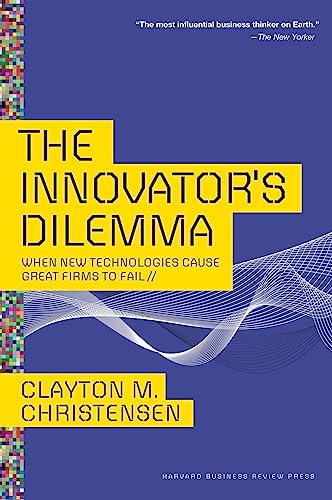
The Innovator's Dilemma: When New Technologies Cause Great Firms to Fail (Management of Innovation and Change) Cover
Podcast Mentions

The Innovator's Dilemma When New Technologies Cause Great Firms to Fail (Management of Innovation and Change)

Clayton M. Christensen

Named one of 100 Leadership & Success Books to Read in a Lifetime by Amazon Editors The bestselling classic on disruptive innovation, by renowned author Clayton M. Christensen.

Podcasts 8
Quotes 13
Huberman Lab

The author refers to "The Innovator's Dilemma" as an example of how a company's culture can influence its success, and the importance of fostering a "culture of growth" where mistakes are embraced as learning opportunities.

"

Now, the layperson could draw a line between that and like the Zoon and Bing and other like failed products.

— Episode: Dr. David Yeager: How to Master Growth M...

Episode: Dr. David Yeager: How to Master Growth Mindset to...

The author refers to "The Innovator's Dilemma" as an example of how a company's culture can influence its success, and the importance of fostering a "culture of growth" where mistakes are embraced as learning opportunities.

"

Now, the layperson could draw a line between that and like the Zoon and Bing and other like failed products.

You know, that's I'll leave that to organizational scholars to decide if that's the story but at least the cautionary tale is like Boeing is another example where Calhoun when he came in as a CEO changed the incentive scheme at Boeing to be something called stack ranking which is where you fire the bottom 10% every six months or a year within your group.

So if your group might be higher performing on average than some other group but the bottom 10% of your group are getting fired.

Okay, and this goes back to GE it's a Jack Welch policy.

Anyway, so that happened two years ago and look what's happened in the last two years.
The Diary Of A CEO with Steven Bartlett

Arianna Huffington referenced the book as one of her favorites, using it to illustrate how highly successful incumbents often overlook disruptive opportunities because of their existing success. She explained that this dynamic allowed the Huffington Post to enter the market as a scrappy, unencumbered challenger. The discussion highlighted the book's insight into why established firms fail to innovate, and it was presented in a strongly positive light.

Highly Recommended

Episode: Arianna Huffington: I Was Lying In A Little Pool O...

Arianna Huffington referenced this book by Clayton Christensen. She used it to explain how established, successful companies sometimes miss opportunities for innovation because of their existing success.

"

the Clay Christensen book the innovators dilemma yes one of my favorite books it's amazing so you know if the New York Times had done then what it's doing now so successfully you know having a great digital presence there would have been no room for the Huffington Post so basically that's the innovators dilemma super successful incumbents miss the moment because they're super successful incumbents

Episode: Arianna Huffington: I Was Lying In A Little Pool O...

The book was referenced in relation to the Huffington Post's success. Huffington explained how established companies, like the New York Times, could miss opportunities due to their existing success and resistance to change, thus opening the door for disruptive innovations like the Huffington Post.

"

I think the mistake often is you build something successful and you stay there and we never stayed there like we launched with politics and news but very quickly we had a dozen other verticals including sleep we had a vertical on sleep we had lifestyle verticals with sports verticals with gay vertical so we kept expanding and then we built our journalism operation we won a Pulitzer we launched in 18 countries so it was a constant expansion and what happened is that again you know the Clay Christensen book the innovators dilemma yes one of my favorite books it's amazing so you know if the New York Times had done then what it's doing now so successfully you know having a great digital presence there would have been no room for the Huffington Post so basically that's the innovators dilemma super successful incumbents miss the moment because they're super successful incumbents yeah and you were young you were scrappy as a company so you could you weren't encumbered by an old way of doing things and old revenue models you could come into the market with a fresh new idea and off it went and it went so far went to the UK and I was 18 years old when I applied to write on the Huffington Post yes amazing I got accepted and I submitted how many articles maybe four or five articles that got published on there but I want to talk about business I want to talk about building a business and what you learned about building a business from the rise of the Huffington Post what are the most important if I was one of your daughters and I came to you I said mum listen I want to build a business and I want it to be even bigger than the Huffington Post grew to be what are the most important things I be thinking about to be successful so I would now start with the founder or the CEO which is put your own oxygen mask on first very often you know you're a founder you think I need to stay up Steven is that you no we talking about didn't we talk about I get asleep every day I need to stay up all day and night sleep with my phone in case something happens in the middle of the night and all the science now makes it very clear that when we are depleted we are going to make bad decisions it's so funny because one night I was at a dinner and Jeff Bezos I that was when I was writing my book on sleep and so I was asking everybody about their sleep habits so I asked him what his sleep habits and he said I sleep eight hours a night and I said you do tell me about it why he said because I'm judged by the quality of my decisions not the quantity of my decisions and and I have noticed the difference because he's very data driven when I have six hours of sleep my decisions are not as good so I said you must write about it he said which I used to say to everybody who knows and and he said no no no no I said I'm a private man I don't need to write about it I said please write about it it's not for you it's going to help so many people who want to be you to realize that they don't need to be sleep deprived and exhausted so I literally bugged him texted him for like three months until finally he wrote about it I think to get me off his back and it was amazing he wrote about it on thrive that we had just launched thrive it was everywhere CNBC the Wall Street Journal he was one of the first CEOs to write about sleep as a performance multiplier a productivity multiplier since then you know Satya Natela has written about it a lot of CEOs have written about a lot of founders in Silicon Valley now people have gone from bragging about how sleep deprived they are I'm wearing my order ring you're looking now yeah you're wearing your hoop and you're an investor I love it's fantastic so everything has changed but it's changed very fast 2016 when I wrote the book people were still bragging about sleep deprivation you know sleep deprivation well I do I mean I collapsed but from sleep deprivation and from buying into this collective delusion that in order to succeed it was two years into building the Huffington Post I was the divorced mother of two little girls and I had bought into this delusion that in order to be super founder and super mom I didn't have the luxury to take care of myself.

Pivot

Podcast

Pivot

It was discussed as a seminal work in the field of business strategy, particularly regarding disruptive innovation. The book's concepts regarding legacy assets and the challenges incumbents face were highlighted.

"

he coined the term disruptive innovation and that was the notion that one it wasn't macro that companies actually could make decisions that were the driving factors in creating innovation or and or th...

— Episode: Kara’s back in action; a listener questi...

Episode: Kara’s back in action; a listener question on WeWo...

It was discussed as a seminal work in the field of business strategy, particularly regarding disruptive innovation. The book's concepts regarding legacy assets and the challenges incumbents face were highlighted.

"

he coined the term disruptive innovation and that was the notion that one it wasn't macro that companies actually could make decisions that were the driving factors in creating innovation or and or that disruption was a function of how poor the incumbents were

and that is the innovators dilemma which everyone says but most people understand what it means and that is companies have such a vested interest in protecting their legacy assets that they're somewhat love to innovate and then a small company comes in and even at the fringes says you know I'm not going to go after all of e-commerce I'm not going after Sears or Walmart I'm just going to go after books and the incumbents ignore them we're not going to go after movies we're not going to go after original scripted TV shows we're just going to ship people cute little CDs in the mail and everybody ignores them because they're tiny and they're not a threat oh we're Luxautica we're not worried about that cute little company that sends five pairs of glasses to your home for that ridiculously cheap price of 99 bucks and they start biting at your ankle and then you wake up and there's such incredible value proposition they're so nimble they're so hungry they're so unafraid they have so few legacy assets that inhibit or hamstring their decisions you wake up and you no longer have a little poodle at your ankle a great white shark has you halfway up you know and it's your torso is halfway in this great white shark

How I Built This with Guy Raz

It was mentioned in relation to the concept of shrinking a traditional pizza oven into a more portable, consumer-friendly version, like the transition from mainframes to personal computers.

"

Yeah, famous Harvard Business School professor who's no longer alive, but wrote The Innovator's Dilemma, right?

— Episode: Ooni Pizza Ovens: Darina Garland and Kri...

Episode: Ooni Pizza Ovens: Darina Garland and Kristian Tapa...

It was mentioned in relation to the concept of shrinking a traditional pizza oven into a more portable, consumer-friendly version, like the transition from mainframes to personal computers.

"

Yeah, famous Harvard Business School professor who's no longer alive, but wrote The Innovator's Dilemma, right?

Mick Unplugged

The book was referenced while discussing how successful companies often forget the origins of their success and face the classic innovator's dilemma.

"

Because the innovator's dilemma, most companies that have been successful don't remember how they got there.

— Episode: Blair LaCorte Unpacks Coaching, Curiosit...

Episode: Blair LaCorte Unpacks Coaching, Curiosity, and Cul...

The book was referenced while discussing how successful companies often forget the origins of their success and face the classic innovator's dilemma.

"

Because the innovator's dilemma, most companies that have been successful don't remember how they got there.

Think Fast Talk Smart: Communication Techniques

Whitney Johnson learned about disruption from Clayton Christensen, who wrote The Innovator's Dilemma and was a professor at Harvard Business School. The book was described as focusing on disruption in the context of products, services, companies, and countries.

"

So disruption, it's a term that I learned from Clayton Christensen. He was a professor at the Harvard Business School and wrote a book called The Innovator's Dilemma.

— Episode: 147. Disrupt Yourself: How to Innovate W...

Episode: 147. Disrupt Yourself: How to Innovate Who You Are...

Whitney Johnson learned about disruption from Clayton Christensen, who wrote The Innovator's Dilemma and was a professor at Harvard Business School. The book was described as focusing on disruption in the context of products, services, companies, and countries.

"

So disruption, it's a term that I learned from Clayton Christensen. He was a professor at the Harvard Business School and wrote a book called The Innovator's Dilemma.

Acquired

Podcast

Acquired

It was one of the books that inspired Ben's Aggregation Theory. It was one of the things.

"

I was inspired by Clay Christensen disruption theory.

— Episode: Stratechery (with Ben Thompson)

Episode: Stratechery (with Ben Thompson)

It was one of the books that inspired Ben's Aggregation Theory. It was one of the things.

"

I was inspired by Clay Christensen disruption theory.

Note: The book recommendations on this page are discovered automatically from podcast transcripts, and may be incorrect or incomplete.