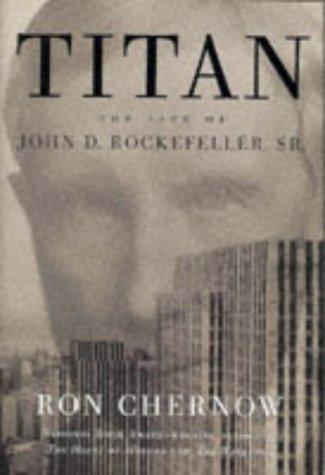
It was described as the definitive biography of John Davison Rockefeller, and served as the primary source material for this episode.
"
the story of John D. Rockefeller transports us back to a time when industrial capitalism was raw and new in America and the rules of the game were unwritten as yet.
the old man had a passion for money that amounted almost to a craze. I never met a man who had such a love of money, except of course for his son in the future.
I believe the power to make money is a gift from God just as are the instincts for art, music and literature to be developed and used to the best of our ability for the good of mankind. Having been endowed with the gift I possess, the gift to make money, I believe it is my duty to make money and still more money and to use the money I make for the good of my fellow man.
John betrayed a special affinity for accounting and an almost mystic faith in numbers. For Rockefeller, ledgers were sacred books that guided decisions and saved one from fallible emotion.
Clark was an old grandmother and was scared to death because we owed money to the banks.
the war had stimulated growth in the use of kerosene by cutting off the supply of southern turpentine, which had yielded a rival illuminant called a campine. The war had also disrupted the whaling industry and led to a doubling of whale oil prices. Moving into the vacuum, kerosene emerged as an economic staple and was primed for a furious post-war boom. This burning fluid extended the day in cities and removed much of the lonely darkness from rural life. Soon, John D. Rockefeller would reign as the undisputed king of that world.
you see this scheme is bound to work. It means an absolute control by us of the oil business. There is no chance for anyone outside but we are gonna give everybody a chance to come in. You are to turn over your refinery to my appraisers and I will give you standard oil company stock or cash as you prefer for the value that we put on your business. I advise you to take the stock. It will be for your own good.
as the owner of almost all the Erie and New York central tank cars, Standard oil's position grew unassailable. At a moment's notice, it could crush either railroad by threatening to withdraw its tank cars. No tank cars, no business.
Rockefeller's creation could only be discussed in superlatives. It was the biggest and richest, the most feared and most admired business organization in the world.
Rockefeller must be accepted as the greatest business administrator America has ever produced.
the general public was of two minds and viewed the new entrepreneurs of which Rockefeller was the foremost as alternatively sinister and heroic. By 1888, Rockefeller began to pop up in fawning magazine features about rich Americans but he was also singled out as a notorious trust king in Joseph Polis Tzer's world and other papers. The press kept up an editorial drum beat against Standard Oil demanding vigorous state and federal antitrust action.
It was the theory of the originators, the larger the volume, the larger the opportunities for the economies and consequently, the better the opportunities for giving the public a cheaper product without the dreadful competition of the late 60s ruining the business. During his career, Rockefeller cut the unit costs of refined oil almost in half and he never deviated from the gospel of industrial efficiency.
own shares of standard oil and your family will never go hungry.