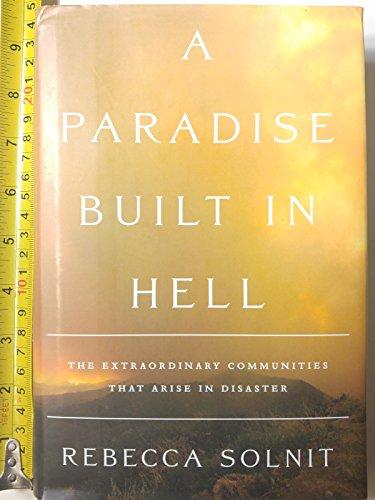

A Paradise Built in Hell: The Extraordinary Communities That Arise in Disaster Cover
Podcast Mentions

A Paradise Built in Hell The Extraordinary Communities That Arise in Disaster

Rebecca Solnit

A startling investigation of what people do in disasters and why it matters Why is it that in the aftermath of a disaster? whether manmade or natural?people suddenly become altruistic, resourceful, and brave? What makes the newfound communities and purpose many find in the ruins and crises after di...

Podcasts 5
Quotes 23
The Ezra Klein Show

He referenced it as a book about people helping each other after calamities.

"

It reminds me of this book by Rebecca Solnit, A Paradise Built in Hell, which is all about the ways people come together after calamity.
— Episode: Emily St. John Mandel on Time Travel, Pa...

Episode: Emily St. John Mandel on Time Travel, Parenting an...

He referenced it as a book about people helping each other after calamities.

"

It reminds me of this book by Rebecca Solnit, A Paradise Built in Hell, which is all about the ways people come together after calamity.

Episode: Emily St. John Mandel on Time Travel, Parenting an...

Ezra referenced Solnit's book when discussing how people tend to help each other after catastrophes rather than devolve into chaos.

"

It reminds me of this book by Rebecca Solnit, A Paradise Built in Hell, which is all about the ways people come together after calamity.

Behind the Bastards

It was discussed as a masterpiece that detailed the San Francisco earthquake and fire of 1906, emphasizing the spontaneous mutual aid and community response that emerged in contrast to the panic and control measures employed by authorities.

"

Holhouser started a tiny soup kitchen with one tin can to drink from and one pie plate to eat from all over the city.

— Episode: Elite Panic: Why The Rich And Powerful C...

Episode: Elite Panic: Why The Rich And Powerful Can't Be Tr...

It was discussed as a masterpiece that detailed the San Francisco earthquake and fire of 1906, emphasizing the spontaneous mutual aid and community response that emerged in contrast to the panic and control measures employed by authorities.

"

Holhouser started a tiny soup kitchen with one tin can to drink from and one pie plate to eat from all over the city.

In treating the citizens as enemies, the occupying armies drove residents and volunteers away from scenes where fire could be prevented in many parts of the city.

All the big hotels such as the St. Francis, the Palace and others were filled with Eastern and other tourists who seemed to have lost their heads entirely.

elites tend to believe in a venal, selfish and essentially monstrous version of human nature, which I sometimes think is their own human nature.

Elite panic frequently brings out another unsavory quirk on the part of some authorities, a tendency to believe the worst about their own citizens.

Episode: Elite Panic: Why The Rich And Powerful Can't Be Tr...

The book was discussed as an example of how people react in a disaster, in this case, the 1906 San Francisco earthquake and fire, showing how mutual aid was common and how the authorities overreacted with panic.

"

Holhouser started a tiny soup kitchen with one tin can to drink from and one pie plate to eat from all over the city.

In treating the citizens as enemies, the occupying armies drove residents and volunteers away from scenes where fire could be prevented in many parts of the city.

All the big hotels such as the St. Francis, the Palace and others were filled with Eastern and other tourists who seemed to have lost their heads entirely.

elites tend to believe in a venal, selfish and essentially monstrous version of human nature, which I sometimes think is their own human nature.

Elite panic frequently brings out another unsavory quirk on the part of some authorities, a tendency to believe the worst about their own citizens.

Episode: Elite Panic: Why The Rich And Powerful Can't Be Tr...

It was discussed as a masterpiece that detailed the San Francisco earthquake of 1906 and how people responded, and how it contrasted with the actions of those in power, especially the military.

"

Holhouser started a tiny soup kitchen with one tin can to drink from and one pie plate to eat from all over the city.

Not a victim of the disaster, but a victor over it. And the hostess of a popular social center, her brothers and sisters keeper.

All the big hotels such as the St. Francis, the Palace and others were filled with Eastern and other tourists who seemed to have lost their heads entirely.

Indeed, the only really scared people that I can remember having seen through the first three days of the fire were people of this class.

All the big hotels such as the St. Francis, the Palace and others were filled with Eastern and other tourists who seemed to have lost their heads entirely. Indeed, the only really scared people that I can remember having seen through the first three days of the fire were people of this class.

The MeatEater Podcast

It's a book about the sociology of disasters, demonstrating that people tend to band together and help each other in times of crisis.

"

There's a great book by Rebecca Solnit called The Paradise Built in Hell. I don't know if any of you guys have read that.

— Episode: Ep. 266: Crying Wolf

Episode: Ep. 266: Crying Wolf

It's a book about the sociology of disasters, demonstrating that people tend to band together and help each other in times of crisis.

"

There's a great book by Rebecca Solnit called The Paradise Built in Hell. I don't know if any of you guys have read that.

On Being with Krista Tippett

It explored the responses to the 1906 San Francisco earthquake, highlighting the unexpected acts of community and cooperation during times of crisis, using the story of Dorothy Day as a key example.

"

You know you write about the San Francisco earthquake of April 18th 1906 which killed 3,000 people and annihilated the center of the city as you say and shattered this 100 mile stretch. But Dorothy Da...

— Episode: Rebecca Solnit — Falling Together

Episode: Rebecca Solnit — Falling Together

It explored the responses to the 1906 San Francisco earthquake, highlighting the unexpected acts of community and cooperation during times of crisis, using the story of Dorothy Day as a key example.

"

You know you write about the San Francisco earthquake of April 18th 1906 which killed 3,000 people and annihilated the center of the city as you say and shattered this 100 mile stretch. But Dorothy Day was in Oakland she's eight years old she watches this thing that in some place you describe as you know you say yes people fall apart but in disaster there's also this falling together that we don't chronicle.

And the question she asked was you know she saw to me this is me looking at this she saw that people were capable of this that all along they knew how to do this right to take care of each other and she said why can't we live this way all the time?

Episode: [Unedited] Rebecca Solnit with Krista Tippett

The book explores the author's observations on human behavior during disasters, challenging common narratives about human nature in crisis. It was mentioned in conversation about the 1906 San Francisco earthquake and the reactions of people.

"

I wrote about in my book on disaster where suddenly people got thrown into this chaos but also into community and found often profound meaning and fulfillment in a very surprising way in the midst of death and horror and ruin.

You know you write about in your book A Paradise Built in Hell which I love so much.

And because she's somebody who had a partner and a child and you know she kept the child but she gave up family life for this larger sense of community.

Note: The book recommendations on this page are discovered automatically from podcast transcripts, and may be incorrect or incomplete.