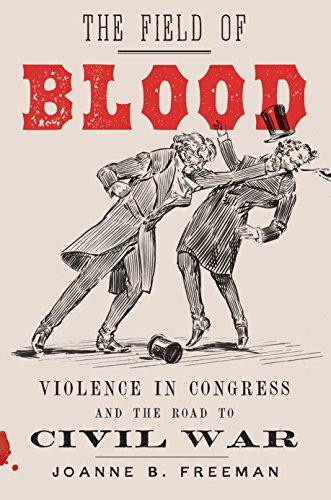

The Field of Blood: Violence in Congress and the Road to Civil War Cover
Podcast Mentions

The Field of Blood Violence in Congress and the Road to Civil War

Joanne B. Freeman

"One of the best history books I've read in the last few years." Historian Joanne B. Freeman recovers the long-lost story of physical violence on the floor of the U.S. Congress. Drawing on an extraordinary range of sources, she shows that the Capitol was rife with conflict in the decades before the...

Podcasts 4
Quotes 11
The Ezra Klein Show

Klein described Freeman's book as a striking study of 19thcentury congressional violence that illuminates the roots of modern political division.

"

I'm going to stick with the theme of the 19th century and recommend Freeman's book The Field of Blood, which looks at political violence inside Congress in the 1830s, 40s and 50s.

— Episode: What a Second Biden Term Would Look Like

Episode: What a Second Biden Term Would Look Like

Klein described Freeman's book as a striking study of 19thcentury congressional violence that illuminates the roots of modern political division.

"

I'm going to stick with the theme of the 19th century and recommend Freeman's book The Field of Blood, which looks at political violence inside Congress in the 1830s, 40s and 50s.

It examines actual brawls between congressmen, weapons, and how that violence culminated in the Civil War, offering a lens to understand today's political divisions.

Strict Scrutiny

Kate mentioned reading this book, noting how wild it was to read in the same week as Pamela Jo Bondi's testimony.

"

I finally read historian Joanne Friedman's Field of Blood, which was--

— Episode: S7 Ep19: Is Sam Alito On His Way Out?

Episode: S7 Ep19: Is Sam Alito On His Way Out?

Kate mentioned reading this book, noting how wild it was to read in the same week as Pamela Jo Bondi's testimony.

"

I finally read historian Joanne Friedman's Field of Blood, which was--

On with Kara Swisher

Author Joanne Freeman discussed her book's exploration of the 80 violent incidents that occurred in the U.S. Congress during the mid-19th century and how they shaped political dynamics. She explained that the mere threat of violence historically led to self-censorship among lawmakers, drawing parallels to modern political rhetoric and recent events. The conversation highlighted the book as a crucial historical lens for understanding the current climate of political intimidation.

Highly Recommended

Episode: Stay Tuned with Preet: Elections, Now & Then (with...

It was mentioned that Freeman's book, published 5-6 years prior, discussed violence and threats in Congress and was referenced in relation to the assassination attempt on Donald Trump. The book's insights into how threats, even without actual violence, can be effective in shaping political dynamics were discussed.

"

For violence or threats to be effective, they just have to seem possible.

In my book I write about... 80 violent incidents in the House and Senate in say a 30-year period.

What matters is that people believed...they could get hurt, they could get shot, they could get challenged to a duel, and that was enough for a long time for them to self-censor.

There's been a lot of violent rhetoric, praising violence...former President Trump...smiling at it, offering to get lawyers for people if they engage in it...

He certainly contributed to a climate in which violence has been in the forefront of our political rhetoric.

Stay Tuned with Preet

The book, "The Field of Blood: Violence in Congress and the Road to Civil War", was discussed as it analyzes violent incidents in the House and Senate, highlighting how the mere possibility of violence was enough to influence political discourse and behavior, even without it actually occurring.

"

And part of the reason for that is you wrote a book five years ago or six years ago called The Field of Blood, Violence in Congress and the Road to Civil War.

— Episode: Elections, Now & Then (with Joanne Freem...

Episode: Elections, Now & Then (with Joanne Freeman)

The book, "The Field of Blood: Violence in Congress and the Road to Civil War", was discussed as it analyzes violent incidents in the House and Senate, highlighting how the mere possibility of violence was enough to influence political discourse and behavior, even without it actually occurring.

"

And part of the reason for that is you wrote a book five years ago or six years ago called The Field of Blood, Violence in Congress and the Road to Civil War.

So, you know, in my book I write about I don't know 80, 70, 80 violent incidents in the House and Senate in say a 30-year period which is a lot but again, I suppose you can do what some mathematically inclined person would do and chop it up.

And so part of what's interesting about this moment is that there's been a lot of violent rhetoric praising violence, former president Trump, you know smiling at it, offering to get lawyers for people if they engage in it, all of that kind of behavior over the years in which he clearly on a certain level enjoys that people are willing to do that for him and that ethos even without actual violence is enough to encourage violence, to discourage people, to intimidate people and to motivate people to step forward and do things that now they feel encouraged to do that they might not have otherwise.

Note: The book recommendations on this page are discovered automatically from podcast transcripts, and may be incorrect or incomplete.