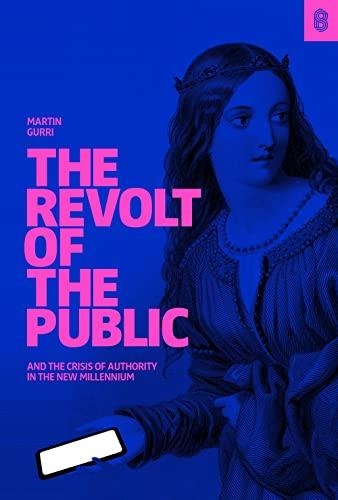
The Revolt of the Public and the Crisis of Authority in the New Millennium
Martin Gurri
How insurgencies—enabled by digital devices and a vast information sphere—have mobilized millions of ordinary people around the world.
In the words of economist and scholar Arnold Kling, Martin Gurri saw it coming. Technology has categorically reversed the information balance of power between the p...
It was mentioned as a book that argues that in the modern information environment, it is challenging for established institutions to maintain trust due to the increased visibility of errors and scandals.
"
There's a book by Martin Gury that makes this argument revolt of the public and makes it globally, that basically in the modern information ecosystem, it's almost impossible to maintain trust as an es...
— Episode: Offline: Ezra Klein on the Democrat’s Ec...
Episode: Offline: Ezra Klein on the Democrat’s Echo Chamber
It was mentioned as a book that argues that in the modern information environment, it is challenging for established institutions to maintain trust due to the increased visibility of errors and scandals.
"
There's a book by Martin Gury that makes this argument revolt of the public and makes it globally, that basically in the modern information ecosystem, it's almost impossible to maintain trust as an establishment because everything you do wrong and even some things you don't do wrong are going to be what everybody knows about you.
Episode: Offline: Ezra Klein on the Democrat’s Echo Chamber
It was mentioned while discussing the decline of trust in large organizations due to increased media scrutiny and transparency in the modern information environment.
"
There's a book by Martin Gury that makes this argument revolt of the public and makes it globally, that basically in the modern information ecosystem, it's almost impossible to maintain trust as an establishment because everything you do wrong and even some things you don't do wrong are going to be what everybody knows about you.
Gurry argues that social media contributed to the decline in trust in institutions in the last decade, but that the trend started in the 1970s with a fracturing of the media landscape, including the rise of talk radio, cable television, and paperback books. He also believes that the public is learning that institutions are bad, not being tricked into thinking so.
"
Martin Gurry wrote I think the best book on this called The Revolt of the Public where he goes through this in detail and he he does he does say that social media had a lot to do with what's happened...
— Episode: Marc Andreessen: How Risk Taking, Innova...
Episode: Marc Andreessen: How Risk Taking, Innovation & Art...
Gurry argues that social media contributed to the decline in trust in institutions in the last decade, but that the trend started in the 1970s with a fracturing of the media landscape, including the rise of talk radio, cable television, and paperback books. He also believes that the public is learning that institutions are bad, not being tricked into thinking so.
"
Martin Gurry wrote I think the best book on this called The Revolt of the Public where he goes through this in detail and he he does he does say that social media had a lot to do with what's happened in the last decade but he says yeah if you go further it was basically two things coinciding one was just a general change in the media environment and in particular the 1970s is when you started to again especially in the 1980s is when you started to get specifically talk radio which was a new outlet and then you also start you also got cable television and then you also by the way it's actually interesting in the 50s 60s you had paperback books which was another one of these which was an outlet so you you you had like a fracturing in the media landscape it started in the 50s through the 80s and then of course the internet like it went open having said that if the elites and institutions were fantastic you would know it more than ever if he has information as Mark Sensible and so the other thing that he says and I agree with is the public is not being tricked into thinking the least institutions are bad they're learning that they're bad right and the mystery and therefore the mystery of the Gallup poll is why those numbers aren't all just zero right which is arguably a lot of cases where they should be I think one reason that by the way he thinks this is bad so he and I have a different view on it so here's our he and I disagree he thinks this is bad so he's he basically says you can't replace it leads with nothing you can't replace institutions with nothing if if because what you're just left with is just going to be wreckage you're gonna left with a completely basically you know atomized out of control society that has no ability to marshal you know any sort of activity in a direction it's just going to be a doggy dog awful you know world I have a very different view on that which we can talk about
He said basically what Martin says Martin says as follows the elites deserve contempt but the only thing worse than these elites that deserve contempt would be no elites at all right and and because any basically says on the other side on the other side of the destruction of the elites and the institutions is nihilism you're basically left with nothing and then by the way there is a nihilistic streak I mean there's nihilistic streak in the in the culture in the politics today there are people who basically would just say yeah just tear the whole system down right and they're without any particular plan for what follows and so you you I think he makes a good point and that you want to be careful that you actually have a plan on the other side that you think it's actually achievable but but again the counter argument to that is if you're not willing to actually tear down the old you're not going to get to the new
The elites deserve contempt but the only thing worse than these elites that deserve contempt would be no elites at all
The Revolt of the Public was mentioned as a book that explored Joe Biden's career and the myth of his greatness that was created by the Democratic establishment.
"
He's the author of the great book from a few years ago called the Revolt of the Public, published on sub stack and one of the very wise published it, republished it over at the Free Press.
— Episode: Trump's Emotional Closing to RNC, and De...
Episode: Trump's Emotional Closing to RNC, and Democrats in...
The Revolt of the Public was mentioned as a book that explored Joe Biden's career and the myth of his greatness that was created by the Democratic establishment.
"
He's the author of the great book from a few years ago called the Revolt of the Public, published on sub stack and one of the very wise published it, republished it over at the Free Press.
In his book, Gurri, a former CIA analyst, posited that technology allows dissent to be communicated in new ways, and that power is organizing differently than before. This makes it harder to centralize and control power in the same way as before.
"
In his book, The Revolt of the Public, Martin Goury, the former CIA analyst, who you should have on your show if you haven't already.
— Episode: The One Thing Elites Don't Want You to L...
Episode: The One Thing Elites Don't Want You to Look at | R...
In his book, Gurri, a former CIA analyst, posited that technology allows dissent to be communicated in new ways, and that power is organizing differently than before. This makes it harder to centralize and control power in the same way as before.
"
In his book, The Revolt of the Public, Martin Goury, the former CIA analyst, who you should have on your show if you haven't already.
Note: The book recommendations on this page are discovered automatically from podcast transcripts, and may be incorrect or incomplete.