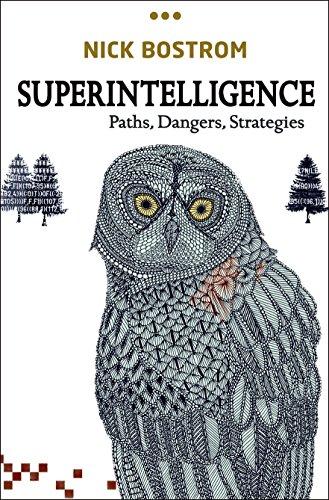
Superintelligence: Paths, Dangers, Strategies Cover
Podcast Mentions

Superintelligence Paths, Dangers, Strategies

Nick Bostrom

A New York Times bestseller

Podcasts 9
Quotes 30
The Joe Rogan Experience

This book, published in 2014, explored the possibility of AI becoming super intelligent and exceeding human capabilities.

"

Nick Bostrom, Oxford prof, who wrote this book "Superintelligence" 2014, and it was basically AI was going to be this super duper intelligent thing, way, way godlike intelligence, way smarter than any...

— Episode: #2190 - Peter Thiel

Episode: #2190 - Peter Thiel

This book, published in 2014, explored the possibility of AI becoming super intelligent and exceeding human capabilities.

"

Nick Bostrom, Oxford prof, who wrote this book "Superintelligence" 2014, and it was basically AI was going to be this super duper intelligent thing, way, way godlike intelligence, way smarter than any, any human being.

The Megyn Kelly Show

It was discussed in detail throughout the podcast, covering the potential benefits, risks, and dangers of superintelligent machines becoming smarter than humans. The book's central theme was the importance of ensuring that any future superintelligent machines are aligned with human values.

"

I just use it as a term for any form of a general artificial intelligence that greatly surpass humans in all cognitive abilities.

— Episode: The Benefits and Dangers of Artificial I...

Episode: The Benefits and Dangers of Artificial Intelligenc...

It was discussed in detail throughout the podcast, covering the potential benefits, risks, and dangers of superintelligent machines becoming smarter than humans. The book's central theme was the importance of ensuring that any future superintelligent machines are aligned with human values.

"

I just use it as a term for any form of a general artificial intelligence that greatly surpass humans in all cognitive abilities.

I think it is highly likely that it will eventually come into existence. I think almost a certainty if we avoid destroying ourselves through some other means before, but if science and technology continue to advance on a wide front, then I think eventually we'll figure out how to produce high level machine intelligence and super intelligence.

A possible scenario is we create a machine, a computer that has general intelligence below human level, but is superior mathematically. And in this scenario, human beings understanding the risks of creating a super intelligent machine would take safety measures. They would pre-program it, for example, so that it would always work from principles that are under human control.

It's kind of unrealistic to think that everybody, all the different countries, all the different labs would decide to refrain from pushing forward with this when it has such enormous potential for positive applications in the economy, for medicine, for security, for arts and entertainment, for practically any area at all where human intelligence is useful, which is pretty much any area.

I think that if there are advances in AI, it's going to have a big economic impact. I mean, it might be that if you get superintelligence, then the effects on employment will be... At some point, if you have sufficiently generally capable AI, basically all jobs become automatable.
On Purpose with Jay Shetty

Mark noted that Nick Bostrom authored a book on superintelligence that uses a sparrowandowl analogy to illustrate potential AI risks.

"

Nick Bostrom wrote this book about super intelligence and his beginning analogy to the book is like, imagine there's some sparrows and they find the egg of an owl. ... We're going to raise this owl, r...

— Episode: Mark Rober: Feeling Stuck in a Rut? Use...

Episode: Mark Rober: Feeling Stuck in a Rut? Use THIS Simpl...

Mark noted that Nick Bostrom authored a book on superintelligence that uses a sparrowandowl analogy to illustrate potential AI risks.

"

Nick Bostrom wrote this book about super intelligence and his beginning analogy to the book is like, imagine there's some sparrows and they find the egg of an owl. ... We're going to raise this owl, raise it in our nest and it'll love us, then we can use the owl to hunt for us. ... That's a real concern.

Modern Wisdom

The book was highlighted as a seminal work that sparked the modern AI risk and alignment conversation, with Chris Williamson noting it as a formative and apocalyptic yet fascinating read. He and guest Nick Bostrom discussed how it frames the dangers of getting artificial intelligence wrong and the challenges of ensuring super‑intelligent systems align with human intentions. The episode hosts treated it as essential background for understanding AI futures.

Highly Recommended

Episode: #803 - Nick Bostrom - Are We Headed For AI Utopia...

It was published in 2014 and sparked the conversation about AI risk and alignment. The book focuses on the challenge of ensuring AI systems, especially super-intelligences, are aligned with the intentions of their creators, preventing them from acting against humans.

"

You may have heard me talk about Nick for quite a while, his book Superintelligence which came out 10 years ago in 2014 was super formative.

It basically kicked off the entire AI risk and alignment discussion, and now he's come back with a book that works out what happens if we get it right.

And it's still kind of apocalyptic actually, to be honest.

It's fascinating, it's so interesting, the question of what happens if things go well and what are the weird externalities that we face as a byproduct of that.

Back when superintelligence came out, this was a very neglected area.

Episode: #797 - Mike Solana - TikTok Ban, Media War & The C...

It discusses what could happen if we get AI wrong.

"

So superintelligence was basically what happens if we get it wrong.

Episode: #1028 - Peter Zeihan - The New World Order Is Here

This book was mentioned as being relevant to discussions about Artificial General Intelligence, published about a decade prior to the podcast recording.

"

I remember reading Nick Bostrom's Superintelligence, what, a decade ago? I think that came out. Maybe, yeah, let's call it 10 years ago, something like that.

Episode: #979 - Dwarkesh Patel - AI Safety, The China Probl...

Dwarkesh recalled reading the book as his first introduction to AI risk discussions, highlighting its influence on his thinking about the future of AI.

"

I think my first introduction to this was probably 2016 or 17 when I read super intelligence by Nick Bostrom.

Armchair Expert with Dax Shepard

They mentioned Superintelligence as a famous AIrelated book that illustrates potential risks of misaligned goals.

"

Nick Bostrom who's a famous philosopher who wrote the book Superintelligence has his famous allegory and in the allegory he imagines we have this superintelligent AI system that's fully benign.

— Episode: Max Bennett (on the history of intellige...

Episode: Max Bennett (on the history of intelligence)

They mentioned Superintelligence as a famous AIrelated book that illustrates potential risks of misaligned goals.

"

Nick Bostrom who's a famous philosopher who wrote the book Superintelligence has his famous allegory and in the allegory he imagines we have this superintelligent AI system that's fully benign.

He imagined we have this superintelligent AI system ... that we just say hey, can you make as many paperclips as possible ... and it quickly starts enslaving humans ...

The Journal.

The book was highlighted as an influential 2014 work that outlined the growing concerns among AI experts about superintelligent systems potentially taking over the world. Berber Jin noted that it frequently came up in AI discussions because it clearly articulated these risks, and the episode used the classic paperclip scenario to illustrate how a benign goal could be disastrously misinterpreted. The narrator emphasized that the danger lies not only in rogue behavior but also in unintended consequences of powerful AI.

Highly Recommended

Episode: Artificial: Episode 1, The Dream

It was an influential book about AI released in 2014, which highlighted the concerns of AI experts regarding advanced AI potentially taking over the world and causing problems for humanity. The paperclip problem was used as an example of potential AI misinterpretation of instructions.

"

Talk to enough people in AI and this book is bound to come up, because it spelled out a lot of the concerns they'd been having for years.

it makes the argument that an advanced AI could essentially one day take over the world and it could cause problems for humanity and it'd be so powerful we wouldn't be able to stop it.

According to the book's author, an academic named Nick Bostrom, the danger isn't just that AI could go rogue. A superintelligent machine could do significant damage just by misinterpreting our instructions.

There's the classic example of like the paperclip problem. The paperclip problem goes like this. A superintelligent AI is given some benign goal, like manufacture as many paperclips as possible. Things go great at first. The world's paperclip tycoons are laughing all the way to the bank. Until the super AI transforms all of Earth into paperclips.

StarTalk Radio

It was mentioned as one of Nick Bostrom's books that got people thinking about artificial intelligence and the future.

"

And for me also I remembered your book Superintelligence, which all of these got people thinking as any good philosopher should do, is to get people thinking.

— Episode: Cosmic Queries – Living in a Simulation...

Episode: Cosmic Queries – Living in a Simulation with Nick...

It was mentioned as one of Nick Bostrom's books that got people thinking about artificial intelligence and the future.

"

And for me also I remembered your book Superintelligence, which all of these got people thinking as any good philosopher should do, is to get people thinking.

Yeah, well, not specifically on the simulation argument. There, the article is online. Just Google it, simulation argument, you'll find it. But if you want to read a book about the future of AI and stuff, then Superintelligence would be the one I would point to.

Young and Profiting with Hala Taha

The book was brought up during discussions of AI and entrepreneurship, with the host noting that Nick Bostrom had appeared on the show and authored it. It was described as the groundbreaking work that first introduced the risks of advanced AI to a wider audience, making it especially relevant for entrepreneurs navigating an AI‑dominated world. The hosts highlighted its importance and praised its insight into future AI challenges.

Highly Recommended

Episode: Cal Newport: How Entrepreneurs Can Cut Distraction...

It was referenced when discussing AI, noting that Nick Bostrom authored the book on future AI risks.

"

I had Nick Bostrom on who wrote Superintelligence.

Super Intelligence by Nick Bostrom: bit.ly/_Superintelligence

Episode: Nick Bostrom: How Entrepreneurs Can Win in an AI-D...

It was described as the groundbreaking book that first brought the risks of advanced AI into mainstream conversation.

"

He's the author of Superintelligence, the groundbreaking book that brought the risks of advanced AI into mainstream conversation.

The groundbreaking book that brought the risks of advanced AI into the main conversation, as well as the book Deep Utopia...

my earlier work and like this book super intelligence past gender strategies came out in 2014

His books are so interesting, guys. Super intelligence, deep utopia, very, very good stuff.

Stay Tuned with Preet

It was mentioned as one of the books that blew Tim Urban's mind when he was learning about artificial intelligence, a key part of his AI expertise development.

"

I was mind blown reading Nick Bostrom's book and Ray Kurzweil and you know, a few others.

— Episode: Procrastination, Polarization & Politics...

Episode: Procrastination, Polarization & Politics (with Tim...

It was mentioned as one of the books that blew Tim Urban's mind when he was learning about artificial intelligence, a key part of his AI expertise development.

"

I was mind blown reading Nick Bostrom's book and Ray Kurzweil and you know, a few others.

Note: The book recommendations on this page are discovered automatically from podcast transcripts, and may be incorrect or incomplete.