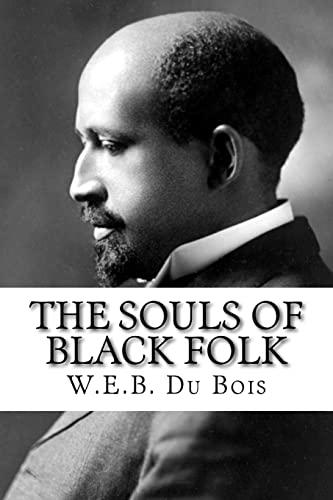

The Souls of Black Folk Cover
Podcast Mentions

The Souls of Black Folk

W.E.B. Du Bois

The Souls of Black Folk is a classic work of American literature by W. E. B. Du Bois. It is a seminal work in the history of sociology, and a cornerstone of African-American literary history.To develop this groundbreaking work, Du Bois drew from his own experiences as an African-American in the Amer...

Podcasts 3
Quotes 18
The Bulwark Podcast

The host described reading this book for the first time last year, saying that it provided a more three-dimensional view of the struggle for racial equality, and offered insights into the different strategies used by prominent figures of the time, such as Frederick Douglass and Booker T. Washington.

"

I gotta tell you, I just read for the first time last year, shame on me, but just so I was interested to have this conversation, The Souls of Black Folks.

— Episode: Eddie Glaude Jr.: Biden Needs to Thread...

Episode: Eddie Glaude Jr.: Biden Needs to Thread the Needle

The host described reading this book for the first time last year, saying that it provided a more three-dimensional view of the struggle for racial equality, and offered insights into the different strategies used by prominent figures of the time, such as Frederick Douglass and Booker T. Washington.

"

I gotta tell you, I just read for the first time last year, shame on me, but just so I was interested to have this conversation, The Souls of Black Folks.

I just read it for the first time last summer.

Partially shame on me, but also shame on my fucking Jesuit school teachers.

It just gave me such a much more three-dimensional view of that struggle.

You know, like reading about it in real time, like first person, you know, about just like the nature of like the different strategies, the different, like what Frederick Douglass or Booker T. Washington, like with somebody who like was looking up to that, you know what I mean?


American History Tellers

The seminal work was published in 1903, in which the author criticized Booker T. Washington for accommodating white prejudice and argued that individual achievement was insufficient without full civil rights and political power.

"

Eight years later, in 1903, he published his seminal work, The Souls of Black Folk, in which he criticized Booker T. Washington for accommodating white prejudice.

— Episode: The Progressive Era | The Call | 3

Episode: The Progressive Era | The Call | 3

The seminal work was published in 1903, in which the author criticized Booker T. Washington for accommodating white prejudice and argued that individual achievement was insufficient without full civil rights and political power.

"

Eight years later, in 1903, he published his seminal work, The Souls of Black Folk, in which he criticized Booker T. Washington for accommodating white prejudice.

On Being with Krista Tippett

Coates discussed reading this book at a young age, noting that he didn't fully understand its implications until later in life. He reflects on how his understanding of the "color line" developed over time, especially during his study of the Civil War.

"

I had to read Souls of Black Folk at a very, very young age. I mean, I probably was like nine or 10.

— Episode: Ta-Nehisi Coates — Imagining a New Ameri...

Episode: Ta-Nehisi Coates — Imagining a New America

Coates discussed reading this book at a young age, noting that he didn't fully understand its implications until later in life. He reflects on how his understanding of the "color line" developed over time, especially during his study of the Civil War.

"

I had to read Souls of Black Folk at a very, very young age. I mean, I probably was like nine or 10.

And I read it. And at the same time, I got to say, I didn't get it.

Episode: [Unedited] Arnold Rampersad with Krista Tippett

It was first read by the interviewee during graduate school and had a powerful effect; its depth and breadth of intelligence, sensibility and imagination were not fully appreciated in other writings about Du Bois. The book's language and sensibility are considered dated by some, but it remains a wonderful book.

"

I sit with Shakespeare and he winces not across the color line. I move arm in arm with Balzac and Dumas. I summon Aristotle and Aurelius and what soul I will and they come all graciously with no scorn nor condescension. So wed with truth, I dwell above the veil.

Is this the life you grudges, oh nightly America? Is this the life you long to change into the dull red hideousness of Georgia? Are you so afraid lest peering from this high Pisgah between Philistine and Malachite, we cite the promised land?

Between me and the other world there is an ever unasked question, unasked by some through feelings of delicacy, by others through the difficulty of rightly framing it. All nevertheless fled around it. They approach me in a half hesitant sort of way, eye me curiously or compassionately. And then instead of saying directly, how does it feel to be a problem? They say, I know an excellent colored man in my town, or I fought at Mechanicsville or do not these Southern outrages make your blood boil at these.

A perfect life was his son's, all joy and love with tears to make it brighter. Sweet as a summer's day beside the Housatonic. The world loved him, the women kissed his curls, the men looked gravely into his wonderful eyes and the children hovered and fluttered about him. I can see him now changing like the sky from sparkling laughter to darkening frowns and then to wandering thoughtfulness as he watched the world. He knew no color line, poor dear, and the veil, though it shadowed him, had not yet darkened half his son. He loved the white matron, he loved his black nurse, and in his little world walked souls alone, uncolored and unclothed. I, yeah, all men are larger and purer by the infinite breath of that one little life.

If still he be, and he be there, and there be there, let him be happy, oh fate.

Episode: [Unedited] Whitney Battle-Baptiste with Krista Tip...

The podcast guest discussed Du Bois' book, describing it as complex and powerful, with soaring language and a voice that jumps off the page. She mentioned revisiting the text recently and finding it as overwhelming as ever.

"

I read The Souls of Black Fog a long time ago, but I've just really been blown away getting back into this again this week.

He's... Rob Cox, who we just talked to in Special Collections, described it as he writes as if it's music and prose, even if it's not technically poetry.

in the very first essay, in the souls of black folk, and he talks about the real question that is there between me and the other world, this ever unasked question, you know, unasked by some through feelings of delicacy, by others through the difficulty of rightly framing it. And the question is, how does it feel to be a problem?

His words speak to me directly.

And the problem with the 20th century is the color line.

Note: The book recommendations on this page are discovered automatically from podcast transcripts, and may be incorrect or incomplete.