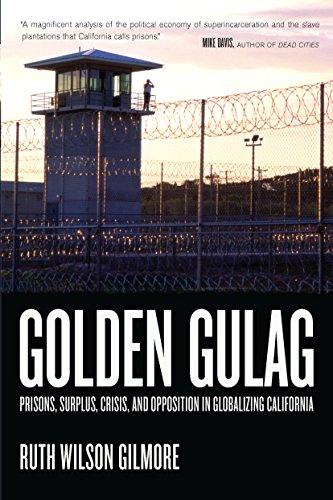

Golden Gulag: Prisons, Surplus, Crisis, and Opposition in Globalizing California (American Crossroads Book 21) Cover
Podcast Mentions

Golden Gulag Prisons, Surplus, Crisis, and Opposition in Globalizing California (American Crossroads Book 21)

Ruth Wilson Gilmore

Since 1980, the number of people in U.S. prisons has increased more than 450%. Despite a crime rate that has been falling steadily for decades, California has led the way in this explosion, with what a state analyst called "the biggest prison building project in the history of the world."

Podcasts 2
Quotes 2
The Bulwark Podcast

This book is a history of the Gulag and it won a Pulitzer Prize.

"

Her books include Red Famine, Stalin's war on Ukraine, the Pulitzer Prize winning Gulag, a history and most recently Twilight of Democracy, the seductive lore of authoritarianism, all very uplifting p...

— Episode: Anne Applebaum: A New Propaganda War

Episode: Anne Applebaum: A New Propaganda War

This book is a history of the Gulag and it won a Pulitzer Prize.

"

Her books include Red Famine, Stalin's war on Ukraine, the Pulitzer Prize winning Gulag, a history and most recently Twilight of Democracy, the seductive lore of authoritarianism, all very uplifting pieces of writing.

On Being with Krista Tippett

It was mentioned that "The Golden Gulag" is one of Ruth Wilson Gilmore's books, specifically discussing the common view of prisons being on the edge of social spaces, economic regions, political territories, and fights for rights. This view is said to be a trick of perspective because edges are also interfaces, connecting places into relationship.

"

You talked about the common view that prisons sit on the edge at the margins of social spaces, economic regions, political territories, and fights for rights. This apparent marginality is a trick of p...

— Episode: Ruth Wilson Gilmore — “Where life is pre...

Episode: Ruth Wilson Gilmore — “Where life is precious, lif...

It was mentioned that "The Golden Gulag" is one of Ruth Wilson Gilmore's books, specifically discussing the common view of prisons being on the edge of social spaces, economic regions, political territories, and fights for rights. This view is said to be a trick of perspective because edges are also interfaces, connecting places into relationship.

"

You talked about the common view that prisons sit on the edge at the margins of social spaces, economic regions, political territories, and fights for rights. This apparent marginality is a trick of perspective because as every geographer knows, edges are also interfaces. For example, even while borders highlight the distinction between places, they also connect places into relationship with each other and the non-contiguous places. So too with prisons.

Note: The book recommendations on this page are discovered automatically from podcast transcripts, and may be incorrect or incomplete.