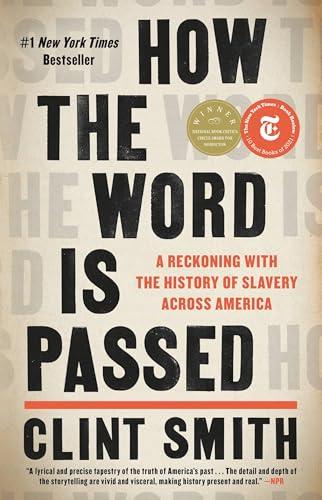

How the Word Is Passed: A Reckoning with the History of Slavery Across America Cover
Podcast Mentions

How the Word Is Passed A Reckoning with the History of Slavery Across America

Clint Smith

This “important and timely” (Drew Faust, Beginning in his hometown of New Orleans, Clint Smith leads the reader on an unforgettable tour of monuments and landmarks—those that are honest about the past and those that are not—that offer an intergenerational story of how slavery has been central in sh...

Podcasts 7
Quotes 42
Pod Save America

It was mentioned to describe a chapter discussing the Lost Cause movement's attempts to rewrite Civil War history, including how it used children to spread falsehoods about it.

"

Clint Smith's book has a really powerful chapter on this about the Lost Cause effort, which is an effort to rewrite the Civil War history, to defend the Confederacy, to make it as if it was about stat...

— Episode: "MAGA v. The Military." (with Sam Sander...

Episode: "MAGA v. The Military." (with Sam Sanders!)

It was mentioned to describe a chapter discussing the Lost Cause movement's attempts to rewrite Civil War history, including how it used children to spread falsehoods about it.

"

Clint Smith's book has a really powerful chapter on this about the Lost Cause effort, which is an effort to rewrite the Civil War history, to defend the Confederacy, to make it as if it was about states' rights or something more noble than just the defense of slavery.

Episode: “Stop the 2024 Steal.”

It was described as a beautiful book, not dry, and conveyed a human texture and sensory detail to the reader regarding the history of slavery in the United States. It was also described as profoundly emancipatory and liberating.

"

I just wanted to start by just telling listeners that, you know, it is when you pick up this book and start reading, it will be obvious to you that the book was written by a poet.

This is not dry nonfiction. It is written in this way that you allow the reader to almost inhabit your mind and your in your body and your experience as you go to these places and you kind of can feel the emotional connection to them. And it's just a beautiful book.

I was DMing you. I picked it up and like the next day I was halfway done and I just can't recommend it enough.

Again, amazing work.

Everybody should buy it. Buy a copy for your friends, buy a copy for your enemies.

Episode: “Stop the 2024 Steal.”

It was described as a beautiful, emotional, and sensory journey through the history of slavery in the US, connecting the past to the present and exploring the legacy of the institution.

"

It is written in this way that you allow the reader to almost inhabit your mind and your in your body and your experience as you go to these places and you kind of can feel the emotional connection to them.

I just can't recommend it enough.

I'm holding up the book. The book, you take the reader on this this remarkable journey to several places across the United States into one stop in Africa, in these places all of deep ties to slavery.

It was just such a the experience for me was added a sort of texture and dynamism to this history that I wanted to do my best to convey to the reader.

Everybody should buy it. Buy a copy for your friends, buy a copy for your enemies.
Strict Scrutiny

This book, which deals with sites in American history and how they reckon with difficult pasts, was discussed, noting it contains a chapter about Monticello.

"

I thought maybe you were going to talk about Clint Smith's how the word is passed, which was fantastic and so good.

— Episode: Our Favorite Things, 2021

Episode: Our Favorite Things, 2021

This book, which deals with sites in American history and how they reckon with difficult pasts, was discussed, noting it contains a chapter about Monticello.

"

I thought maybe you were going to talk about Clint Smith's how the word is passed, which was fantastic and so good.

And basically it's a story of all of these sites in American history and how they sort of reckon with the difficult questions in their past. Yeah. And because he has a chapter about Monticello, I have been waiting for the last year.

The Bulwark Podcast

The author talks about how the book is a personal journey to understand the history of slavery in America. Smith went on a journey to different locations and had conversations with many people about how the history of slavery is remembered and understood today.

"

So in 2017 I watched several Confederate statues come down in my hometown in New Orleans, statues of PGT Beauregard, Jefferson Davis, Robert E. Lee.

— Episode: Clint Smith: A Reckoning with History

Episode: Clint Smith: A Reckoning with History

The author talks about how the book is a personal journey to understand the history of slavery in America. Smith went on a journey to different locations and had conversations with many people about how the history of slavery is remembered and understood today.

"

So in 2017 I watched several Confederate statues come down in my hometown in New Orleans, statues of PGT Beauregard, Jefferson Davis, Robert E. Lee.

And so I've been thinking a lot about, well, how are these stories propagated? How are these stories told? To what extent are the people in places that have a relationship to this history telling the story honestly, running from their responsibility to tell the story honestly or kind of doing something in between?

And so I decided I need to follow it. So talk about having those conversations, right? You're going to the cemetery and talking with people that work there. And you end up going to this kind of event for the sons of the Confederate veterans and trying to talk to some of the attendees. Obviously you stand out.

And Jeff had this round belly, this salt and pepper handlebar mustache, this long ponytail, this Confederate biker vest that had Confederate paraphernalia all over it.

And I think that that is, that's the centerpiece of this, right? It's so much of this is about identity. So much is about the story we have been told, the story we tell ourselves about ourselves. And part of what you realize is that for so many people, history is not about primary source documents.

What A Day

Podcast

What A Day

A highly recommended book with a chapter dedicated to Angola, a prison in Louisiana, that was discussed in the podcast. The chapter details the harsh conditions and history of the prison.

"

Clint Smith, who did the podcast Justice in America with me, has an incredible chapter in his book about Angola. I highly recommend it, how the word was passed.

— Episode: The Deal with the Border Deal

Episode: The Deal with the Border Deal

A highly recommended book with a chapter dedicated to Angola, a prison in Louisiana, that was discussed in the podcast. The chapter details the harsh conditions and history of the prison.

"

Clint Smith, who did the podcast Justice in America with me, has an incredible chapter in his book about Angola. I highly recommend it, how the word was passed.

American History Tellers

The book explored the history of slavery across America by visiting nine different historical sites and one location overseas to understand how they reckoned with their relationship to this history. The author started writing the book in 2017 after seeing Confederate monuments being removed in New Orleans.

"

He's a staff writer for The Atlantic and author of the forthcoming book How the Word is Past, a reckoning with the history of slavery across America.

— Episode: America's Monuments | The Trouble With C...

Episode: America's Monuments | The Trouble With Confederate...

The book explored the history of slavery across America by visiting nine different historical sites and one location overseas to understand how they reckoned with their relationship to this history. The author started writing the book in 2017 after seeing Confederate monuments being removed in New Orleans.

"

He's a staff writer for The Atlantic and author of the forthcoming book How the Word is Past, a reckoning with the history of slavery across America.

How the Word is Passed, a Reckoning with the History of Slavery Across America.

And so I got really sort of obsessed with how different historical sites in different cities and different places across the country reckoned with or failed to reckon with their relationship to the history of slavery.

And then I end the book with a trip to the National Museum of African American History and Culture with my grandparents.

How the Word is Passed, a reckoning with the history of slavery across America. It's available June 1st.

Episode: America's Monuments | 58,000 Names | 6

This book was mentioned as being written by Clint Smith, a staff writer for The Atlantic, and it offered a look at how monuments and landmarks across America grapple with the history of slavery.

"

On the next episode, I'm speaking to Clint Smith, staff writer for The Atlantic and author of How the Word is Passed, a look at how monuments and landmarks across America grapple with the history of slavery.

On Being with Krista Tippett

It was discussed how Clint Smith's book explored the physicality of the American history of slavery and the entanglement between language and the intelligence of the body.

"

And I've been following Clint Smith for a few years, first through his wonderful book How the Word Is Past.

— Episode: Clint Smith — What We Know in the "Marro...

Episode: Clint Smith — What We Know in the "Marrow of Our B...

It was discussed how Clint Smith's book explored the physicality of the American history of slavery and the entanglement between language and the intelligence of the body.

"

And I've been following Clint Smith for a few years, first through his wonderful book How the Word Is Past.

But as I delved into the fullness of his work, I found that he also, and I would say first and foremost, is a poet.

His narrative nonfiction book, How the Word Is Past, a reckoning with the history of slavery across America won the National Book Critics Circle Award for Nonfiction and many other honors.

So I think you know I never quite know what the shape of an interview will be until I actually do the prep even though I might think I know and this time something really emerged that may be a little different from what I thought or from what you've done before.

I want to talk about how the word was passed where again you know we even talk about word and body and language and who you are and story and how all of that is intertwined and you know one of the kind of distinctive contributions of this book I mean I don't know that I saw this word used but to me it's kind of a pilgrimage that you took uh two places and you know you mentioned monuments little while ago and and it was kind of sparked it kind of gestated in your mind as statues started coming down um which were you know symbolic and of course not just symbolic but these physical things and so this was really a pilgrimage you know it was about history but it was about standing on certain ground right it was about being physically present to it um well first of all would you talk about this just this phrase how the word was passed where that came from why that is the title of the book.

Episode: [Extended] Clint Smith with Krista Tippett

This book is Clint Smith's 2021 narrative nonfiction work that won the National Book Critics Circle Award for Nonfiction. The book is a poignant and insightful exploration of the legacy of slavery in America, through a pilgrimage to sites and monuments across the country.

"

I'm sitting here with my three books.

And I think the producer you've been dealing with is Kayla Edwards.

And you probably haven't made this connection, but she was the opinion section editor of the Davidson newspaper, like you.

So I want you to know that as we start.

I think that was like five or six years ago now.

The Daily Stoic

This book was mentioned in a discussion about the complexities of American history, particularly regarding statues of Confederate figures and the legacy of slavery. It was mentioned as a relevant and helpful resource for understanding this history.

"

I would have mad there's actually a great book called How the Word is Past yeah that's the book yeah yeah that's one word is passed

— Episode: Tony Gonzalez on Becoming Your Best Self

Episode: Tony Gonzalez on Becoming Your Best Self

This book was mentioned in a discussion about the complexities of American history, particularly regarding statues of Confederate figures and the legacy of slavery. It was mentioned as a relevant and helpful resource for understanding this history.

"

I would have mad there's actually a great book called How the Word is Past yeah that's the book yeah yeah that's one word is passed

Episode: David Rubenstein on Patriotic Philanthropy and the...

It was described as one of Ryan Holiday's favorite books of the year. The book is a travel memoir focusing on historical sites in America and their connection to American history.

"

one of my favorite books of the year, How the Word is Past by Clint Smith.

Episode: Author Clint Smith and the History We Decide to Se...

It was described as a travel memoir and historical narrative, exploring controversial and provocative monuments and landmarks related to American slavery. The book's exploration of the Angola prison, a former plantation, was highlighted.

"

His book How the Word is Past, A Reckoning with the History of Slavery Across America was an instant number one New York Times bestseller.

It starts out in New Orleans, it ends all the way at a slave market in Africa. He stops in at a Confederate cemetery.

Some of the most fascinating writing that he does is about the Angola prison, a former plantation turned maximum security prison in Louisiana.

This is a great book. You absolutely should read it and I really enjoyed my conversation with him and I'm excited to bring it to you.

Check out his book How the Word is Past, A Reckoning with the History of Slavery in America

Note: The book recommendations on this page are discovered automatically from podcast transcripts, and may be incorrect or incomplete.