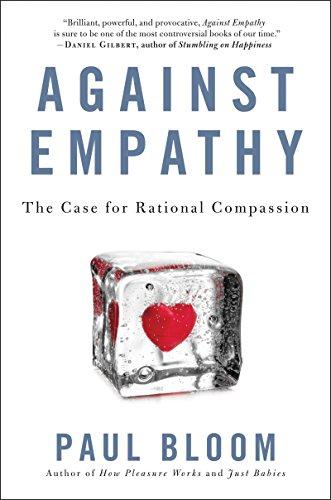

Against Empathy: The Case for Rational Compassion Cover
Podcast Mentions

Against Empathy The Case for Rational Compassion

Paul Bloom

New York Post We often think of our capacity to experience the suffering of others as the ultimate source of goodness. Many of our wisest policy-makers, activists, scientists, and philosophers agree that the only problem with empathy is that we don’t have enough of it.

Podcasts 5
Quotes 16
Hidden Brain

It was mentioned in the context of a discussion on whether empathy is inherently biased and whether it should be avoided, specifically in regards to building rational compassion.

"

The psychologist Paul Bloom, who wrote the book Against Empathy, the Case for Rational Compassion, he argues that empathy tends to be parochial and it tends to be biased.


— Episode: You 2.0: Empathy Gym

Episode: You 2.0: Empathy Gym

It was mentioned in the context of a discussion on whether empathy is inherently biased and whether it should be avoided, specifically in regards to building rational compassion.

"

The psychologist Paul Bloom, who wrote the book Against Empathy, the Case for Rational Compassion, he argues that empathy tends to be parochial and it tends to be biased.
Episode: You 2.0: The Empathy Gym

It was mentioned in the context of arguments against empathy, suggesting it's often parochial and biased, potentially leading to prejudice.

"

The psychologist Paul Bloom, who wrote the book Against Empathy, the Case for Rational Compassion, he argues that empathy tends to be parochial and it tends to be biased.
The Ben Shapiro Show

A book by a psychologist was referenced to discuss how empathy can be problematic in politics because it causes one to elevate certain people above others by sympathizing with their positions.

"

Empathy is where you put yourself in somebody else's shoes sympathy is where you sympathize with somebody else's positions empathy makes you elevate certain people above other people because you're em...

— Episode: Ep. 1201 - The Authoritarian Left Is On...

Episode: Ep. 1201 - The Authoritarian Left Is On The March

A book by a psychologist was referenced to discuss how empathy can be problematic in politics because it causes one to elevate certain people above others by sympathizing with their positions.

"

Empathy is where you put yourself in somebody else's shoes sympathy is where you sympathize with somebody else's positions empathy makes you elevate certain people above other people because you're empathizing with them. So empathy can actually be a problem in politics there's a great book called Against Empathy by a psychologist all about this

Episode: Ep. 1076 - The Anybody-But-Trump Convention

This book by social scientist Paul Bloom argued against empathy, promoting rational compassion instead.

"

there's an entire book by a guy named paul bloom who's a social scientist called against empathy the case for rational compassion right

10% Happier with Dan Harris

This was Paul Bloom's previous book, which served as a critique of emotional empathy and advocated for rational compassion instead. The speaker noted that emotional empathy is exhausting and too narrow, favoring people who look like us.

"

Then we dive into Paul's previous book to talk about the difference between cognitive empathy and emotional empathy.

— Episode: The Right Kind of Suffering | Paul Bloom

Episode: The Right Kind of Suffering | Paul Bloom

This was Paul Bloom's previous book, which served as a critique of emotional empathy and advocated for rational compassion instead. The speaker noted that emotional empathy is exhausting and too narrow, favoring people who look like us.

"

Then we dive into Paul's previous book to talk about the difference between cognitive empathy and emotional empathy.

my book before here was a critique of empathy and argument at emotional empathy could lead us astray but what we're talking about here is cognitive empathy

my book was interested in emotional empathy feeling what other people feel so you're anxious I get anxious you're happy I get happy and I think this is going to be great could be great source of joy could be great source of personal connection but the problem is from a moral point of view if we let empathy guide us it's too narrow

the subtitle of my book against empathy is the case for rational compassion and it's a nice connection with our interests because men it mindfulness meditation argue to be one way to sort of quell empathy

No Stupid Questions

Bloom argues against the benefits of empathy, claiming it can lead to detrimental consequences, and that rational compassion is a better approach.

"

So where do you think he falls on the spectrum?

— Episode: 200. What’s the Difference Between Empat...

Episode: 200. What’s the Difference Between Empathy and Sym...

Bloom argues against the benefits of empathy, claiming it can lead to detrimental consequences, and that rational compassion is a better approach.

"

So where do you think he falls on the spectrum?

He's very famous for his work on children, on development of moral emotions.

I remember when this book came out because I was talking to a friend about empathy and I got into an argument.

But here's something I thought was really interesting in Paul's book.

He talks about the negative implications that can come from empathy.

Episode: 44. Is Empathy in Fact Immoral?

It was described as shocking and bold, arguing that empathy is a primary driver of inequality and immorality, appealing to narrow prejudices rather than improving lives.

"

Empathy is one of the leading motivators of inequality and immorality and that far from helping us to improve the lives of others, empathy is a capricious and irrational emotion that appeals to our narrow prejudices.

Empathy he writes is a spotlight focusing on certain people in the here and now. This makes us care more about them but it leaves us insensitive to the long-term consequences of our acts and blind as well to the suffering of those we do not or cannot empathize with.

Our empathy for those close to us is a powerful force for war and atrocity toward others. It is corrosive in personal relationships, it exhausts the spirit and can diminish the force of kindness and love.

Note: The book recommendations on this page are discovered automatically from podcast transcripts, and may be incorrect or incomplete.