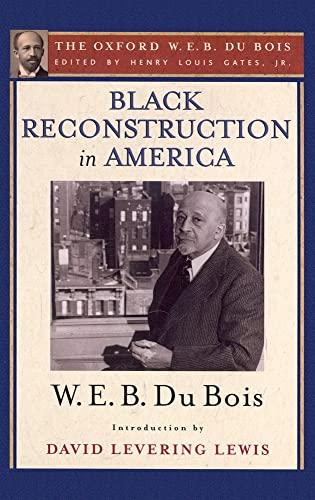

Black Reconstruction in America (The Oxford W. E. B. Du Bois): An Essay Toward a History of the Part Which Black Folk Played in the Attempt to Reconstruct Democracy in America, 1860-1880 Cover
Podcast Mentions

Black Reconstruction in America (The Oxford W. E. B. Du Bois) An Essay Toward a History of the Part Which Black Folk Played in the Attempt to Reconstruct Democracy in America, 1860-1880

W. E. B. Du Bois

W. E. B. Du Bois was a public intellectual, sociologist, and activist on behalf of the African American community. He profoundly shaped black political culture in the United States through his founding role in the NAACP, as well as internationally through the Pan-African movement. Du Bois's sociolog...

Podcasts 4
Quotes 15
The Ezra Klein Show

It was recommended as essential reading for anyone in America to understand the Reconstruction era.

"

Okay. I think everybody in America should read Black Reconstruction by W.E.B. Du Bois.

— Episode: Best Of: Nikole Hannah-Jones and Ta-Nehi...

Episode: Best Of: Nikole Hannah-Jones and Ta-Nehisi Coates...

It was recommended as essential reading for anyone in America to understand the Reconstruction era.

"

Okay. I think everybody in America should read Black Reconstruction by W.E.B. Du Bois.

Episode: How Identity Politics Took Over the Republican Par...

Klein mentioned DuBois's Black Reconstruction in America as an alternative to Foner's Reconstruction, stressing its importance for a full understanding of the era.

"

I don't care if you read Eric Foner's book on Reconstruction or W.B. Du Bois' Black Reconstruction in America.

Episode: Nikole Hannah-Jones and Ta-Nehisi Coates on the Fi...

Nicole urged listeners that everyone in America should read DuBois's classic "Black Reconstruction in America, 18601880".

"

I think everybody in America should read Black Reconstruction by W.E.B. Du Bois
Behind the Bastards

Du Bois argued that it was a general strike of the enslaved black proletariat that brought down the plantation system, not President Lincoln or Union bullets.

"

The North shrank at the very thought of encouraging servile insurrection against the whites. Above all, it did not propose to interfere with property. Black people on the whole were considered cowards...

— Episode: It Could Happen Here Weekly 66

Episode: It Could Happen Here Weekly 66

Du Bois argued that it was a general strike of the enslaved black proletariat that brought down the plantation system, not President Lincoln or Union bullets.

"

The North shrank at the very thought of encouraging servile insurrection against the whites. Above all, it did not propose to interfere with property. Black people on the whole were considered cowards and inferior beings whose very presence in America was unfortunate.

did not want to be free.

Episode: It Could Happen Here Weekly 10

The book Black Reconstruction was referenced to support the idea of the first general strike. It was suggested that the first general strike was enslaved people leaving the plantations and withdrawing their labor from that situation.

"

And I think the general strike is kind of an amorphous idea especially online as more people learn about labor and learn about it. But it's also like kind of a specific thing. You can't just declare like, okay, we're all not going to go to work tomorrow. Like cool but there's so much planning that goes into it to make sure that people are able to do that and sustain that and the people that are traditionally already left out or the most vulnerable and marginalized, like their needs are prioritized because the people that can afford to declare general strike and not show up for a week, like that's all well and good for them. But what about everyone else who can barely afford to go to work at all? Yeah. I've had these arguments with people online and it's often like, well, you're saying we shouldn't - like if we just do it, people will figure it out. Like the infrastructure will be built after the fact. I'm like that's - I'm glad that you're in a situation where you feel like you could handle that kind of uncertainty but like a single mother of four who relies on her job to like keep them fed and alive isn't going to be like someone will figure out how to feed my kids. Like that's not how people work.

And arguably like one of the first ones was in Black Reconstruction, the book, there's this argument that the first general strike was enslaved people leaving the plantations and withdrawing their labor from that situation. Like that was a form of striking.

Episode: It Could Happen Here Weekly 10

The podcast hosts discussed Du Bois's book "Black Reconstruction", which argues that the first general strike in the United States was enslaved people leaving the plantations.

"

And I think the general strike is kind of an amorphous idea especially online as more people learn about labor and learn about it. But it's also like kind of a specific thing. You can't just declare like, okay, we're all not going to go to work tomorrow. Like cool but there's so much planning that goes into it to make sure that people are able to do that and sustain that and the people that are traditionally already left out or the most vulnerable and marginalized, like their needs are prioritized because the people that can afford to declare general strike and not show up for a week, like that's all well and good for them. But what about everyone else who can barely afford to go to work at all?

And arguably like one of the first ones was in Black Reconstruction, the book, there's this argument that the first general strike was enslaved people leaving the plantations and withdrawing their labor from that situation. Like that was a form of striking.

Episode: It Could Happen Here Weekly 10

The book argues that the first general strike was when enslaved people left the plantations and withdrew their labor.

"

And I think the general strike is kind of an amorphous idea especially online as more people learn about labor and learn about it. But it's also like kind of a specific thing. You can't just declare like, okay, we're all not going to go to work tomorrow. Like cool but there's so much planning that goes into it to make sure that people are able to do that and sustain that and the people that are traditionally already left out or the most vulnerable and marginalized, like their needs are prioritized because the people that can afford to declare general strike and not show up for a week, like that's all well and good for them. But what about everyone else who can barely afford to go to work at all? Yeah. I've had these arguments with people online and it's often like, well, you're saying we shouldn't - like if we just do it, people will figure it out. Like the infrastructure will be built after the fact. I'm like that's - I'm glad that you're in a situation where you feel like you could handle that kind of uncertainty but like a single mother of four who relies on her job to like keep them fed and alive isn't going to be like someone will figure out how to feed my kids. Like that's not how people work.

And arguably like one of the first ones was in Black Reconstruction, the book, there's this argument that the first general strike was enslaved people leaving the plantations and withdrawing their labor from that situation. Like that was a form of striking.

Episode: It Could Happen Here Weekly 10

The book discusses a theory about the first general strike, where enslaved people left the plantations and withdrew their labor, which was a form of striking.

"

The book there's this argument that the first general strike was enslaved people leaving the plantations and withdrawing their labor from that situation.

American History Tellers

Du Bois's book challenged the Dunning School's interpretation of Reconstruction, arguing that it was not a failure due to Black people's unpreparedness for freedom.

"

Du Bois, he writes Black Reconstruction in the 1930s, and he completely turns the Dunning School on its head and says, no, the Reconstruction era did not fail because Black people were ill-prepared fo...

— Episode: Reconstruction Era | Counter Narratives...

Episode: Reconstruction Era | Counter Narratives | 7

Du Bois's book challenged the Dunning School's interpretation of Reconstruction, arguing that it was not a failure due to Black people's unpreparedness for freedom.

"

Du Bois, he writes Black Reconstruction in the 1930s, and he completely turns the Dunning School on its head and says, no, the Reconstruction era did not fail because Black people were ill-prepared for freedom.

And what Du Bois writes in this really centering Black freed people as part of this reconstruction study actually forms the foundation of Eric Foner's Reconstruction, which is what people consider the seminal book about Reconstruction now.

But at the time when Du Bois writes this, it doesn't get the mainstream attention.

Note: The book recommendations on this page are discovered automatically from podcast transcripts, and may be incorrect or incomplete.