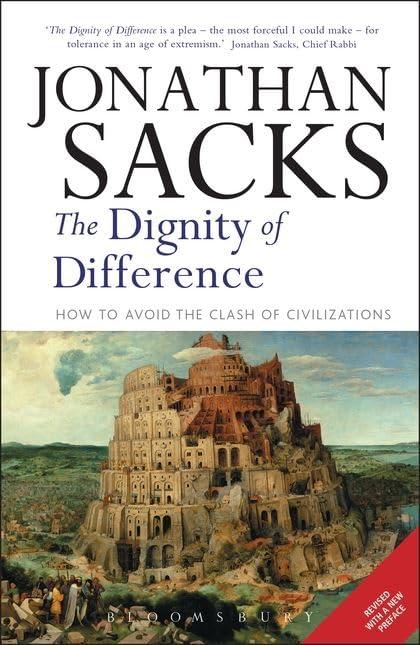

The Dignity of Difference: How to Avoid the Clash of Civilizations Cover
Podcast Mentions

The Dignity of Difference How to Avoid the Clash of Civilizations

Jonathan Sacks

2001 began as the United Nations Year of Dialogue between Civilizations. By its end the phrase most widely quoted was "the clash of civilizations." The tragedy of September 11 intensified the danger posed by religious differences throughout the world. As the politics of identity replaces the politic...

Podcasts 2
Quotes 15
What Now? with Trevor Noah

The host praised the book as a recommended read, noting that its author, a respected Jewish rabbi, explored the transition from broadcasting to narrow casting. He encouraged listeners to explore the author's works, emphasizing this title's relevance to discussions on cultural differences. The overall tone was enthusiastic and supportive.

Highly Recommended

Episode: Prime Minister Mia Mottley: Climate, Immigration,...

The book was highlighted as a recommended read, noted for discussing the shift from broadcasting to narrow casting.

"

the Jewish rabbi who I really truly respected, Jonathan Sachs, his chief rabbi in London, wrote a series of books and I encourage you to read them all. But one is The Dignity of Difference, which is where he talks about moving from broadcasting to narrow casting.
On Being with Krista Tippett

It was his most famous book, focusing on contradictory callings and how to be true to convictions while honoring shared life. It met with some criticism from British rabbis who thought his ideas on religious pluralism were heretical.

"

When I sat with Rabbi Sacks in 2010, we focused on what was perhaps his most famous book, The Dignity of Difference.

— Episode: Remembering Rabbi Lord Jonathan Sacks

Episode: Remembering Rabbi Lord Jonathan Sacks

It was his most famous book, focusing on contradictory callings and how to be true to convictions while honoring shared life. It met with some criticism from British rabbis who thought his ideas on religious pluralism were heretical.

"

When I sat with Rabbi Sacks in 2010, we focused on what was perhaps his most famous book, The Dignity of Difference.

His 2002 book, The Dignity of Difference, met criticism from some British rabbis that his ideas about religious pluralism might be heretical.

I think that sounded like it made a lot of sense to many people. The case you make in The Dignity of Difference is also aimed towards the traditions being constructive parts of the 21st century but you take that in a different direction.

You know, I remember a very intelligent, excellent American journalist commentator after September 11th, 2001. He made a statement that what those events demonstrated was that in order for the three monotheistic religions in particular to survive and be constructive members of society in the 21st century, they would have to relinquish their exclusive truth claims.

You've said that the 20th century saw the collapse of moral language. So in fact, even as we are forced to take up these very difficult intimate conversations, I think that's an interesting observation.

Episode: [Unedited] Rabbi Lord Jonathan Sacks with Krista T...

This book explores the challenges of navigating difference in an increasingly diverse world, emphasizing the importance of loving the stranger and finding unity in diversity. The author's experience at Ground Zero after 9/11 deeply impacted his views on this topic.

"

It was standing at ground zero, you know, a couple of months afterwards in January, well it was January 2002, together with the Archbishop of Canterbury and religious leaders throughout the world. And we were looking at this wreckage, the sheer harm that hate can do.

Episode: [Unedited] The Dalai Lama, Jonathan Sacks, Kathari...

Jonathan Sacks discussed the concept of happiness from a Jewish perspective, highlighting the difference between Oshia (happiness felt) and Simkhah (happiness made) and emphasizing the importance of shared happiness within a community.

"

The Hebrew, the biblical Hebrew has two key words for happiness. One is Oshia and one is Simkhah, and they are very different.

Oshia is the happiness we feel. Simkhah is the happiness we make.

Simkhah is the happiness we make when we come together to give collective thanks for the miracle and the gift of simply being alive.

Simcha reminds us of the basic distinction just made by his holiness between material goods and spiritual goods.

Episode: [Unedited] The Dalai Lama, Jonathan Sacks, Kathari...

Jonathan Sacks discussed the Hebrew words for happiness, "Oshia" (happiness felt) and "Simkhah" (happiness made), emphasizing the importance of shared happiness and gratitude in community. He connected the loss of gratitude in affluent societies with unhappiness and the weakening of relationships.

"

The Hebrew, the biblical Hebrew has two key words for happiness. One is Oshia and one is Simkhah, and they are very different.

Oshia is the happiness we feel. Simkhah is the happiness we make.

Simkhah is the happiness we make when we come together to give collective thanks for the miracle and the gift of simply being alive.

The consumer society is constantly tempting us all the time. To spend money we don't have. To buy things we don't need for the sake of happiness that won't last.

Note: The book recommendations on this page are discovered automatically from podcast transcripts, and may be incorrect or incomplete.