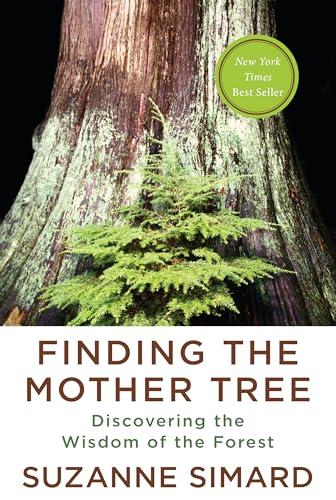

Finding the Mother Tree: Discovering the Wisdom of the Forest Cover
Podcast Mentions

Finding the Mother Tree Discovering the Wisdom of the Forest

Suzanne Simard

NEW YORK TIMES “

Podcasts 2
Quotes 13
The Ezra Klein Show

Suzanne Simard's Finding the Mother Tree was highlighted as a recent work that revealed underground forest networks and resource sharing among trees.

"

Let me talk specifically about the work of a scientist who has herself just recently published a book. It's Dr. Suzanne Simard and the book is Finding the Mother Tree.

— Episode: Best Of: This Conversation With Richard...

Episode: Best Of: This Conversation With Richard Powers Is...

Suzanne Simard's Finding the Mother Tree was highlighted as a recent work that revealed underground forest networks and resource sharing among trees.

"

Let me talk specifically about the work of a scientist who has herself just recently published a book. It's Dr. Suzanne Simard and the book is Finding the Mother Tree.

Simard has been instrumental in a revolution in our way of thinking about what's happening underground at the root level in a forest.

Episode: This Conversation With Richard Powers Is a Gift

Ezra Klein highlighted Simard's book for revealing the complex, cooperative underground networks of trees and fungi that share resources.

"

It's the book by Dr. Suzanne Simard... the work of a scientist who showed that forests are wired up in very complex and identifiable ways, with trees sharing sugars, hydrocarbons, and secondary metabolites through fungal networks.

On Being with Krista Tippett

It was released recently and details the author's research on how trees communicate with each other, and the vital role of "mother trees" in forest ecosystems. The book uses the metaphor of mother trees to illustrate the interconnectedness of the forest and the importance of collaboration.

"

In forests, the same thing like the below ground world is like a perfect example of that. You know, these bacteria, the fungi, the archaea, they're the ones that are cycling the carbon, decomposing th...

— Episode: Suzanne Simard — Forests Are Wired For W...

Episode: Suzanne Simard — Forests Are Wired For Wisdom

It was released recently and details the author's research on how trees communicate with each other, and the vital role of "mother trees" in forest ecosystems. The book uses the metaphor of mother trees to illustrate the interconnectedness of the forest and the importance of collaboration.

"

In forests, the same thing like the below ground world is like a perfect example of that. You know, these bacteria, the fungi, the archaea, they're the ones that are cycling the carbon, decomposing things, cycling nitrogen, you know, filtering water, building soil, soil structure.

And the caregivers of the forest. They are. They're the fundamental foundation of the forest. They're the legacy of the forest that helps move it forward.

And so I felt like we've got to move this field forward or it's going to die. It's going to get mired in having to prove the same things over and over again.

So every tree is linked to every other tree, all the little trees, the seedlings, the saplings are all linked into the networks that these old trees had established through their lifetime.

And that these, the biggest oldest trees were the hubs of the network. They were the nuclei. They were what everything else was linked into and they were linked to each other, these other smaller nodes as well.

Episode: [Unedited] Suzanne Simard with Krista Tippett

The book discusses Simard's research on the interconnectedness of trees in a forest ecosystem, challenging the traditional view of competition and highlighting the importance of collaboration and communication among trees through networks of fungi. The author details her experiments using radioactive isotopes to demonstrate carbon transfer between trees and the role of "mother trees" in nurturing younger trees.

"

In 1997, you published this NITRA article, which I, well, first of all, it was, it was rejected. And, and you went back and re-read it, rewrote it. And I get the feeling that you did not expect that they would put it on the cover. They put it on the cover, correct? Or they...

That was nature. Yeah, they put that on the front cover. Yeah. With a picture of these diverse forests with, you know, all these different tree species.

And so I labeled paper birch with radioactive carbon dioxide. That means I put a plastic bag over the shoot and I left that and I injected radioactive CO2 and I let the birch photosynthesize for a couple of hours, taking up that radioactive CO2.

And then I went over to the Douglas fir and I held the Geiger counter up to it. And there was a faint crackle. And that's when I knew, I knew that they were sharing carbon, which was mind blowing, right?

But man is part of nature. And his war against nature is inevitably a war against himself.

Note: The book recommendations on this page are discovered automatically from podcast transcripts, and may be incorrect or incomplete.