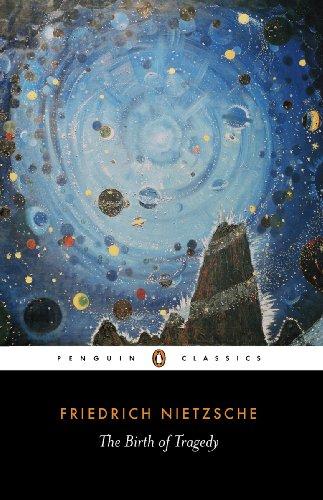

The Birth of Tragedy: Out of the Spirit of Music (Penguin Classics) Cover
Podcast Mentions

The Birth of Tragedy Out of the Spirit of Music (Penguin Classics)

Friedrich Nietzsche

Nietzsche's first published book,

Podcasts 4
Quotes 6
Candace

Podcast

Candace

The idea of the Oedipus complex and incest as the way to become a god was mentioned as coming from this work by Nietzsche.

"

So if you talk, he got ideas from Nietzsche, the whole idea of the Oedipus complex, the whole idea of incest as the way to become a god comes from Nietzsche. It's in The Birth of Tragedy, that powerfu...

— Episode: Candace Owens x E. Michael Jones

Episode: Candace Owens x E. Michael Jones

The idea of the Oedipus complex and incest as the way to become a god was mentioned as coming from this work by Nietzsche.

"

So if you talk, he got ideas from Nietzsche, the whole idea of the Oedipus complex, the whole idea of incest as the way to become a god comes from Nietzsche. It's in The Birth of Tragedy, that powerful passage at the end of The Birth of Tragedy.

The Rest Is History

The hosts pointed out that the book was Nietzsche's early work, written when he was twenty‑eight, in which he contrasted Dionysus with Apollo and prefigured later Freudian ideas about Oedipus. They highlighted how this framing shaped modern understandings of Dionysian themes in Greek culture. The discussion was descriptive rather than a direct endorsement.

Episode: 604. Greek Myths: Sex, Drugs & Tragedy (Part 3)

The hosts noted that Nietzsche published this work at age twentyeight, positioning Dionysus as the counterpart to Freud's Oedipus and framing the Dionysian aspects of Greek culture.

"

And the classicist who most famously reacts against it is the great philosopher Friedrich Nietzsche, who oddly ends up talking to a horse in a quite kind of Dionysian manner. But very early on in his career, long before that, he published a book called The Birth of Tragedy. He was only 28 when he did it. He was already a professor of Greek.

And essentially in that book, he is doing for Dionysus what Freud would do for Oedipus a couple of decades later. Kind of make him into, I guess you'd call him a meme now.

Episode: 604. Greek Myths: Sex, Drugs & Tragedy (Part 3)

The book was highlighted as Nietzsche's early work that contrasted Dionysus with Apollo and shaped modern views of Dionysian themes.

"

He published a book called The Birth of Tragedy.

Modern Wisdom

They noted that this early work introduced Nietzsche's idea that art can help celebrate harsh life.

"

And then, you know, this theme re-emerges and thus breaks Zarathustra. The first metamorphosis of Nietzsche's bermensch is called the camel. ... So at the very kind of, well, in Thus Spake Zarathustra...

— Episode: #974 - Joe Folley - Existential Philosop...

Episode: #974 - Joe Folley - Existential Philosophy, Nietzs...

They noted that this early work introduced Nietzsche's idea that art can help celebrate harsh life.

"

And then, you know, this theme re-emerges and thus breaks Zarathustra. The first metamorphosis of Nietzsche's bermensch is called the camel. ... So at the very kind of, well, in Thus Spake Zarathustra, actually, no, before that, one of his first published works is called The Birth of Tragedy. It's about art.

Philosophize This!

Nietzsche argued that great artwork embodies both Dionysian (chaotic, passionate) and Apollonian (ordered, rational) energies; Socrates, by prioritizing rationality, neglected the Dionysian, thus steering Western thought astray.

"

In Nietzsche's first book, The Birth of Tragedy, Nietzsche makes the case that great artwork has represented in it both the energies of Dionysus and Apollo.

— Episode: Episode #211 ... Nietzsche returns with...

Episode: Episode #211 ... Nietzsche returns with a hammer!

Nietzsche argued that great artwork embodies both Dionysian (chaotic, passionate) and Apollonian (ordered, rational) energies; Socrates, by prioritizing rationality, neglected the Dionysian, thus steering Western thought astray.

"

In Nietzsche's first book, The Birth of Tragedy, Nietzsche makes the case that great artwork has represented in it both the energies of Dionysus and Apollo.

Note: The book recommendations on this page are discovered automatically from podcast transcripts, and may be incorrect or incomplete.