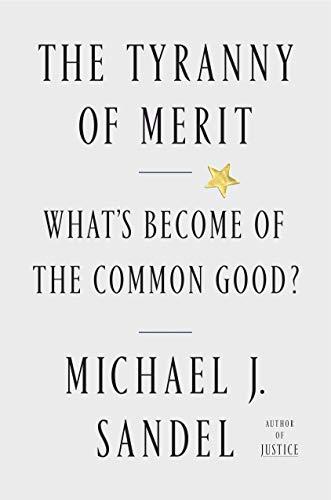

The Tyranny of Merit: What's Become of the Common Good? Cover
Podcast Mentions

The Tyranny of Merit What's Become of the Common Good?

Michael J. Sandel

A These are dangerous times for democracy. We live in an age of winners and losers, where the odds are stacked in favor of the already fortunate. Stalled social mobility and entrenched inequality give the lie to the American credo that "you can make it if you try". The consequence is a brew of ange...

Podcasts 4
Quotes 18
The Ezra Klein Show

He said the book examined ideas of merit and justice, arguing that the existing system unfairly rewards the privileged.

"

So first is Tyranny of Merit by Michael Sandel, a justice philosopher at Harvard.
— Episode: Would Bernie Have Won?

Episode: Would Bernie Have Won?

He said the book examined ideas of merit and justice, arguing that the existing system unfairly rewards the privileged.

"

So first is Tyranny of Merit by Michael Sandel, a justice philosopher at Harvard.
Philosophize This!

The Tyranny of Merit questions whether rewarding people solely based on talent, hard work, and qualifications is a good way to recognize people in society. The book suggests that a meritocracy can lead to unintended consequences, such as a feeling of deservingness among the successful and a sense of humiliation and resentment among those struggling. This, in turn, contributes to a decline in civic virtue, populism, and corrosive attitudes towards each other.

"

Michael Sandel in his 2020 book called The Tyranny of Merit is going to question whether that's actually a good way to be giving recognition in a society.

— Episode: Episode #205 ... Why a meritocracy is co...

Episode: Episode #205 ... Why a meritocracy is corrosive to...

The Tyranny of Merit questions whether rewarding people solely based on talent, hard work, and qualifications is a good way to recognize people in society. The book suggests that a meritocracy can lead to unintended consequences, such as a feeling of deservingness among the successful and a sense of humiliation and resentment among those struggling. This, in turn, contributes to a decline in civic virtue, populism, and corrosive attitudes towards each other.

"

Michael Sandel in his 2020 book called The Tyranny of Merit is going to question whether that's actually a good way to be giving recognition in a society.

The person that originally coined the term meritocracy was a guy named Michael Young back in the year 1958. He wrote a book called The Rise of the Meritocracy.

It's a fiction novel that's about a dystopian future where society organizes things around a meritocracy.

It tells successful people that you're the reason for all your success and you don't have to consider all the factors outside of your control that made your situation a pretty fortunate one.

We start to view the entire concept of education in our societies as just a way for people to acquire credentials so they can get paid in the world.

Episode: Episode #204 ... The importance of philosophy, jus...

The podcast mentions that in his recent book, Sandel suggests that success is the ultimate thing we honour in our societies, and we flatter the successful and humiliate the unsuccessful.

"

As Sandel talks about in his more recent book, the tyranny of merit, are the consequences of that, that we got a bunch more successful people in the world rolling around in Bugatti's or do we just have a society that ends up more divided one where, as he says, we flatter the successful in the world and humiliate the unsuccessful.

No Stupid Questions

The book, The Tyranny of Merit, was said to discuss meritocracy and how it may not be a good system to strive for. The book was written by one of the speaker's professors from Harvard, Michael Sandel.

"

There is another book on this topic of merit and meritocracy. This one was written by one of the professors I took a course with at Harvard named Michael Sandel. It was called Justice.

— Episode: 181. What’s So Great About Meritocracy?

Episode: 181. What’s So Great About Meritocracy?

The book, The Tyranny of Merit, was said to discuss meritocracy and how it may not be a good system to strive for. The book was written by one of the speaker's professors from Harvard, Michael Sandel.

"

There is another book on this topic of merit and meritocracy. This one was written by one of the professors I took a course with at Harvard named Michael Sandel. It was called Justice.

And so this is, I think, his latest book came out in 2020, The Tyranny of Merit. What's become of the common good?

Let me just say that neither of these titles make it seem at all like they have a bias. I'm just kidding. Meritocracy, trap. The tyranny of merit. You don't have to guess. Right. I mean, it's interesting to have one of the most eminent professors at one of the most eminent universities in the world talk about the tyranny of merit, because oftentimes merit has been the hero.

Stay Tuned with Preet

The book was highlighted across several episodes as a thought‑provoking critique of meritocracy and its role in widening political and economic divides, especially regarding those without college credentials. Host Preet Bharara repeatedly recommended it, describing it as a must‑read that reshaped his daily thinking about inequality and the common good. The discussion emphasized how the work indicts credentialism and the resentment it fuels among those who feel looked down upon by elites.

Highly Recommended

Episode: The Pragmatic Progressive (with Rep. Ritchie Torre...

It was discussed in relation to the political divide and how progressives and Democrats value college education, potentially overlooking those who didn't attend.

"

And he talks about how progressives and Democrats in particular valorize college.

Episode: The Fight for the Senate (with Jon Ossoff)

It was recommended by Preet Bharara for its thought-provoking exploration of the disenfranchisement of those who didn't attend college and the meritocratic narrative that often blames those who are less successful.

"

Another book along those lines that I think also helps understand where we are in the country in a justice framework to figure out why it is that there's so much inequality in the country and what inequality means and what we should be striving for in a just society. Because it's not necessarily what people think. And the book that I really enjoyed reading and made me think, I think about it almost every day, is the book by Michael J. Sandel, my former Harvard professor, called The Tyranny of Merit,

Episode: The Fight for the Senate (with Jon Ossoff)

Preet Bharara mentioned it as a thought-provoking book that made him think about the disenfranchisement of those not as successful in life, particularly related to inequality and meritocracy.

"

And the book that I really enjoyed reading, it made me think, I think about it almost every day, is the book by Michael J. Sandel, my former Harvard professor, called The Tyranny of Merit,

Episode: The Merit Trap (with Michael Sandel)

It was discussed as an intense indictment of America's relationship with achievement and how it has fueled resentment among those who feel that elites look down on them. It was also discussed how it explores the corrosive role of meritocracy in the politics of our current moment.

"

People who have technocratic expertise, but who lack human judgment and experience, practical wisdom, sense of history, they've gotten us, if you just look back at the last half century, they've gotten us into some pretty dangerous political circumstance.

Sandel's new book, The Tyranny of Merit, What's Become of the Common Good?, is an intense indictment of America's relationship with achievement.

I think it's a must read for everyone.

One of the most galling features of meritocratic hubris is its credentialism.

The moral of Henry Aaron's story is not that we should love meritocracy but that we should despise a system of racial injustice that can only be escaped by hitting home runs.

Note: The book recommendations on this page are discovered automatically from podcast transcripts, and may be incorrect or incomplete.