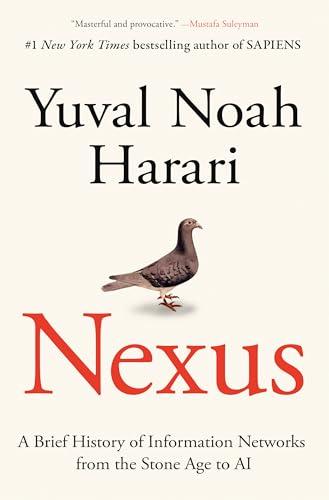

Nexus: A Brief History of Information Networks from the Stone Age to AI Cover
Podcast Mentions

Nexus A Brief History of Information Networks from the Stone Age to AI

Yuval Noah Harari

NEW YORK TIMES

Podcasts 4
Quotes 18
The Ezra Klein Show

Sullivan recommended Nexus for its thoughtful, if occasionally disagreeable, exploration of AI, noting it warns that humans are creating not just tools but autonomous agents.

"

The second is a book that I'm just partly through, but I actually I'll read the whole thing, ... which is Nexus by Yuval Hariri. ... it paints a picture of what we are going to be contending with arti...

— Episode: Biden Promised to ‘Turn the Page’ on Tru...

Episode: Biden Promised to ‘Turn the Page’ on Trump. What W...

Sullivan recommended Nexus for its thoughtful, if occasionally disagreeable, exploration of AI, noting it warns that humans are creating not just tools but autonomous agents.

"

The second is a book that I'm just partly through, but I actually I'll read the whole thing, ... which is Nexus by Yuval Hariri. ... it paints a picture of what we are going to be contending with artificial intelligence that, frankly, is a little bit worrisome, but is also so deeply thoughtful. One of the points he makes is, for the first time, humans are inventing not a tool, but an agent.

What Now? with Trevor Noah

In the episode, Trevor Noah introduced the title while chatting with Yuval Noah Harari, highlighting its focus on how information networks shape human behavior and the risks posed by AI. The discussion emphasized the book’s central question about why intelligent humans often act irrationally, linking it to societal breakdowns and current global issues. The hosts treated the work as a thought‑provoking but contentious contribution to understanding societal dynamics.

Episode: Making Bureaucracies Sexier with Yuval Noah Harari...

This book explores why humans, despite their intelligence, engage in self-destructive behaviors. The central theme revolves around the role of information in shaping human decisions and actions, and the potential threats posed by AI.

"

Well his new book, Nexus, is just as contentious. It focuses on a possible answer to what makes society work and what could break it completely.

And the key question that starts Nexus is if humans are so smart, why are we so stupid?

The rise of AI, the war in the Middle East, the breakdown in communication between politicians and the people. In this episode we discuss it all.

Episode: Meet Derek Fordjour – One of My Favorite People [V...

Trevor mentioned learning about the concept of shared fictions from Yuval Noah Harari's book Nexus during a previous podcast episode.

"

I learned it from Yuval Noah Harari, who we had on the podcast, and in his book, Nexus, he's talking about how humans have connected all of these ideas and made societies out of agreed fictions.

The Diary Of A CEO with Steven Bartlett

It was discussed in detail as a comprehensive and insightful exploration of the history of information networks, including how the flow of information has shaped societies and the implications of AI in this context. It was pre-ordered during the podcast.

"

After reading your new book, Nexus,

— Episode: Yuval Noah Harari: This Election Will Te...

Episode: Yuval Noah Harari: This Election Will Tear The Cou...

It was discussed in detail as a comprehensive and insightful exploration of the history of information networks, including how the flow of information has shaped societies and the implications of AI in this context. It was pre-ordered during the podcast.

"

After reading your new book, Nexus,

You could have written many a book. You're someone that's, I think, broadly curious about the nature of life, but also the nature of history.

For you to write a book that is so detailed and comprehensive, there must have been a pretty strong reason why this book had to come from you now.

It's a book about the long-term history of information networks.

I think that to understand what is really new and important about AI, we need perspective of thousands of years to go back and look at previous information revolutions, like the invention of writing and the printing press and the radio.

The Daily Show: Ears Edition

The author discussed his book about information networks, how people process excessive information, and why there is still hope in bureaucracy. He compared information overload to consuming too much junk food, suggesting the need for an 'information diet'.

"

No it's basically like thinking that more food is always good for you you know there is a limit to how much food the body needs and in a similar way there is a limit to how much food for the thought f...

— Episode: Inside the Debate Spin Room & Retaining...

Episode: Inside the Debate Spin Room & Retaining Hope in Bu...

The author discussed his book about information networks, how people process excessive information, and why there is still hope in bureaucracy. He compared information overload to consuming too much junk food, suggesting the need for an 'information diet'.

"

No it's basically like thinking that more food is always good for you you know there is a limit to how much food the body needs and in a similar way there is a limit to how much food for the thought for food for the mind the mind needs which is information and the same way that most there is so much junk food out there there is also so much junk information out there and we basically need to go on an information diet.

the most misunderstood and abused word in the english language today is the word excited people think that excited means happy like they i meet you and i say oh i'm so excited to meet you yeah that's what happened with us backstage yeah yeah yeah yeah yeah but excited excited doesn't mean happy it doesn't mean excited means that all your nervous system is in your brain is like fuzzing it's on and it's good to be excited sometime but if you keep an organic being an animal excited all the time it eventually collapses and dies

if we if for every dollar and every minute that we invest in developing artificial intelligence we also invest in exploring and developing our own minds we will be okay but if we put all our bets on the technology on the ais and neglect to develop ourselves this is very bad news for humanity

Episode: Jordan Klepper Covers Kamala & Trump's Debate Prep...

The podcast discussed Harari's book about information networks, touching upon the overload of information, whether AI is an existential threat, and the importance of human understanding in bureaucracy. The conversation highlighted the book's exploration of information overload and its comparison to overeating.

"

It's basically like thinking that more food is always good for you. There is a limit to how much food the body needs. And in a similar way, there is a limit to how much food for the mind the mind needs, which is information.

And the same way that most, there is so much junk food out there, there is also so much junk information out there. And we basically need to go on an information diet.

The most important thing to understand about AI is that AI is not a tool. It is an agent. It's the first technology in history that can make decisions and invent new ideas by itself.

The kind of existential threat we are facing is not this Hollywood scenario of a single computer trying to take over the world. It's millions of AI bureaucrats in the banks, in the governments, in the armies, in the schools making decisions about us.

If we if for every dollar and every minute that we invest in developing artificial intelligence, we also invest in exploring and developing our own minds, it will be OK. But if we put all our bets on the technology, on the AIs and neglect to develop ourselves, this is very bad news for humanity.

Note: The book recommendations on this page are discovered automatically from podcast transcripts, and may be incorrect or incomplete.