Losing the Nobel Prize: A Story of Cosmology, Ambition, and the Perils of Science's Highest Honor Cover
Podcast Mentions

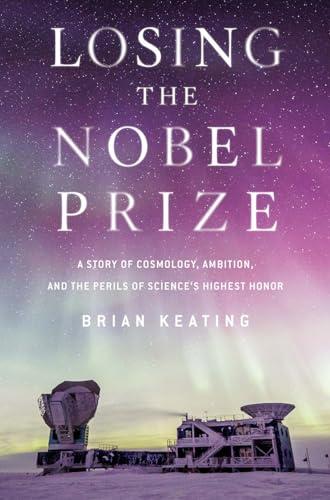
Losing the Nobel Prize A Story of Cosmology, Ambition, and the Perils of Science's Highest Honor

Brian Keating

A What would it have been like to be an eyewitness to the Big Bang? In 2014, astronomers wielding BICEP2, the most powerful cosmology telescope ever made, revealed that they’d glimpsed the spark that ignited the Big Bang. Millions around the world tuned in to the announcement broadcast live from Ha...

Podcasts 4
Quotes 20
The Shawn Ryan Show

Brian Keating discussed his memoir, noting it had been ranked as a best science book of the year and highlighted as one of Amazon's Editor's Best Nonfiction Books of All Time.

"

You are the author of Losing the Nobel Prize, ranked a Best Science Book of the Year by Science Friday, Physics Today and Forbes, and one of Amazon's Editor's Best Nonfiction Books of All Time.

— Episode: #316 Brian Keating - Brian Keating - The...

Episode: #316 Brian Keating - Brian Keating - The First Obj...

Brian Keating discussed his memoir, noting it had been ranked as a best science book of the year and highlighted as one of Amazon's Editor's Best Nonfiction Books of All Time.

"

You are the author of Losing the Nobel Prize, ranked a Best Science Book of the Year by Science Friday, Physics Today and Forbes, and one of Amazon's Editor's Best Nonfiction Books of All Time.

My first book's called losing the Nobel Prize, so something went wrong. Something went really wrong. We made a claim that we saw what caused the universe to begin its expansion and that's a type of quantum field. We call that quantum field the inflaton or the inflationary field and we said we detected the shrapnel of the explosion basically.

The Jordan B. Peterson Podcast

It was described as a memoir of Brian Keating's career, focusing on his quest to detect early reverberations of the universe's spacetime structure in order to see whether inflation or an alternative took place.

"

It's the story of how uh that a scientist can become obsessed in this case the scientist is me it's a memoir of my career trying to detect these early reverberations of universe's spacetime structure...

— Episode: 348. Black Holes, Time Travel, and the O...

Episode: 348. Black Holes, Time Travel, and the Origin of t...

It was described as a memoir of Brian Keating's career, focusing on his quest to detect early reverberations of the universe's spacetime structure in order to see whether inflation or an alternative took place.

"

It's the story of how uh that a scientist can become obsessed in this case the scientist is me it's a memoir of my career trying to detect these early reverberations of universe's spacetime structure in order to see whether or not inflation or an alternative took place to ignite the hot big bang that we do observe and have have stacks and reams of evidence to support so the existence of matter the existence of the CMB the existence of galaxies and expansion those all support the fact the universe was in an extremely hot and dense state early on in its history but they don't provide the mechanism by which that came about.

It's a play on words because that polarization signal I told you about Jordan the orientation is called a curl so it's called a curl tight motion but there's a profound nerd joke for you.

that's described in my book Losing the Nobel Prize we claimed we detected these waves of gravity that's as close as scientists think we can get to the detecting the smoking gun it's actually the smoke from the gun if you will of the initial inflationary expansion of the universe

so the results were accurate so what's the stat what's the status of the quantum fluctuation field agglomeration theory now you didn't provide evidence that it was the case right is that still the extent theory in relation yes the initial agglomeration of matter it is it is it is an end it's that theory you just know it's your claim to have provided evidence for it exactly and we made the most precise detection ever of this type of signal it's just the interpretation was wrong we didn't make a blunder we didn't say there's faster than light neutrinos or what we made an exquisitely precise measurement of dust in our galaxy which is useful by the way because what we see we'll never see a unit well as I said until we get out of the galaxy which won't even happen you know with with trillions of dollars of funding it's it's physically impossible right so until we we're always going to be measuring a combined signal a potential cosmic signal plus an actual dust signal

I mean we're human beings we have to support and there's and there's a lot to be said about good honest work and the work that colleagues and I are engaged in but we were confronted with the discovery of a lifetime and that would not only mean as I said before that we had discovered you know gravitational waves which had never been observed in this fashion and in 2014 when we made this announcement at Harvard you know that we had discovered the aftershocks of the inflationary epoch but that we had discovered evidence for the multiverse and and yet what did it get undone by the most humble meager make substance in the whole world which in the universe which is called dust
StarTalk Radio

It was mentioned as the title of a book by Brian Keating, discussing the BICEP project and its attempt to detect inflation.

"

And that's it right there if you're watching on screen. Otherwise, I'm showing a picture of our telescope at the South Pole, Antarctica, where I've been twice. We put a telescope there, and we've upgr...

— Episode: Cosmic Queries – Big Bang Bonanza with B...

Episode: Cosmic Queries – Big Bang Bonanza with Brian Keati...

It was mentioned as the title of a book by Brian Keating, discussing the BICEP project and its attempt to detect inflation.

"

And that's it right there if you're watching on screen. Otherwise, I'm showing a picture of our telescope at the South Pole, Antarctica, where I've been twice. We put a telescope there, and we've upgraded it ever since. In 2014--

The Jordan Harbinger Show

Brian Keating, a professor of physics and astronomy, is the author of this book, which has a humorous title, and it was mentioned as an example of scientific illiteracy being celebrated rather than criticised.

"

He's a jet pilot, author of the hilariously titled Losing the Nobel Prize.

— Episode: 349: How to Pick Your Battles Without Be...

Episode: 349: How to Pick Your Battles Without Being a Door...

Brian Keating, a professor of physics and astronomy, is the author of this book, which has a humorous title, and it was mentioned as an example of scientific illiteracy being celebrated rather than criticised.

"

He's a jet pilot, author of the hilariously titled Losing the Nobel Prize.

Episode: 347: Brian Keating | Losing the Nobel Prize

It details the author's experience in cosmology, his pursuit of the Nobel Prize, and the challenges and insights he gained, ultimately questioning the value of such accolades.

"

the book started off as a with a title Losing the Nobel Prize sort of as a double on tone.

the Nobel Prize needs to be done away with at least it's negative aspects that we can get into and therefore it needs to be lost in its current form and kind of revived in a better form.

our discovery was really one for the ages if it had held up the reason that it wasn't awarded to us no member of my team one so we all lost it in a certain sense is because we were trying to study the origin of the very largest thing that possibly exists namely the universe and in so doing we were spoiled and actually ruined our results weren't wrong we didn't make a blunder but it turned out we were kind of tripped up by the smallest substance in the universe namely dust.

I wouldn't trade it I got fired from Stanford it's one of the best if not the best you know place to study physics to do it's physics I got fired I mean can't I'd never been fired from anything I was you know like the academic golden boy and here I was my first real job out of graduate school and it was the best thing that ever happened to me I never would have met my mentor Andrew Lang I never would have been taken under his wing I would have never have it the opportunity to create this experiment called bicep I would never have gotten the job that I have at UC San Diego I never would have met my wife and I never would have had my kids.

life can only be lived going forward but it can only be understood looking backwards and that's the theme of the ethical will you're looking back and it doesn't have to be the very end of your life like Alfred Nobel it can be right now it should be right now don't delay don't tary thank God Coby wrote his book before he died and thank God you know Victor Frankl and Anne Frank and others wrote their books do it yourself too.

Episode: 349: How to Pick Your Battles Without Being a Door...

It was mentioned as being the hilariously titled book written by Brian Keating, a professor of physics and astronomy.

"

He's a jet pilot, author of the hilariously titled Losing the Nobel Prize.

Episode: 347: Brian Keating | Losing the Nobel Prize

It details the author's journey as a cosmologist striving for the Nobel Prize, his near-miss discovery, and his reflections on the nature of scientific ambition and the pursuit of accolades.

"

The book started off as a with a title 'Losing the Nobel Prize' sort of as a double on tone.

It became like you know winning an Oscar or winning best podcast of the year it became a goal into itself.

I had to deal with this crushing blow as you say to come so close and not win after all the blood sweat and tears and travel and people that I knew and loved and lost over the decade it took to make these measurements.

I'm still told that by people that the research I'm doing is great I'm still have a chance to win the Nobel Prize and I say that would be pretty ironic at this point after all the criticism I make in the book.

I wanted to take the clothes off the emperor or show that the emperor is naked that this you know kind of sacrificing yourself and again I'm not a scrabbing motives to either these gentlemen one of whom I knew well why they committed suicide will probably never know exactly why.

Note: The book recommendations on this page are discovered automatically from podcast transcripts, and may be incorrect or incomplete.