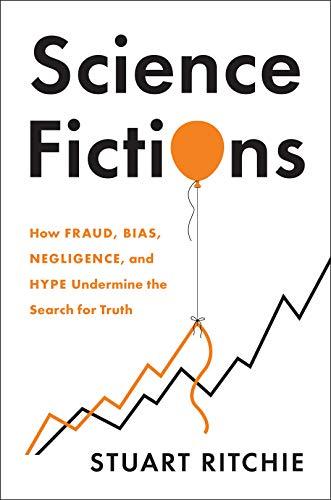
Science Fictions
How Fraud, Bias, Negligence, and Hype Undermine the Search for Truth
Stuart Ritchie
An insider’s view of science reveals why many scientific results cannot be relied upon – and how the system can be reformed.
Science is how we understand the world. Yet failures in peer review and mistakes in statistics have rendered a shocking number of scientific studies useless – or, worse, badl...
The book explores the replication crisis in psychology, where many well-known findings have been shown to be false when replicated. It also discusses how the incentives in science can lead to fraud and bias.
"
And that's the absurdity as part of the story.
— Episode: 436: Stuart Ritchie | The Science Fictio...
Episode: 436: Stuart Ritchie | The Science Fictions Undermi...
The book explores the replication crisis in psychology, where many well-known findings have been shown to be false when replicated. It also discusses how the incentives in science can lead to fraud and bias.
"
And that's the absurdity as part of the story.
The part of the experiment that we specifically replicated was just about word lists like we didn't do the exciting porn part sure you didn't.
I think there are true believers. I think people believe that this stuff is real.
It's been described as like the gesture in the core of science because it's like a really absurd thing which is not really good.
I think we can safely assume that he believes that this is true.
Episode: 436: Stuart Ritchie | The Science Fictions Undermi...
The host and guest discussed the book in detail, and the host mentioned that it was written by Stuart Ritchie, a lecturer in the Social, Genetic and Developmental Psychiatry Centre at King's College London. The conversation centered around the topic of scientific fraud, bias, and negligence, with the guest highlighting the importance of critical thinking when evaluating scientific studies.
"
So basically that is what that paper and that was posted on a mainstream psychology journal.
So it kind of illustrates that there's something maybe a bit funny with the way we do science.
And so if you dig into the statistics of the paper, there are lots of reasons where he might have been able to find what looked like a real result but actually there wasn't.
I think there are true believers. I think people believe that this stuff is real. I think people believe that we have a like a tiny, tiny tendency.
I think that study was actually fraudulent, that was made up.
Note: The book recommendations on this page are discovered automatically from podcast transcripts, and may be incorrect or incomplete.