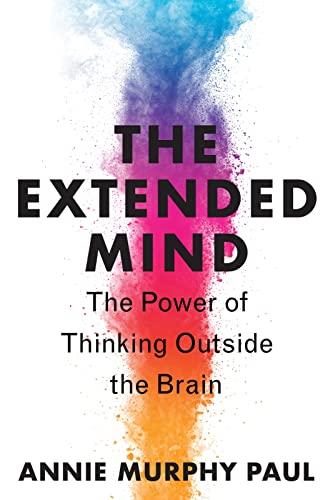

The Extended Mind: The Power of Thinking Outside the Brain Cover
Podcast Mentions

The Extended Mind The Power of Thinking Outside the Brain

Annie Murphy Paul

A Use your head.

Podcasts 3
Quotes 15
The Ezra Klein Show

Ezra said he had begun reading this book on the human brain, which discusses embodied cognition and how the body informs thought before conscious awareness.

"

I started reading this book about the human brain by Annie Murphy Paul called The Extended Mind, and she talks about embodied cognition and the ways in which we seem to do some level of calculation at...

— Episode: Best Of: How Octopuses Upend What We Kno...

Episode: Best Of: How Octopuses Upend What We Know About Ou...

Ezra said he had begun reading this book on the human brain, which discusses embodied cognition and how the body informs thought before conscious awareness.

"

I started reading this book about the human brain by Annie Murphy Paul called The Extended Mind, and she talks about embodied cognition and the ways in which we seem to do some level of calculation at some subconscious level that is picked up by our body before it is picked up by conscious thought.

Episode: Our Workplaces Think We’re Computers. We’re Not.

Ezra Klein read the book and said it reshaped his view of the mind as contextual rather than computerlike, prompting him to change how he structures his days. Annie MurphyPaul explained that the book challenges the computer metaphor and introduces ideas like an interceptive journal and the brainasmagpie metaphor.

"

Then I began reading this new book, The Extended Mind by Annie Murphy Paul.

You write, quote, when fed a chunk of information, a computer processes it in the same way on each occasion, whether it's been at work for five minutes or five hours, whether it is located in a fluorescent lit office or positioned next to a sunny window, whether it's near other computers or is it the only computer in the room. This is how computers operate. But the same doesn't hold for human beings.

In this book, I wanted to challenge the metaphor of the computer and point out that actually the brain evolved in particular settings, mostly outside, and that the brain is not a computer.

I write in the book about keeping what's known as an interceptive journal, and that means when you're contemplating a choice or decision, pay attention to how your body feels and note that down.

I compare the brain to a magpie, one of these birds that plucks a twig here and a piece of string here, but also more unusual things. The brain builds its nests from whatever is available in its immediate environment.

Episode: How Octopuses Upend What We Know About Ourselves

Ezra said he started reading this book about the human brain, which discusses embodied cognition and subconscious calculation.

"

I started reading this book about the human brain by Annie Murphy Paul called The Extended Mind, I think it is.

10% Happier with Dan Harris

It is a manual for how to think with your extended mind, which she says can help people think better. It explores how our minds extend beyond the skull into our bodies, surroundings, relationships, and tools.

"

The mind does not stop at the standard demarcations of skin and skull, they argued. Rather, it is more accurately viewed as an extended system, a coupling of biological organism and external resources...

— Episode: The Science Of Getting Out Of Your Head...

Episode: The Science Of Getting Out Of Your Head | Annie Mu...

It is a manual for how to think with your extended mind, which she says can help people think better. It explores how our minds extend beyond the skull into our bodies, surroundings, relationships, and tools.

"

The mind does not stop at the standard demarcations of skin and skull, they argued. Rather, it is more accurately viewed as an extended system, a coupling of biological organism and external resources. Once the hegemony of skin and skull is usurped, they concluded, we may be able to see ourselves more truly as creatures of the world.

It's worth a try. Yeah. Yes, actually, there's been research to suggest that people who are induced to move in more fluid ways come up with more and more creative ideas than people who are still or move in more constricted ways.

I'm glad you mentioned fidgeting because part of what I wanted to do with this book was push back against the sort of pro-brain bias that our culture has. Andy Clark, the philosopher that we were mentioning earlier, he likes to say that we're a very brain bound culture, meaning we're really focused on the brain. We kind of fetishize the brain and we not just push aside or dismiss or ignore the body. We actually kind of denigrate it.

The brain didn't really evolve to do what we ask it to do so much these days, which is to wrestle with abstract concepts and symbols. So the more we can make our thinking work resemble those activities that the brain really evolved for, like navigating through three-dimensional space or manipulating material objects, the better we'll be able to think.

I think we could begin to think about how could we not only measure but also encourage the development of all of our extended minds. And I think we're going to need every bit of intelligence that we can muster to tackle the problems of this world. And so I think the extended mind is going to be ever more necessary.

Episode: Why Your Brain Turns The Miraculous Into The Munda...

It was discussed as a book about how we think with more than just our brains - with our bodies, relationships, and surroundings - and was mentioned in relation to Maria's and Dan's preference for thinking while in motion.

"

I actually just recently posted an interview with Annie Murphy-Paul who wrote a book called The Extended Mind about the fact that we...

The Daily Stoic

This book explores the idea that we think with our bodies, encompassing internal processes, environmental interactions, and relationships with others.

"

the book I read is called *The Extended Mind*

— Episode: Austin Kleon On Maintaining Healthy Habi...

Episode: Austin Kleon On Maintaining Healthy Habits, Growin...

This book explores the idea that we think with our bodies, encompassing internal processes, environmental interactions, and relationships with others.

"

the book I read is called *The Extended Mind*

her point is that a lot of our thinking comes from internal stuff with our body and then our bodies interactions with our environment and like the other people around us and so there are all these...

Note: The book recommendations on this page are discovered automatically from podcast transcripts, and may be incorrect or incomplete.