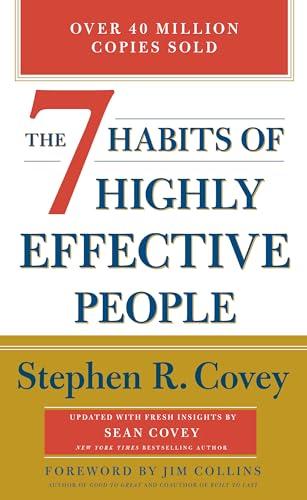
The 7 Habits of Highly Effective People: 30th Anniversary Edition (*LARGE PRINT) Cover
Podcast Mentions

The 7 Habits of Highly Effective People 30th Anniversary Edition (*LARGE PRINT)

Stephen R. Covey

New York Times bestseller -- over 40 million copies sold [LARGE PRINT HARDCOVER]

Podcasts 10
Quotes 37
On Purpose with Jay Shetty

Jay Shetty repeatedly highlighted the book as one of his favorites, citing its principles for managing anxiety, focusing on the circle of influence, and building confidence. He referenced it when discussing how to control what you can, inspire personal growth in relationships, and reduce stress. The overall tone was positive, presenting the title as a valuable resource for developing effective habits.

Highly Recommended

Episode: 7 Steps To Transform An Anxious Mindset & How To O...

It was mentioned in relation to controlling what you can and cannot control, as a method for managing anxiety and worries.

"

It's by Stephen Covey who wrote the book Seven Habits of Highly Effective People, one of my favorite ones.

Episode: 7 Habits of Highly Confident People and 7 Ways to...

It was mentioned as a source of inspiration for the episode's discussion on confidence, particularly the habits that contribute to it, although it was focused on the topic of confidence rather than effectiveness.

"

I'm a big fan of the book, Seven Habits of Highly Effective People by Stephen Covey.

Episode: 7 Ways Successful People Stay Calm at Work and Man...

Stephen Covey's book was mentioned in relation to the concept of the circle of influence versus the circle of concern, which was discussed as a way to manage stress by focusing on what one can control.

"

Now Stephen Covey famously talked about the circle of influence versus a circle of concern in his incredible book, The Seven Habits of Highly Effective People.

How I Built This with Guy Raz

It was mentioned as one of the books that Daymond John was consuming along with other self-help books, such as those by Tony Robbins and Think and Grow Rich, during his entrepreneurial journey.

"

And so how productive I was going to be later on, or I can put in P&L statements and listen to Tony Robbins and listen to Jay Abraham and Think and Grow Rich and Seven Highly Effective Habits of whate...

— Episode: FUBU: Daymond John

Episode: FUBU: Daymond John

It was mentioned as one of the books that Daymond John was consuming along with other self-help books, such as those by Tony Robbins and Think and Grow Rich, during his entrepreneurial journey.

"

And so how productive I was going to be later on, or I can put in P&L statements and listen to Tony Robbins and listen to Jay Abraham and Think and Grow Rich and Seven Highly Effective Habits of whatever people.

The Bible in a Year (with Fr. Mike Schmitz)

The speaker mentions the concept of starting with the end in mind, which is a principle from "The 7 Habits of Highly Effective People" by Stephen Covey, as a way to live wisely because knowing what you want to achieve allows you to live with purpose.

"

was it um Stephen Covey who had said begin with the end in mind as a way to live wisely because I know what's coming or I have an idea of what I where I want to end up therefore I'm going to live in a...

— Episode: Day 151: Wisdom and Folly (2024)

Episode: Day 151: Wisdom and Folly (2024)

The speaker mentions the concept of starting with the end in mind, which is a principle from "The 7 Habits of Highly Effective People" by Stephen Covey, as a way to live wisely because knowing what you want to achieve allows you to live with purpose.

"

was it um Stephen Covey who had said begin with the end in mind as a way to live wisely because I know what's coming or I have an idea of what I where I want to end up therefore I'm going to live in a way that's intentional trying to get towards that place

No Stupid Questions

The book was referenced several times, often to illustrate concepts like scarcity versus abundance mindset and to note its influence on business self‑help literature. Angela Duckworth cited it as a source of the Eisenhower Matrix and mentioned having read it repeatedly, while Mike and Stephen Dubner highlighted a misattributed quote that actually originated from Peter Drucker. Overall, the hosts treated the title as a well‑known, moderately influential work rather than a central recommendation.

Episode: 168. Would You Be Happier if You Were More Creativ...

It was incorrectly attributed to the book's author; the quote 'Do first things first, and second things not at all' actually originated from Peter Drucker's 'The Effective Executive'.

"

It was the old Stephen Covey, 'Do first things first, and second things not at all'.

Finally Mike attributes the quotation 'Do first things first, and second things not at all' to Stephen Covey, author of the 1989 book 'The Seven Habits of Highly Effective People'. The line actually comes from the 1966 book 'The Effective Executive' by Peter Drucker whose work was a significant influence on Covey.

Episode: 145. Do You Have a Scarcity Mindset or an Abundanc...

It was mentioned as the origin of the terms 'scarcity mindset' and 'abundance mindset'. The book was described as self-helpy and business-focused, emphasizing effectiveness in commercial and business contexts.

"

Then I felt silly about being surprised actually came from an extraordinarily popular book called the seven habits of highly effective people By Steven Covey who was an interesting guy who I didn't really know.

Covey says that a scarcity mentality refers to people who see life as a finite pie in other words, it becomes a zero-sum game, right? If you have something I can't have it.

He writes that people with a scarcity mentality have a very difficult time sharing recognition and credit power or profit whereas someone with an abundance mentality has the idea that there's plenty out there for everyone.

So I think these are really two different things we're talking about and I think what Matthew is writing is to ask what psychology has to say about this sort of Getting ahead framework that's posed by Steven Covey of setting off scarcity versus abundance.

This is a book that Steven Covey first published in 1989. It was kind of a self-helpy business book.

Episode: 60. Why Do We Complain?

It was mentioned as a book that Angela had read multiple times and where she learned about Eisenhower's Matrix.

"

I actually know about this matrix because I have read Stephen Covey's book more times than anyone would believe. This is the seven habits of highly effective people.

Episode: 37. How Do You Know if People Don’t Like You?

It was briefly mentioned and discussed in context of Angela's misreferencing of another book.

"

Angela appropriately enough confuses the work with another best-selling self-help book, The Seven Habits of Highly Effective People, which was written by author and businessman Stephen Covey.

The Jordan Harbinger Show

It was mentioned as an example of a book that achieved lasting influence because it was built as a system, not just a one-time publication, and was discussed in the context of creating residual results.

"

when he decided he would write seven habits one of the reasons he did that what sort of push them over the edge was that he had a friend who was very successful at the time as a speaker and had ideas...

— Episode: 534: Greg McKeown | How to Make What Mat...

Episode: 534: Greg McKeown | How to Make What Matters Effor...

It was mentioned as an example of a book that achieved lasting influence because it was built as a system, not just a one-time publication, and was discussed in the context of creating residual results.

"

when he decided he would write seven habits one of the reasons he did that what sort of push them over the edge was that he had a friend who was very successful at the time as a speaker and had ideas and had people that were interested in so on and then he died prematurely and that was it was gone his ideas were gone there was nothing else left and that was when he said okay well I've got to create something that is independent of me but I don't show up for the event you know when I can't show up for the event anymore this thing carries on.

so for me my goal when writing essentialism and now writing effortless isn't just hey have a New York Times best seller I'm glad they both have been but the key is to write something that can exist in perpetuity.

Steven Covey's marketer said he spent three years day and night making that book an overnight success

Episode: 215: How to Invest Wisely and Crush Student Debt |...

It was mentioned in the context of a listener struggling with procrastination and instant gratification, and the book was referenced as a guide to prioritizing tasks.

"

I've read the seven habits of highly effective people by Stephen Covey and I know that I should be spending time focusing on activities in the first and second quadrant but I just seem to be perpetually trapped in the fourth quadrant.

Episode: 85: Jim Kwik | How to Unlock Your Brain's Secret S...

It was referenced in relation to the concept of seeking first to understand before being understood, a key principle for effective communication and building relationships.

"

one of my favorite books growing up was by mentor mine Dr. Stephen Covey wrote seven habits highly effective people and one of the habits of most effective people that he's his research found is they seek first to understand then to be understood they seek first to understand someone and then to be understood by them

Episode: 215: How to Invest Wisely and Crush Student Debt |...

It was mentioned in relation to the importance of focusing on important activities, but the individual felt stuck in less productive ones.

"

I've read the seven habits of highly effective people by Stephen Covey and I know that I should be spending time focusing on activities in the first and second quadrant but I just seem to be perpetually trapped in the fourth quadrant

Episode: 85: Jim Kwik | How to Unlock Your Brain's Secret S...

It was referenced as a book by Jim's mentor which discussed the habit of seeking first to understand then to be understood, a concept related to active listening and presence.

"

one of my favorite books growing up was by mentor mine Dr. Stephen Covey wrote seven habits highly effective people and one of the habits of most effective people that he's his research found is they seek first to understand then to be understood they seek first to understand someone and then to be understood by them

Episode: 534: Greg McKeown | How to Make What Matters Effor...

It was discussed as a book that served as an example of creating something that could exist independently of the author, with the author's friend's untimely death pushing him to create something that would last.

"

One of the reasons he did that what sort of push them over the edge was that he had a friend who was very successful at the time as a speaker and had ideas and had people that were interested in so on and then he died prematurely and that was it was gone his ideas were gone there was nothing else left.

He spent three years day and night making that book an overnight success.

They built two systems they built the ideas into books and they built an institute so to speak it's a business that would continue.

Episode: 215: How to Invest Wisely and Crush Student Debt |...

It was mentioned in passing that the book discusses the importance of focusing on important activities, but the individual in the scenario felt perpetually trapped in the fourth quadrant.

"

I've read the seven habits of highly effective people by Stephen Covey and I know that I should be spending time focusing on activities in the first and second quadrant but I just seem to be perpetually trapped in the fourth quadrant.

Episode: 85: Jim Kwik | How to Unlock Your Brain's Secret S...

The book was mentioned during a discussion about the importance of listening, where the speaker highlighted Covey's emphasis on seeking first to understand before being understood.

"

One of my favorite books growing up was by mentor mine Dr. Stephen Covey wrote seven habits highly effective people and one of the habits of most effective people that he's his research found is they seek first to understand then to be understood.

The Daily Stoic

The podcast referenced the second habit in Stephen Covey's book, "Begin with the End in Mind," relating it to the Stoic concept of clarifying intentions and defining success.

"

And as it happens the second habit in the seven habits of highly effective people is begin with an end in mind having an end in mind is no guarantee that you'll reach it no stoic would tolerate that a...

— Episode: Do This Every Day | Clarify Your Intenti...

Episode: Do This Every Day | Clarify Your Intentions

The podcast referenced the second habit in Stephen Covey's book, "Begin with the End in Mind," relating it to the Stoic concept of clarifying intentions and defining success.

"

And as it happens the second habit in the seven habits of highly effective people is begin with an end in mind having an end in mind is no guarantee that you'll reach it no stoic would tolerate that assumption but not having an end in mind is a guarantee that you won't

A Bit of Optimism

It was mentioned in passing, and the speaker was unsure of the exact publication date, but recalled a story from the book about someone who takes up two parking places or the person who's shitty on the train.

"

When I hear your story about, it reminds me of Stephen Covey. Was this book written like 30 years ago? Seven Habits? I don't even remember.

— Episode: More Thinking About Thinking with Brené...

Episode: More Thinking About Thinking with Brené Brown and...

It was mentioned in passing, and the speaker was unsure of the exact publication date, but recalled a story from the book about someone who takes up two parking places or the person who's shitty on the train.

"

When I hear your story about, it reminds me of Stephen Covey. Was this book written like 30 years ago? Seven Habits? I don't even remember.

followHIM

Podcast

followHIM

It was mentioned that Stephen Covey once had a group of teenagers write down how they saw themselves and then how God saw them based on scriptures, patriarchal blessings, talents, and gifts.

"

I remember something that Stephen Covey did once with a group of young adults or teenagers

— Episode: "How do I see myself the way the Lord se...

Episode: "How do I see myself the way the Lord sees me?" :...

It was mentioned that Stephen Covey once had a group of teenagers write down how they saw themselves and then how God saw them based on scriptures, patriarchal blessings, talents, and gifts.

"

I remember something that Stephen Covey did once with a group of young adults or teenagers

he had people take a piece of paper, fold it in half. And on one side of the page, that was just to make it into columns. And then in column one, right at the top, how I see myself, right? How others see me.

he was a little surprised at how negative kids could be about themselves. I'm this, I'm that, I'm weird, I'm strange. I'm not attractive. I'm whatever.

And then he said on the other side, I want you to write down how God sees me and started to go through scriptural references. What is the worth of a soul? What has he done for you? What has he said about you in your patriarchal blessing, which is amazing, your talents, your gifts, your capacities.

Episode: If I repent of a sin and then do it again, can I r...

It was mentioned in relation to the concept of repentance as a continuous process of turning back towards the right path, similar to an airplane course-correcting while in flight.

"

Stephen Covey talked about it once, is that an airplane is off course about 90% of the time.

Episode: Articles of Faith : Brother Ahmad S. Corbitt

The speaker mentioned the author's book, 'The Six Events of the Restoration', which suggests that the order of the restoration events is a formula for solving life's problems and that the order of the Articles of Faith mirrors the order in which things fell apart in the apostasy.

"

You know about the seven habits. Well, the six events of the restoration, Brother Covey suggested the, the order of the events of the restoration are kind of a formula for solving life's problems.

I think I heard Brother Covey once at an education week also kind of say, if you look at the order of the Articles of Faith, you kind of see the order in which things fell apart as the apostasy began that started with the nature of God and then with the original sin and things like that.

Episode: Doctrine & Covenants 98-101 Part 2 : Sherilyn Farn...

It was mentioned in connection with an anecdote about Albert Einstein's curiosity about the universe and its purpose. It was used to emphasize the importance of understanding the 'why' behind creation, something the gospel provides answers for.

"

I want to Steven and Kovies books he talks about Albert Einstein being asked if you could ask out anything what would you ask him and Albert Einstein said well I ask him how he made the universe and then he changed his mind it said no wait I would ask him why he created the universe because then I would know the meaning of my life and recently I found that Steven Hawking in our day said that you know science may one day be able to tell us how the universe was created but it won't be able to tell us why does the universe bother to exist and we have beautiful answers here in the gospel

Elevation with Steven Furtick

It was mentioned as a book that Steven Furtick intends to read and implement alongside Proverbs and Philippians to continue improving himself.

"

I'm gonna be me. I'm gonna be me. I'm a dance over this foundation that God gave me and I'm gonna work on it And I'm gonna read the seven habits of highly effective people and Proverbs and Philippians...

— Episode: But Now Be Strong

Episode: But Now Be Strong

It was mentioned as a book that Steven Furtick intends to read and implement alongside Proverbs and Philippians to continue improving himself.

"

I'm gonna be me. I'm gonna be me. I'm a dance over this foundation that God gave me and I'm gonna work on it And I'm gonna read the seven habits of highly effective people and Proverbs and Philippians, and I'm gonna do it

Note: The book recommendations on this page are discovered automatically from podcast transcripts, and may be incorrect or incomplete.