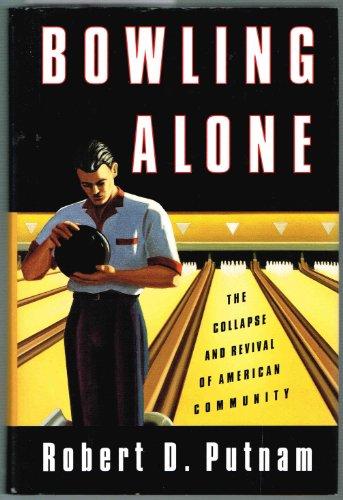

Bowling Alone: The Collapse and Revival of American Community Cover
Podcast Mentions

Bowling Alone The Collapse and Revival of American Community

Robert D. Putnam

Shows how changes in work, family structure, age, women's roles, and other factors have caused people to become increasingly disconnected from family, friends, neighbors, and democratic structures--and how they may reconnect.

Podcasts 13
Quotes 36
The Joe Rogan Experience

Ben Shapiro cites sociologist Robert D. Putnam's book "Bowling Alone," which explores the concept of social capital and the potential downsides of diversity, suggesting that it can be beneficial when aligned with common goals.

"

He wrote an entire book about the social fabric called Bowling Alone who's kind of the pioneer in the idea of social capital and what he said is that he went in with to writing this book with the idea...

— Episode: #1276 - Ben Shapiro

Episode: #1276 - Ben Shapiro

Ben Shapiro cites sociologist Robert D. Putnam's book "Bowling Alone," which explores the concept of social capital and the potential downsides of diversity, suggesting that it can be beneficial when aligned with common goals.

"

He wrote an entire book about the social fabric called Bowling Alone who's kind of the pioneer in the idea of social capital and what he said is that he went in with to writing this book with the idea that diversity is our strength and then he did some research and what he found is that ethnic diversity only correlates with two things and these are his words. Increased TV watching and increased protest marches that's all it, unless, unless it is within the boundaries of a common goal.


The Shawn Ryan Show

The author, Robert Putnam, is a social scientist who wrote a book called 'Bowling Alone' about a period of American history that was much like present times, in terms of polarization, high crime, and uncontrolled immigration. He talks about a period in the early 1900s where the US had a lot of problems and social capital groups started to form in order to combat them.

"

Robert Putnam in his book, Bowling Alone, he's a social scientist.

— Episode: #36 Lt. Col. Scott Mann - Operation Pine...

Episode: #36 Lt. Col. Scott Mann - Operation Pineapple Expr...

The author, Robert Putnam, is a social scientist who wrote a book called 'Bowling Alone' about a period of American history that was much like present times, in terms of polarization, high crime, and uncontrolled immigration. He talks about a period in the early 1900s where the US had a lot of problems and social capital groups started to form in order to combat them.

"

Robert Putnam in his book, Bowling Alone, he's a social scientist.

He talks about how in the early 1900s, America was in these really dark times, really dark times. You had polarized politics, crime was terrible, immigration was off the chain and unchecked and people were screaming that America was on its last leg.

Today, Explained

This book, written 25 years ago, argued that declining social connections were leading to a decline in democratic society. The speaker noted that the book became even more relevant than anticipated as many of the predicted negative trends in American society came to pass over the following decades.

"

25 years ago, Bob wrote a book called Bowling Alone. It was grounded in data, and it offered a simple premise. Once upon a time, Americans joined bowling leagues. Now they're going bowling by themselv...

— Episode: Why volunteering is worth it

Episode: Why volunteering is worth it

This book, written 25 years ago, argued that declining social connections were leading to a decline in democratic society. The speaker noted that the book became even more relevant than anticipated as many of the predicted negative trends in American society came to pass over the following decades.

"

25 years ago, Bob wrote a book called Bowling Alone. It was grounded in data, and it offered a simple premise. Once upon a time, Americans joined bowling leagues. Now they're going bowling by themselves.

He extended the metaphor, positing that our declining social connections were leading to a decline in our democratic society. Lonely Americans, he wrote, are not great for America.

The book was a strike. It's still influential today.

In the book Bowling Alone, which was written almost 30 years ago, 25 to 30 years ago, I talked about the decline in these connections, decline in what I called social capital.

Freakonomics Radio

The book was highlighted as a landmark, seminal work on social capital that documents the decline of community involvement in the United States since the 1960s. Stephen Dubner referenced it repeatedly as a key source for understanding social networks and their policy implications, while Mark Zuckerberg cited its relevance to his own ideas about community membership. The discussion emphasized the book’s influence on how scholars and practitioners think about the value of social connections and their impact on upward mobility.

Highly Recommended

Episode: Trust Me (Ep. 266 Rebroadcast)

It was discussed as a landmark book on social capital, which was published in 2000. The author had started thinking about the concept decades earlier, and it was initially inspired by a question about Italian politics.

"

Putnam is also the author of the landmark book Bowling Alone, which was published in 2000.

Episode: 328. Extra: Mark Zuckerberg Full Interview

The book's themes were discussed by Mark Zuckerberg, relating to community membership and its importance. It was described as seminal work in the field.

"

Putnam's work shares a lot of the themes that I was just talking about today.

He wrote some of the seminal work on community membership and did some of the longest ranging studies on that.

Episode: Trust Me (Rebroadcast)

It was discussed as a landmark book published in 2000 that explores social capital and how it has declined in the US. Putnam had begun thinking about this topic decades before.

"

Putnam is also the author of the landmark book Bowling Alone, which was published in 2000.

Episode: Is the American Dream Really Dead?

It was discussed as an example of social capital, which was explained as the idea of whether a community would help you when needed, and how this affects upward mobility.

"

Now this concept of social capital, as you may know, Stephen was popularized in a very well-known book by Bob Putnam called Bowling Alone.

The reason for the title of that book is social capital is notoriously difficult to measure.

It is that social networks have value.

So I was amazed to find, I remember actually discussing this with Bob in his office at Harvard that the number of bowling alleys is actually very highly correlated with the rates of upward mobility in our own data.

Episode: 266. Trust Me

It was discussed in the context of social capital decline in the US, starting in the 1960s, as people became more isolated from community activities and organizations.

"

Putnam is also the author of the landmark book bowling alone, which was published in 2000.

That's a really enormous effect David Halpern again from the British government's behavioral insights team as Obvious as the benefits of social capital might seem we almost hardly seem to notice that it's there Says incredibly consequential and we see it in lots of areas of policy that we touch on

In other words, would it be in his words a fancy television? In other words, it will isolate us more and more or would it be a fancy telephone and would connect us more and more Because technology has both those capabilities

Putnam found that social capital was relatively low in the US in the early 1900s and rose fairly steadily through the 1960s But that's when the decline began.

But he warns it's not easy to do diversity diversity brings out the turtle in us That in a more diverse setting everybody kind of pulls in and disconnects from their neighbors

The Megyn Kelly Show

It was written to sound the alarm about the country becoming more fragmented and isolationist, due to people staying at home and watching TV too much, not joining community activities, and the resulting decline in mental health and community spirit.

"

He was trying to sound the alarm. He recently spoke with, I think it was the Times again, and said, nothing's improved.

— Episode: BREAKING: Donald Trump Survives Assassin...

Episode: BREAKING: Donald Trump Survives Assassination Atte...

It was written to sound the alarm about the country becoming more fragmented and isolationist, due to people staying at home and watching TV too much, not joining community activities, and the resulting decline in mental health and community spirit.

"

He was trying to sound the alarm. He recently spoke with, I think it was the Times again, and said, nothing's improved.

Nothing's improved. It was just this morning, I think. I think I listened to this this morning on their podcast. Where he said, I tried to sound the alarm, but it's only gotten worse. It was six or seven years before the iPhone came out that I published. First it was an article, then it was a book. And we've only gone into our corners more, both in terms of our devices, the way we live our lives and our politics.

He got annoying and started to talk about Trump, of course, in a completely inappropriate way. But the underlying point, the first point is well taken.

There are two ties that are important in socialization. One is to people who are like you and the second is to people who are not like you.

He said, well, they don't they don't pursue number two. They have the bonding that comes with being around people who are like you, but they refuse to reach out beyond MAGA. You know, they demonize people outside of MAGA.

On Purpose with Jay Shetty

Robert Putnam wrote Bowling Alone, which explores the decline of social capital in the United States, partly attributing it to the decline in social connection and the rise of technology.

"

There's this great Harvard researcher named Robert Putnam. He wrote a book called Bowling Alone.

— Episode: Dan Buettner: 5 Secrets to Live to 100+...

Episode: Dan Buettner: 5 Secrets to Live to 100+ & The Hack...

Robert Putnam wrote Bowling Alone, which explores the decline of social capital in the United States, partly attributing it to the decline in social connection and the rise of technology.

"

There's this great Harvard researcher named Robert Putnam. He wrote a book called Bowling Alone.

99% Invisible

It was mentioned as a book that examined how people used to be more involved in group activities, but now tended to stay home more, a point that was discussed in the context of social interaction and infrastructure.

"

about 20 years ago, a great social scientist named Robert Putnam wrote a book called Bowling Alone.

— Episode: Palaces for the People

Episode: Palaces for the People

It was mentioned as a book that examined how people used to be more involved in group activities, but now tended to stay home more, a point that was discussed in the context of social interaction and infrastructure.

"

about 20 years ago, a great social scientist named Robert Putnam wrote a book called Bowling Alone.

10% Happier with Dan Harris

This book was mentioned as a famous work by a Harvard researcher that discussed the trend of social isolation, predating the widespread use of mobile phones.

"

you know bowling alone that great book by the Harvard researcher came out before the phone as far as I can remember with the whole idea that we we now this was a famous book about how we used to have...

— Episode: Escape from Zombieland, Koshin Paley Ell...

Episode: Escape from Zombieland, Koshin Paley Ellison

This book was mentioned as a famous work by a Harvard researcher that discussed the trend of social isolation, predating the widespread use of mobile phones.

"

you know bowling alone that great book by the Harvard researcher came out before the phone as far as I can remember with the whole idea that we we now this was a famous book about how we used to have bowling leagues.

Episode: Sharon Salzberg, 'Real Love'

This book was mentioned as an example concerning the breakdown of normal community mechanisms, which the author noted people are trying to create community outside of in response to.

"

like that book bowling alone you know like um and how people are really trying to create some sense of community

Episode: Sharon Salzberg, 'Real Love'

This book was referenced when discussing the breakdown of normal mechanisms of community and how people were trying to create a sense of community in other ways.

"

I also saw and wrote a little bit about sort of the breakdown of the normal mechanisms of community like that book bowling alone you know like um and how people are really trying to create some sense of community and I just did an interview about how an app can do that

Real Survival Stories

Brett Archibald's book, "Alone", tells the story of his survival after being swept overboard into the Indian Ocean during a stormy boat trip in Indonesia.

"

For more on Brett's story read his book, Alone.

— Episode: Man Overboard: No Land in Sight

Episode: Man Overboard: No Land in Sight

Brett Archibald's book, "Alone", tells the story of his survival after being swept overboard into the Indian Ocean during a stormy boat trip in Indonesia.

"

For more on Brett's story read his book, Alone.

The Bulwark Podcast

The book was mentioned in the context of discussing the decline of community and belonging in American society, which Frank Bruni suggests is a factor contributing to grievance culture.

"

It's what was written about prophetically and it turns out prematurely in "Bowling Alone."

— Episode: Frank Bruni: The Age of Grievance

Episode: Frank Bruni: The Age of Grievance

The book was mentioned in the context of discussing the decline of community and belonging in American society, which Frank Bruni suggests is a factor contributing to grievance culture.

"

It's what was written about prophetically and it turns out prematurely in "Bowling Alone."

The Clay Travis and Buck Sexton Show

The book was mentioned as a source that found that when demographic changes are swift and strong, it causes a depletion in trust in both institutions and among individual people.

"

And there's been many social studies, including the book Bowling Alone, that found that when demographic changes are so strong and so swift, it causes a depletion in trust in both institutions and tru...

— Episode: Clay Travis and Buck Sexton Show H3 - Ju...

Episode: Clay Travis and Buck Sexton Show H3 - Jun 10 2022

The book was mentioned as a source that found that when demographic changes are swift and strong, it causes a depletion in trust in both institutions and among individual people.

"

And there's been many social studies, including the book Bowling Alone, that found that when demographic changes are so strong and so swift, it causes a depletion in trust in both institutions and trust among individual people, not just among people who look differently than you, but people who look the same than you.

No Stupid Questions

It was discussed in relation to the decline of social connections and the loss of community-building institutions, such as bowling leagues and churches, in modern society.

"

Bob Putnam who wrote Bowling Alone and whose work I think you know of.

— Episode: 149. Is It Harder to Make Friends as an...

Episode: 149. Is It Harder to Make Friends as an Adult?

It was discussed in relation to the decline of social connections and the loss of community-building institutions, such as bowling leagues and churches, in modern society.

"

Bob Putnam who wrote Bowling Alone and whose work I think you know of.

Bob Putnam wrote Bowling Alone about how as you know I guess like that Americans are spending time alone that they used to spend with friends

is that American adults spend time alone that they used to spend with others and he would I think say that what churches do and what pubs do and softball leagues for adults and volunteering for the Salvation Army and a lot of other institutions.

Note: The book recommendations on this page are discovered automatically from podcast transcripts, and may be incorrect or incomplete.