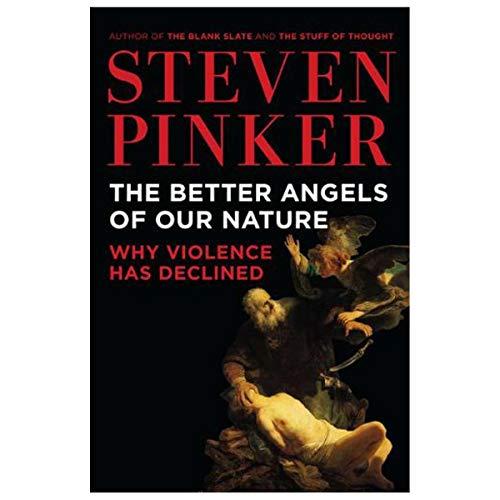
The Better Angels of Our Nature: Why Violence Has Declined Cover
Podcast Mentions

The Better Angels of Our Nature Why Violence Has Declined

Steven Pinker

Selected by Faced with the ceaseless stream of news about war, crime, and terrorism, one could easily think we live in the most violent age ever seen. Yet as New York Times bestselling author Steven Pinker shows in this startling and engaging new work, just the opposite is true: violence has been d...

Podcasts 8
Quotes 21
The Joe Rogan Experience

Penn described the book as one of the most subversive works of our time and said it blew his mind with a particular line about progress. He noted that the book argues humanity is improving despite persistent violence.

"

And you mentioned Pinker. Yeah. And that's everything I will say is redundant to Pinker. I mean that better angels of our nature is one of I think the most subversive books of our time.

— Episode: #1343 - Penn Jillette

Episode: #1343 - Penn Jillette

Penn described the book as one of the most subversive works of our time and said it blew his mind with a particular line about progress. He noted that the book argues humanity is improving despite persistent violence.

"

And you mentioned Pinker. Yeah. And that's everything I will say is redundant to Pinker. I mean that better angels of our nature is one of I think the most subversive books of our time.

The thing that blew my mind about pinker in that book better angels ... blew my mind is there's this line ... that has been obsessing me.

Episode: #1201 - William von Hippel

He mentioned Pinker's work on the decline of violence over human history.

"

I think Pinker's got the best answer to this question, which is basically, what structures do you need to put in place to make the world a safer and less violent place? That's his book, Better Angels of Our Nature.
Freakonomics Radio

It was argued that the commonly held belief that history was violent was incorrect. It was suggested that violence has decreased over time, with figures and examples provided.

"

He argues that our rosy view of history is pretty much entirely wrong In tribal societies, hunter-gatherers and hunter-quarter culturalists

— Episode: 43. The Decline and Fall of Violence

Episode: 43. The Decline and Fall of Violence

It was argued that the commonly held belief that history was violent was incorrect. It was suggested that violence has decreased over time, with figures and examples provided.

"

He argues that our rosy view of history is pretty much entirely wrong In tribal societies, hunter-gatherers and hunter-quarter culturalists

An average of about 15% of people met their ends through violence In the 20th century, if you try to come up with the highest estimate you can Combining all the wars, all the genocides, all the man-made famines You get to about 3%

The Jordan B. Peterson Podcast

The book, authored by Steven Pinker, was mentioned in the context of a discussion about human aggression and its decrease over time, and how Pinker's perspective aligns with that of Marian Tupy in regards to material well-being.

"

but all of the qualities of humanity that you describe are sort of they're parsed off near the end of the book into a single chapter as if they're just secondary side effects of some more profound rat...

— Episode: 188. Saving The Humanities | Stephen Bla...

Episode: 188. Saving The Humanities | Stephen Blackwood

The book, authored by Steven Pinker, was mentioned in the context of a discussion about human aggression and its decrease over time, and how Pinker's perspective aligns with that of Marian Tupy in regards to material well-being.

"

but all of the qualities of humanity that you describe are sort of they're parsed off near the end of the book into a single chapter as if they're just secondary side effects of some more profound rationality let's say and it's the rationality that's concentrating on material well-being

but he wrote the better angels of our nature if I remember correctly as well showing that human aggression has decreased substantially over the last number of centuries

Honestly with Bari Weiss

It was mentioned as one of Steven Pinker's books and argues that wars are less frequent and less deadly than they've been at any time.

"

Part of the argument of Enlightenment now and before that better angels of our nature is that over the course of history what we might call Enlightenment values have increased.

— Episode: Steven Pinker: Why Smart People Believe...

Episode: Steven Pinker: Why Smart People Believe Stupid Thi...

It was mentioned as one of Steven Pinker's books and argues that wars are less frequent and less deadly than they've been at any time.

"

Part of the argument of Enlightenment now and before that better angels of our nature is that over the course of history what we might call Enlightenment values have increased.

This was an argument against your book called Cosmolive Conferency, The Better Angels of Our Nature, which basically says wars are less frequent, less deadly than they've been at any time despite the fact that you think otherwise. Some of the counterarguments, one of which is just that.

No Stupid Questions

It was mentioned as a book summarizing the positive trends in global human prosperity and well-being over the last few hundred years, contrasting it with common doomsayer predictions.

"

This is like this Steven Pinker hypothesis.

— Episode: 132. Is It Wrong to Enjoy Yourself While...

Episode: 132. Is It Wrong to Enjoy Yourself While the World...

It was mentioned as a book summarizing the positive trends in global human prosperity and well-being over the last few hundred years, contrasting it with common doomsayer predictions.

"

This is like this Steven Pinker hypothesis.

Yes. Yes, Pinker wrote a book about it.

I think he did a really good job summarizing it, but there are a lot of people who've been writing about this.

Episode: 221. Why Are We So Pessimistic?

This book was mentioned as a predecessor to Pinker's work in *Enlightenment Now*, both discussing how the world is objectively improving.

"

So, well, I'm familiar with the work Better Angels of Our Nature, which I think preceded Enlightenment Now, right?

The Jordan Harbinger Show

It was mentioned as an example of Pinker's work showing that the rate of wars, rape, and child abuse have decreased over time, using data to demonstrate progress and push back against fatalistic views of human nature.

"

And then in better angels of our nature term of course that I stole from Abraham Lincoln but it fit the idea perfectly so that it's not just a theoretical possibility it's happened war is come down an...

— Episode: 593: Steven Pinker | Why Rationality See...

Episode: 593: Steven Pinker | Why Rationality Seems Scarce

It was mentioned as an example of Pinker's work showing that the rate of wars, rape, and child abuse have decreased over time, using data to demonstrate progress and push back against fatalistic views of human nature.

"

And then in better angels of our nature term of course that I stole from Abraham Lincoln but it fit the idea perfectly so that it's not just a theoretical possibility it's happened war is come down and rape and child abuse you just whatever you have the data you plot them over time and the graphs go down

Episode: 593: Steven Pinker | Why Rationality Seems Scarce

It was discussed as a book that focused on the decline of violence over time, including war, rape, and child abuse, using data and graphs to support the claim that things have gotten better.

"

writing books like enlightenment now or better angels rationality are inherently encouraging it's almost contrarian because of our propensity to focus on the negative why do we need an accurate view of the world that why is this important well it's for the same reason that it's better to see things than to wear a blindfold or hallucinate namely the more you know about the world the better equipped you are to act on it to solve problems when they arise to figure out what works and what doesn't to protect the institutions and the laws and the practices that have made life better get rid of the ones that have made life worse the more you know about the world the better equipped you are to act on it don't get me wrong I agree with the idea that we should keep our eye on a positive view of the future because I think it also encourages us to solve the problems that we do have.

and then in better angels of our nature term of course that I stole from Abraham Lincoln but it fit the idea perfectly so that it's not just a theoretical possibility it's happened war is come down and rape and child abuse you just whatever you have the data you plot them over time and the graphs go down and then like now I brought that to other measures of human well being such as poverty and literacy and work hours and happiness so it's probably fending off the accusation that a belief in human nature is depressing and fatalistic reactionary and means there's nothing we can do to improve our lot it's kind of pushing back against that idea that led me into the idea of human progress.

The Daily Stoic

Referenced in the context of the decline of violence and the progress of humanity. The podcast host discussed how rationality is a necessary component for this progress.

"

He's a two-time fueled surprise finalist, one of times most hundred influential people in the world, foreign policies, 100 global thinkers sold a bazillion books.

— Episode: Steven Pinker on the Pursuit of Rational...

Episode: Steven Pinker on the Pursuit of Rationality | Neve...

Referenced in the context of the decline of violence and the progress of humanity. The podcast host discussed how rationality is a necessary component for this progress.

"

He's a two-time fueled surprise finalist, one of times most hundred influential people in the world, foreign policies, 100 global thinkers sold a bazillion books.

His book Better Angels is about the decline of violence and the progress we've made as a species.

Well, it is an example of the my side bias which is one of the most pervasive of all of the cognitive biases.

The one is, well how can you say things are declined bad stuff happens? Yeah, but those are totally compatible, namely bad stuff happens but in the past even more bad stuff happened. That is it's the decline is not the same as a disappearance to say that X is less than Y is not the same as saying that X is zero so there's that.

It doesn't mean that every improvement was conceptualized and argued for in the better angels I talked about, for example the decline of tribal reading and feuding and blood feuds, the decline of medieval brigandage and homicide and deaths from jousting and other conflicts along medieval nights.

Note: The book recommendations on this page are discovered automatically from podcast transcripts, and may be incorrect or incomplete.