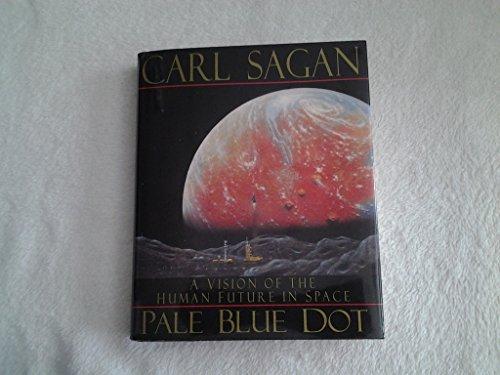
Pale Blue Dot: A Vision of the Human Future in Space Cover
Podcast Mentions

Pale Blue Dot A Vision of the Human Future in Space

Carl Sagan

"FASCINATING . . . MEMORABLE . . . REVEALING . . . PERHAPS THE BEST OF CARL SAGAN'S BOOKS."

Podcasts 4
Quotes 30
Hidden Brain

A listener suggested watching Carl Sagan's Pale Blue Dot as a visual exercise for gaining perspective.

"

one of my favorite is Carl Sagan's Pale Blue Dot and ...

— Episode: The Power of Family Stories

Episode: The Power of Family Stories

A listener suggested watching Carl Sagan's Pale Blue Dot as a visual exercise for gaining perspective.

"

one of my favorite is Carl Sagan's Pale Blue Dot and ...

Distractible

The book was briefly referenced as the source of some framed posters in both episodes, with no further discussion of its content or themes. The hosts mentioned it only in passing.

No quotes extracted yet.

StarTalk Radio

The hosts highlighted the book as a poetic reflection on the iconic Voyager image, using it to illustrate humanity’s tiny, fragile place in the cosmos. Neil deGrasse Tyson repeatedly cited it as a spiritual inspiration and a symbol of planetary brotherhood and environmental responsibility, while Carl Sagan’s own words were quoted to emphasize the humbling view of Earth as a lone speck. Overall, the discussion praised the work for its elegant prose and its powerful reminder that we must care for our planet ourselves.

Highly Recommended

Episode: The Story of Space Imaging with Carolyn “Madam Sat...

It was described as an allegory of the human condition and turned the book and the picture itself into a popular meme.

"

Our posturing, our imagined self-importance, the delusion that we have some privileged position in the universe are challenged by this point of pale light.

Our planet is a lonely speck in the great enveloping cosmic dark.

In our obscurity, in all this vastness, there is no hint that help will come from elsewhere to save us from ourselves.

Episode: StarTalk Live! at the Beacon: Searching for Life i...

It was inspired by a photo of Earth taken by the Voyager 1 spacecraft and was discussed at length, with Sagan's prose being described as greater than the image itself, emphasizing the fragility and uniqueness of Earth.

"

It became almost the spiritual inspiration for the book, Carl Sagan's book, The Pale Blue Dot.

So it's just Earth, just barely a pixel in the image and it was not in a sea of stars but it's a sea of nothingness.

But that's just because the aperture of a lens, if you set it for the lighting of the Earth then you're not going to see the stars but they're there. It's not like they weren't there.

So, in the Pale Blue Dot, the book, Carl Sagan waxed poetic and philosophical with great elegance on what our place is in space and in the universe in general upon reflecting on this pale blue dot.

In our obscurity, in all this vastness, there is no hint that help will come from elsewhere to save us from ourselves. It's up to us.

Episode: Extended Classic: Madame Saturn – A Conversation w...

It was written by Carl Sagan and became a popular book about the image of Earth taken by the Voyager spacecraft, promoting the idea of planetary brotherhood and environmental protection.

"

Carl Sagan writes an entire book with that title.

It has become synonymous with planetary brotherhood and protection of the environment.

Episode: Madame Saturn: A Conversation with Carolyn Porco (...

It was written by Carl Sagan and discussed the image of Earth taken by Voyager 1, which was dubbed the Pale Blue Dot, and its significance in terms of planetary brotherhood and environmental protection.

"

Yeah, I'm thinking it's like the first cosmic meme, pale blue dot.

Carl Sagan writes an entire book with that title.

It has become synonymous with planetary brotherhood and protection of the environment.

Episode: StarTalk Live: I, Robot (Part 1)

It was inspired by the Voyager 1 image of Earth from a great distance and explored humanity's place in the cosmos, reflecting on our insignificance and interconnectedness.

"

So this image led Carl Sagan to write a very famous book called The Pale Blue Dodd and in it he waxes poetic about our presence in space.

He talks about as you stare upon this pale blue dot, barely a pixel in the image. This is Earth, something we're so accustomed to seeing with mountains and valleys and craters and hills and oceans. It's big. It is not even a pixel in this image.

And he says everyone you've ever known, read about, heard about, lived out their lives on that speck and all the wars that are fought over the temporary command of one plot of land versus another, all happened on this speck.

Everyone who contributed to what we call history lived out their lives on that dodd.

Episode: StarTalk Live! at the Beacon: Searching for Life i...

It was inspired by the iconic image of Earth, a pale blue dot, taken by the Voyager 1 spacecraft. The book discussed humanity's place in the universe and emphasized our responsibility to care for our planet.

"

It became almost the spiritual inspiration for the book, Carl Sagan's book, The Pale Blue Dot.

So, in the Pale Blue Dot, the book, Carl Sagan waxed poetic and philosophical with great elegance on what our place is in space and in the universe in general upon reflecting on this pale blue dot.

It's iconic. I mean it just really...people really love it.

Episode: Extended Classic: Madame Saturn – A Conversation w...

It was written by Carl Sagan and the title was inspired by a famous photo taken by the Voyager spacecraft, showing Earth as a small, pale blue dot in the vastness of space.

"

Carl Sagan writes an entire book with that title.

It has become synonymous with planetary brotherhood and protection of the environment.

Episode: Madame Saturn: A Conversation with Carolyn Porco (...

It was mentioned that Carl Sagan wrote a book titled "Pale Blue Dot", which became a symbol for planetary brotherhood and environmental protection, based on the famous Voyager 1 image of Earth.

"

Yeah, I'm thinking it's like the first cosmic meme, pale blue dot.

Carl Sagan writes an entire book with that title.

It has become synonymous with planetary brotherhood and protection of the environment.

Episode: StarTalk Live: I, Robot (Part 1)

It was inspired by a Voyager image of Earth, and described the significance of our planet within the vastness of space in a poetic and humbling way.

"

So this image led Carl Sagan to write a very famous book called The Pale Blue Dodd and in it he waxes poetic about our presence in space.

Stay Tuned with Preet

It was discussed in the context of a photo taken by the Voyager 1 spacecraft, which showed Earth as a small, fragile speck in the vastness of space; a humbling experience that emphasized the importance of cherishing our planet.

"

Look again at that dot. That's here. That's home. That's us. On it, everyone you love, everyone you know, everyone you ever heard of, every human being who ever was, lived out their lives. The aggrega...

— Episode: Trump's 2nd Rodeo & SCOTUS Overreaches (...

Episode: Trump's 2nd Rodeo & SCOTUS Overreaches (with Micha...

It was discussed in the context of a photo taken by the Voyager 1 spacecraft, which showed Earth as a small, fragile speck in the vastness of space; a humbling experience that emphasized the importance of cherishing our planet.

"

Look again at that dot. That's here. That's home. That's us. On it, everyone you love, everyone you know, everyone you ever heard of, every human being who ever was, lived out their lives. The aggregate of our joy and suffering, thousands of confident religions, ideologies, and economic doctrines, every hunter and forager, every hero and coward, every creator and destroyer of civilization, every king and peasant, every young couple in love, every mother and father, hopeful child, inventor and explorer, every teacher of morals, every corrupt politician, every superstar, every supreme leader, every saint and sinner in the history of our species, lived there on a mote of dust suspended in a sunbeam.

The Earth is the only world known so far to harbor life. There is nowhere else, at least in the near future, to which our species could migrate. Visit? Yes. Settle? Not yet. Like it or not, for the moment, the Earth is where we make our stand.

It has been said that astronomy is a humbling and character-building experience. There is perhaps no better demonstration of the folly of human conceits than this distant image of our tiny world. To me, it underscores our responsibility to deal more kindly with one another and to preserve and cherish the pale blue dot, the only home we've ever known.

Note: The book recommendations on this page are discovered automatically from podcast transcripts, and may be incorrect or incomplete.