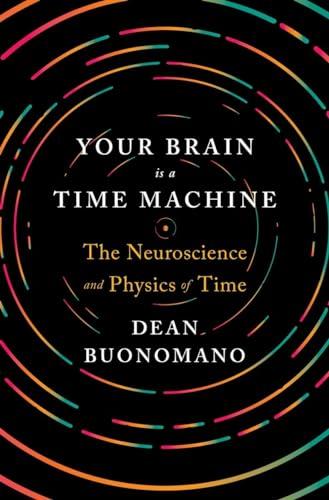

Your Brain Is a Time Machine: The Neuroscience and Physics of Time Cover
Podcast Mentions

Your Brain Is a Time Machine The Neuroscience and Physics of Time

Dean Buonomano

A leading neuroscientist embarks on a groundbreaking exploration of how time works inside the brain. In

Podcasts 2
Quotes 4
Huberman Lab

It was suggested as a good read for those interested in learning more about the neuroscience and physics of time, specifically how it relates to our brain.

"

If you're interested in learning more about time perception, I'd like to point you to a really excellent book called Your Brain Is a Time Machine, the Neuroscience and Physics of Time.

— Episode: Time Perception & Entrainment by Dopamin...

Episode: Time Perception & Entrainment by Dopamine, Seroton...

It was suggested as a good read for those interested in learning more about the neuroscience and physics of time, specifically how it relates to our brain.

"

If you're interested in learning more about time perception, I'd like to point you to a really excellent book called Your Brain Is a Time Machine, the Neuroscience and Physics of Time.

The book was written by Professor Dr. Dean Buonomano, who's a professor at UCLA and a world expert in the neuroscience and physics of time.

The Ezra Klein Show

The host praised the book's title and explained that it explores both subjective and objective aspects of time. It was noted that the book presents research on how time perception changes in unusual conditions.

"

His book, Your Brain is a Time Machine, what a great name. It gets at these two levels of time, the time that we experience and the time that exists as best we understand it outside of our experience.

— Episode: Time Is Way Weirder Than You Think

Episode: Time Is Way Weirder Than You Think

The host praised the book's title and explained that it explores both subjective and objective aspects of time. It was noted that the book presents research on how time perception changes in unusual conditions.

"

His book, Your Brain is a Time Machine, what a great name. It gets at these two levels of time, the time that we experience and the time that exists as best we understand it outside of our experience.

I was struck by some research in your book or some experiments, more to the point where people would volunteer for one reason or another to be functionally in a cave or a dark room for quite a long time. And then months or a year later they would come out and they would think much less time had passed than actually what had.

Note: The book recommendations on this page are discovered automatically from podcast transcripts, and may be incorrect or incomplete.