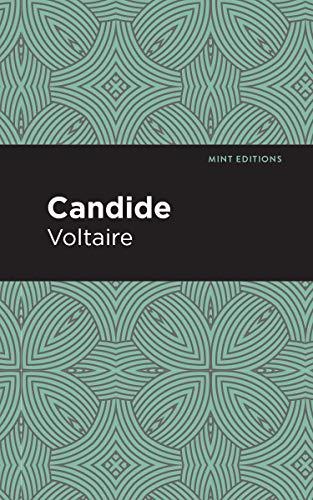

Candide (Mint Editions (Humorous and Satirical Narratives)) Cover
Podcast Mentions

Candide (Mint Editions (Humorous and Satirical Narratives))

Voltaire

Young Candide is ejected from his idyllic life in a protected castle and finds himself encountering wild adventures and harsh trials that put to the test his teacher’s claim that we live in the best of all possible worlds. Honest and simple to a fault, Candide finds that a bit of romance leads only...

Podcasts 7
Quotes 19
Stuff You Should Know

The hosts noted that Voltaire wrote Candide to mock Leibniz's idea of an optimized universe, calling it preposterous.

"

I read that Voltaire wrote Candide to mock Leibniz and his idea of the optimized universe because he thought it was so preposterous.
— Episode: Battle Royale: Optimists vs Pessimists

Episode: Battle Royale: Optimists vs Pessimists

The hosts noted that Voltaire wrote Candide to mock Leibniz's idea of an optimized universe, calling it preposterous.

"

I read that Voltaire wrote Candide to mock Leibniz and his idea of the optimized universe because he thought it was so preposterous.
The Rest Is History

The hosts mentioned Voltaire's satirical novel, noting it was published in 1759 and used to mock philosophical optimism during the Lisbon earthquake debate.

"

Even more famous work, Condide, which he published four years after that in 1759.

— Episode: 229. Portugal: Gold, Earthquakes, and Br...

Episode: 229. Portugal: Gold, Earthquakes, and Brazil (Part...

The hosts mentioned Voltaire's satirical novel, noting it was published in 1759 and used to mock philosophical optimism during the Lisbon earthquake debate.

"

Even more famous work, Condide, which he published four years after that in 1759.

So in Condit, his, you know, Voltaire's famous kind of satire on that kind of philosophical optimism. It's exemplified by the figure of Pangloss, who is the supposedly the greatest philosopher in the Holy Roman Empire and he accompanies Candide. And they get kind of involved in the earthquake, Pangloss spaying the rubble and the fire and the death and people screaming beneath the shattered fabric of all these churches. He says, oh, it's all for the best.

Behind the Bastards

It was referenced in the context of the character Pangloss and the idea that everything is the best it could be, a philosophy that the hosts found similar to Jordan Peterson's worldview.

"

This is why Voltaire in fucking Candide I brought up Pangloss like he is mocking this idea that like the Pangloss is this like philosopher guy who's saying like this is the best of all possible worlds...

— Episode: Part One: We Watch More of Jordan Peters...

Episode: Part One: We Watch More of Jordan Peterson's New S...

It was referenced in the context of the character Pangloss and the idea that everything is the best it could be, a philosophy that the hosts found similar to Jordan Peterson's worldview.

"

This is why Voltaire in fucking Candide I brought up Pangloss like he is mocking this idea that like the Pangloss is this like philosopher guy who's saying like this is the best of all possible worlds and everything that happens and it is like the best that can possibly be which is if you're in charge always the way in which you want people to feel like that's all Jordan Peterson is is fucking Pangloss with a fucking binzo problem.

Episode: Part One: Helena Blavatsky: the woman who inspired...

It was discussed as a book in which Voltaire provides a Turkish Dervish with the final word, supporting the idea that Eastern religions and mythology have sacred truths that Westerners have forgotten.

"

He gives kind of the final word in the book to a Turkish Dervish

Episode: Part One: Helena Blavatsky: the woman who inspired...

It was mentioned as a book where Voltaire provided a final viewpoint, through a Turkish Dervish, on the importance of Eastern and Asian religion and mythology in a way he believed provided moral superiority over Westerners.

"

in Candide. He gives kind of the final word in the book to a Turkish Dervish

Episode: Part One: Peter Thiel and the Anti-Christ

The conversation suggested that Peter Thiel might have read Candide in college as an example of the kind of literature he references.

"

Maybe he read Candide and he was like, so that's what they do in college.

Fresh Air

Podcast

Fresh Air

The program listed Candide among Leonard Bernstein's Broadway scores, indicating it as one of the works featured in the discussion.

"

His most popular music was the music he wrote for Broadway musicals, including On the Town, Wonderful Town, West Side Story, and Candide.

— Episode: Bradley Cooper & Yannick Nézet-Séguin On...

Episode: Bradley Cooper & Yannick Nézet-Séguin On 'Maestro'

The program listed Candide among Leonard Bernstein's Broadway scores, indicating it as one of the works featured in the discussion.

"

His most popular music was the music he wrote for Broadway musicals, including On the Town, Wonderful Town, West Side Story, and Candide.

No Stupid Questions

The hosts recalled reading the title in school and despising it, yet the concluding line about cultivating one's garden stuck with them as a reminder to focus on what they can control. Both Angela Duckworth and Stephen Dubner referenced it across episodes to illustrate the idea of personal agency. While the book itself was not enjoyed, its core message was valued.

Episode: 132. Is It Wrong to Enjoy Yourself While the World...

It was mentioned in the context of a personal anecdote. Angela disliked reading it in high school but took away the core message of focusing on what you can control and cultivate your own sphere of influence.

"

I remember reading in French class, I think it was junior year, and Dr. Rowland had assigned Candide by Voltaire, and I hated it by the way.

You have to cultivate your garden.

There's what you can't do, and there's what you can do, and the things that you can do, just do and don't be paralyzed.

Episode: 88. Is Self-Improvement Too Selfish?

Stephen Dubner mentioned reading Voltaire's 'Candide' in high school, relating the concept of 'cultivating your garden' to focusing on what you can personally control, rather than broader societal issues.

"

You know, when I was in high school, I read Candide. Did you read Candide by Voltaire? Let us go cultivate our garden.

And even as a junior in high school, I was like, oh you have to cultivate your own garden. Don't try to do things that you can't change even though you know that they should be changed.

Episode: 20. Should We Separate the Art From the Artist?

It was mentioned that Angela Duckworth disliked it when she had to read it for a French class as a teenager, but the memorable final line "cultivate our garden" was recalled.

"

I also remember when I was 16, I had to read, I think for a French class, Candide, which I hated by Voltaire.

Cultivate our garden.

Episode: 20. Should We Separate the Art From the Artist?

It was mentioned as a book the speaker disliked when she was 16 years old, but they will never forget the last line. The speaker stated that she despised it.

"

I had to read, I think for a French class, Candide, which I hated by Voltaire.

I despised it, but I'll never forget the last line. Cultivate our garden. We must cultivate our garden.

Episode: 20. Should We Separate the Art From the Artist?

The speaker mentioned reading this book for a French class at age 16 and strongly disliking it, but recalling the final line: 'Cultivate our garden.'

"

I also remember when I was 16, I had to read, I think for a French class, Candide, which I hated by Voltaire. I despised it, but I'll never forget the last line. Cultivate our garden.

The Daily Stoic

The speaker used Voltaire's novel, "Candide," to introduce the term "Panglossian," describing a naive and excessively optimistic outlook.

"

the word for this attitude is not stoic it's pan glossian a term derived from the novel can deed from Voltaire

— Episode: The Truly Wise Make Time For Leisure | A...

Episode: The Truly Wise Make Time For Leisure | Ask Daily S...

The speaker used Voltaire's novel, "Candide," to introduce the term "Panglossian," describing a naive and excessively optimistic outlook.

"

the word for this attitude is not stoic it's pan glossian a term derived from the novel can deed from Voltaire

Note: The book recommendations on this page are discovered automatically from podcast transcripts, and may be incorrect or incomplete.