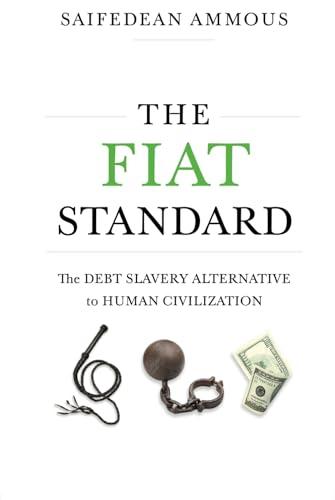
It argues that the Fiat standard is responsible for the rise of time preference across the globe, as well as the corruption of the planet and the politicization of university campuses. It uses a similar analytical lens as The Bitcoin Standard to critique the Fiat system.
"
And the newly released Fiat Standard.
So the Bitcoin standard? Yeah, well first of all thank you very much for having me on. It's a true pleasure to be talking to you. I published the Bitcoin standard in 2018 and it was a book that tried to explain the economics of Bitcoin, why Bitcoin functions, why it functions the way it does and what are the implications that you would expect from the continued growth of Bitcoin in the future.
I think that's highly related to the time preference of individuals which is an enormously important topic so historically all throughout human history you know we're always moving to a harder money because we're looking for a better form of money and that culminated by the end of the 19th century with everybody in the world being on the classical gold standard basically the entire planet was on the same currency one money chosen on the market very hard to produce holding onto its value offering anybody in the world the ability to save for their future essentially for free you know you just you get paid in the coin you keep the coin safe and then 20 years later that coin is not only held onto its value it's likely appreciated more because in those 20 years we've made more cars more houses more apples more oranges more everything but we haven't made a lot more gold so the gold coins remains valuable and so historically you see this has coincided with a decline in interest rates which from the Austrian perspective is a measure of time preference a time preference is what determines interest rate and time preference is the degree of discounting for the future so effectively as long as we're using harder and harder money we are being able to provide for the future better and that's reducing our uncertainty of the future you know now you're you can be fairly confident that the money that you worked for today that you can save it and it'll be there for you in five years time when you start thinking more about yourself in five years time and as our technology for money has improved and as our ability to save is improved our time horizon is expanded our time preference is dropped we start thinking more and more about the future that encourages us to save more to invest more and then that leads to capital accumulation which leads to the increase in productivity and I think the whole world was basically lowering its time preference until the early 20th century and then in the early 20th century this is kind of the central argument of The Fiat Standard by switching to an easy money where now you know in the 20th century we move to government money which has been increasing on average I calculate at something like roughly 14% a year globally so you move from a money supply that's being inflated and one or two percent has the average human being in the world you have that same gold coin now you're stuck with your government's local script that is inflating at on average 14% you know some people have witnessed 200% of the money so that on average
The lowest averages you'll see are in the US Switzerland Denmark and Sweden and they're about six to seven percent per year over the last fifty-sixty years that's really as good as it gets for fiat as a kind of average so you're constantly you know you need a return of six percent or seven percent just to keep up basically yeah and you know seven percent is is not nothing seven percent means you basically lose half the value stored in ten years and that's seven percent that's in the good cases there are countries that have had an average of 200 percent because you know they had years and once the money supply went up tenfold within one year and that that has happened so you think about the examples of people living in hyper inflationary societies and I used to live in Lebanon until recently and you see that when the currency collapses you know think about the stories about warmer Germany or about any Latin American country or Lebanon is in poverty when you hear about their inflation you know the stories are of people that have been reduced to very very very short-term thinking your money you get paid on the beginning of the month your money is going to be worth half of its price by the end of its by the end of the month so you get paid and you run straight to the supermarket I remember I was a kid growing up in Brazil and I remember that you know the first day of the month the supermarkets would be overrun and there would be people fighting and things would be crazy because everybody's trying to get things now before everybody else gets their paycheck and buys everything and then bids off the price so your time horizon is shortened when your money is losing its value
Money is an incredible technology for lowering our time preference that's kind of one of my central arguments in The Fiat Standard that money is the best mechanism we have for moving value to the future because you know you can save a fishing boat and you can save something else but you don't know what's going to happen in the future you don't know if you want to move away from where you are money itself is enormously important because it's very useful you save some money and then doesn't matter what happens in your town you take the money and you can go away so it protects you against the uncertainty of the future and when that money is compromised your ability to think of the future as massively compromised as well and I think you know the hyperinflationary examples are an extreme example of that but I think the 20th century itself was one global slow train wreck of watching humanity's time preference rise as you know generation after generation of people all over the world witnessed their currency devalued everybody saw it there isn't the single people in the world that has escaped this you know doesn't matter if you live in western Europe or Africa or Latin America everybody has been screwed by inflation in the 20th century and everybody has a story in their family about somebody who saved up and worked hard diligently and then one day they woke up and all their money was gone and all of the wealth that they worked for was gone everybody has gone through this and it leaves a mark it leaves a mark it tells you know don't be the sucker who saves for tomorrow because you know you missed out on
In the Bitcoin standard a lot of Bitcoin standard was about government money but you could always say more because it's just been so enormously important over the last 100 years so in The Fiat Standard I take the same kind of analytical lens that I used in the Bitcoin standard to look at Bitcoin which was you know when I started writing the book it was this obscure thing that only a bunch of weirdos on the internet that I heard about and I tried to kind of come at the same with the same kind of lens at the fiat system and trying to ignore all the hoopla of the century of propaganda and academic work
I think the fundamental idea is that in the fiat system the way that you mind and you currency into existence is through lending you when you when your bank makes a new loan they don't take somebody else's money and give it to you they make new money essentially out of thin air and they hand it to you they put it in your back account so this I think is a very key insight so in big one we have walked through that so everyone understands exactly what the banks are doing because that is not something that people know or understand
And I think you know an a less charitable interpretation by an Austrian economist of a mainstream economist is that there is essentially court gestures for the inflationary central banks the central banks need an intellectual apparatus that gets on TV and says you know we have to print all this money in order to prevent unemployment from happening and to better to prevent bad things from happening but really I think you know the bigger story here is the money printing of course is highly lucrative for governments and so of course governments are highly favorable of people who uh want that so Bitcoin is powerful in this regard because a um you know economically it's succeeding and intellectually it's succeeding as well I think it's a massive challenge to the mainstream economics establishment their complete inability to explain it or to try and present and uh acquire an explanation for why it behaves the way it does or why it grows is absolutely astonishing you know it's been there for 12 years it's worth a trillion dollars right now and the vast majority of university professors will tell you oh it's just a tulip somehow they're convinced that the fact that you know agricultural product prices went up for a few months in Amsterdam in the 17th century somehow invalidates the fact that we have a form of money that travels internationally and is hard and is completely outside the state the the control of the state it's it's it's argument by sound by almost they haven't even given it much thought because there's not much uh to say it's argument by dismissive analogy yes which is very common also in the climate change discussion as you always notice