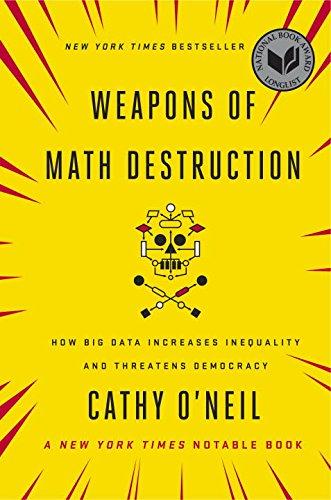
Weapons of Math Destruction: How Big Data Increases Inequality and Threatens Democracy Cover
Podcast Mentions

Weapons of Math Destruction How Big Data Increases Inequality and Threatens Democracy

Cathy O'Neil

Longlisted for the National Book Award We live in the age of the algorithm. Increasingly, the decisions that affect our lives—where we go to school, whether we get a car loan, how much we pay for health insurance—are being made not by humans, but by mathematical models. In theory, this should lead...

Podcasts 2
Quotes 6
Pivot

Podcast

Pivot

This book was mentioned by Baratunde Thurston as a resource for understanding algorithmic bias and the need for building better systems.

"

I have a bunch of resources and I point to other people. I mean, Weapons of Math Destruction was a great book.

— Episode: How Facebook and Twitter are dealing wit...

Episode: How Facebook and Twitter are dealing with racist p...

This book was mentioned by Baratunde Thurston as a resource for understanding algorithmic bias and the need for building better systems.

"

I have a bunch of resources and I point to other people. I mean, Weapons of Math Destruction was a great book.

99% Invisible

It was discussed in detail as an example of how algorithms can negatively impact individuals and populations, particularly in areas like criminal justice, teacher evaluation, and hiring practices.

"

I'm Cathy O'Neil. I'm a mathematician, data scientist, activist, and author. I wrote the book, Weapons of Math Destruction, How Big Data Increases Inequality and Threatens Democracy.

— Episode: The Age of the Algorithm

Episode: The Age of the Algorithm

It was discussed in detail as an example of how algorithms can negatively impact individuals and populations, particularly in areas like criminal justice, teacher evaluation, and hiring practices.

"

I'm Cathy O'Neil. I'm a mathematician, data scientist, activist, and author. I wrote the book, Weapons of Math Destruction, How Big Data Increases Inequality and Threatens Democracy.

And they're characterized by three properties, that they're very widespread and important. So like they make important decisions about a lot of people. Number two, that they're secret, that the people don't understand how they're being scored. And number three, that they're destructive.

She calls them weapons of math destruction.

We're shifting the blame, if you will, from the society, which is the one that should own these problems to the individual and punishing them for it.

O'Neill gets that different jobs require people with different personality types, but she says a hiring algorithm is a blunt and unregulated tool that ends up disqualifying big categories of people, which makes it a classic weapon of math destruction.

Note: The book recommendations on this page are discovered automatically from podcast transcripts, and may be incorrect or incomplete.