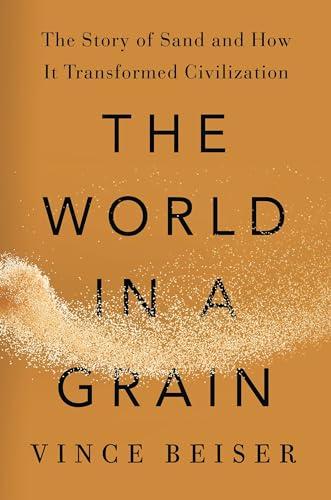

The World in a Grain: The Story of Sand and How It Transformed Civilization Cover
Podcast Mentions

The World in a Grain The Story of Sand and How It Transformed Civilization

Vince Beiser

A finalist for the PEN/E. O. Wilson Literary Science Writing Award

Podcasts 2
Quotes 20
99% Invisible

It was discussed as a fascinating book exploring sand's importance in shaping modern civilization, highlighting how sand is vital to concrete, glass, and silicon chips, ultimately emphasizing that it's a finite resource being rapidly depleted.

"

sand is actually the most important solid substance on Earth. It's the literal foundation of modern civilization.

— Episode: Built on Sand

Episode: Built on Sand

It was discussed as a fascinating book exploring sand's importance in shaping modern civilization, highlighting how sand is vital to concrete, glass, and silicon chips, ultimately emphasizing that it's a finite resource being rapidly depleted.

"

sand is actually the most important solid substance on Earth. It's the literal foundation of modern civilization.

We use more sand than any other natural resource in the world, except for air and water.

We use about 50 billion tons of the stuff every single year, which is enough to cover the entire state of California.

the question isn't really what's going to happen when we run out of sand the question is What's going to happen when we run out of everything

Vince Beiser's book is called the world in a grain

The Jordan Harbinger Show

It was discussed how important sand is for modern civilization, from concrete to computer chips, and how unsustainable our use of it has become due to rapid urbanization, especially in developing countries.

"

Sand is to cities what flour is to bread, and for the gluten-free of us listening to the show, it's what cells are to our bodies.

— Episode: 97: Vince Beiser | Why Sand Is More Impo...

Episode: 97: Vince Beiser | Why Sand Is More Important Than...

It was discussed how important sand is for modern civilization, from concrete to computer chips, and how unsustainable our use of it has become due to rapid urbanization, especially in developing countries.

"

Sand is to cities what flour is to bread, and for the gluten-free of us listening to the show, it's what cells are to our bodies.

Sand is at the core of our daily lives, used to make concrete, glass, asphalt, silicon chips in laptops, and smartphones.

Without sand, there's no modern civilization.

We use about 50 billion tons of sand every year. That's enough to cover the entire state of California every single year.

China used more cement in the last few years than the United States did in the entire 20th century.

Episode: 97: Vince Beiser | Why Sand Is More Important Than...

The book explored the importance of sand in modern civilization, highlighting its use in various aspects from concrete to computer chips, while also emphasizing the finite nature of this resource and the environmental damage caused by its extraction.

"

Sand is to cities what flour is to bread... It's what cells are to our bodies.

Sand is the most important solid substance on earth... without sand we have no modern civilization.

We use about 50 billion tons of sand every year... that's enough to cover the entire state of California every single year.

The sand that we use for computer chips needs to be 99.99999999999999999% pure... that's 11 9s after the decimal.

China used more cement in the last few years than the United States did in the entire 20th century.

Episode: 97: Vince Beiser | Why Sand Is More Important Than...

It explored the crucial role of sand in modern civilization, highlighting its importance in various applications from concrete to computer chips and the environmental and social issues caused by its unsustainable extraction.

"

Sand is to cities what flour is to bread...It's what cells are to our bodies.

Without sand there's no modern civilization.

We use about 50 billion tons of sand every year. That's enough to cover the entire state of California every single year.

Desert sand is basically useless to us.

The cycle to create new sand takes 200 million years.

Note: The book recommendations on this page are discovered automatically from podcast transcripts, and may be incorrect or incomplete.